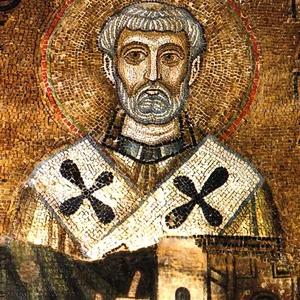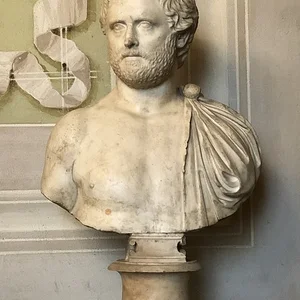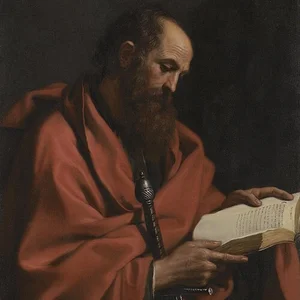

A Christian apostle and missionary of the 1st century, Paul of Tarsus played a decisive role in spreading Christianity throughout the Roman Empire. His epistles form an essential part of the New Testament.
Paul of Tarsus(5 — 66)
Paul of Tarsus
Rome antique
9 min read
Frequently asked questions
Famous Quotes
« There is neither Jew nor Greek, there is neither slave nor free, there is neither male nor female; for you are all one in Christ Jesus.»
« Love is patient and kind; love does not envy.»
« I can do all things through him who strengthens me.»
Key Facts
- Born around 5 AD in Tarsus, Cilicia (present-day Turkey), a Roman citizen
- Converted to Christianity on the road to Damascus (around 33–36 AD)
- Undertook three major missionary journeys across the Mediterranean
- Authored around a dozen epistles that are foundational to the New Testament
- Martyred in Rome around 64–65 AD under Emperor Nero
Works & Achievements
The longest and most systematic of Paul's epistles, considered the most complete exposition of his theology. It develops the concepts of justification by faith, grace, and universal salvation open to both Jews and Greeks.
A letter addressed to the troubled community of Corinth, responding to numerous practical and theological questions. It contains the famous hymn to charity (chapter 13) and the earliest written account of the Eucharistic Last Supper.
A passionate letter defending Christian freedom against those who imposed circumcision on converts. It forcefully asserts that faith in Christ abolishes distinctions between Jews and Gentiles, men and women, slaves and free people.
The oldest surviving letter of Paul and probably the earliest text in the New Testament. It reassures the community of Thessalonica about the fate of Christians who had died before the return of Christ.
Written from his Roman prison, this letter expresses deep joy and particular affection for the community of Philippi, the first church founded in Europe. It contains a major Christological hymn describing the humiliation and exaltation of Christ.
During his three great journeys across the eastern Mediterranean, Paul traveled more than 15,000 kilometers, founding dozens of Christian communities in Asia Minor, Greece, and the islands. This missionary endeavor stands as the most remarkable concrete achievement of his life.
Anecdotes
Saul of Tarsus, the future Paul, was present and consenting at the stoning of Stephen, the first Christian martyr, around 36 AD. He guarded the cloaks of those who carried out the execution. This terrible scene came just before his own dramatic conversion on the road to Damascus.
On the road to Damascus, where he was headed to persecute Christians, Paul was struck down by a blinding light and heard a voice asking him: 'Saul, Saul, why do you persecute me?' He remained blind for three days, eating and drinking nothing, before his sight was restored by a disciple.
In Lystra (in present-day Turkey), after healing a man who had been lame from birth, Paul and his companion Barnabas were mistaken for gods by the local population. The inhabitants wanted to offer them sacrifices, calling them Zeus and Hermes. Paul had to beg them to stop, declaring that he was only a man like themselves.
Paul was imprisoned in Philippi along with Silas. In the middle of the night, an earthquake shook the prison's foundations, the doors flew open, and the chains fell loose. The jailer, believing the prisoners had escaped and fearing he would be put to death, was about to take his own life when Paul called out to reassure him — and then baptized him.
A Roman citizen by birth — a rare privilege granted to his family from Tarsus — Paul invoked this status on several occasions to avoid punishment without legal trial. In Jerusalem, his citizenship spared him from flogging and allowed him to be transferred to Rome to stand trial, which in turn gave him the opportunity to preach in the capital of the Empire.
Primary Sources
For I am not ashamed of the gospel: it is the power of God for salvation to everyone who has faith, to the Jew first and also to the Greek.
If I speak in the tongues of men and of angels, but have not love, I am a noisy gong or a clanging cymbal.
There is neither Jew nor Greek, there is neither slave nor free, there is neither male nor female; for you are all one in Christ Jesus.
But Saul, still breathing threats and murder against the disciples of the Lord, went to the high priest and asked him for letters to the synagogues at Damascus.
Three times I have been beaten with rods, once I was stoned, three times I have been shipwrecked; a night and a day I have been adrift at sea.
Key Places
Paul's birthplace, a major intellectual center of the ancient world in Cilicia. It was here that he received a Hellenistic education before being sent to Jerusalem to study under the rabbi Gamaliel.
The site of Paul's dramatic conversion on the road to the city, around 36 AD. He stayed there after his recovery and preached for the first time in the synagogues, to the great astonishment of the Jewish community.
Paul was trained here as a Pharisee and persecuted the early Christians in this city. He returned several times after his conversion to meet Peter and James, and was ultimately arrested during his final visit.
A cosmopolitan port city where Paul spent eighteen months and founded an important Christian community. It was from Corinth that he wrote the Epistle to the Romans, and he addressed two of his longest epistles to its community.
Capital of the Roman province of Asia, where Paul resided for more than two years during his third journey. His preaching there sparked riots orchestrated by craftsmen who sold statuettes of Artemis and feared for their livelihoods.
Paul's ultimate destination, as he dreamed of evangelizing the capital of the Empire. Imprisoned and then put to death under Nero around 66–68 AD, he was beheaded there. The Basilica of Saint Paul Outside the Walls marks the traditional site of his tomb.
Typical Objects

Paul dictated his epistles to a secretary (amanuensis) using a reed calamus and ink. He would sometimes add a few lines in his own hand, in large letters, to authenticate the letter.

Paul worked as a tentmaker (skenopoios) to support himself during his missionary journeys. This manual trade allowed him to preach without depending financially on the communities he founded.

As an educated Pharisee, Paul wore these small leather boxes containing Torah verses in his youth, bound to the forehead and arm during prayer. They symbolize his deep rootedness in Jewish tradition.

An essential companion for the ancient traveler, the walking staff accompanied Paul across the thousands of kilometers he covered on foot along Roman roads. He used it both for walking and to defend himself against bandits.

Short messages and drafts were written on wooden boards coated with wax, into which one carved with a metal stylus. Paul used these for quick communications among his fellow workers.

In his second epistle to Timothy, Paul asks that his cloak left at Troas be brought to him. This thick, hooded garment was the traveler's cloak par excellence, indispensable for Mediterranean winters.
School Curriculum
Vocabulary & Tags
Key Vocabulary
Daily Life
Morning
Paul rose at dawn, before the heat of the day. True to his Jewish upbringing, he began with prayer, reciting the Psalms and meditating on Scripture. In the cities where he settled for a few weeks, he would go early to the workshop to work leather and weave tents — a trade he practiced in the morning so he would be free to teach in the afternoon.
Afternoon
In the afternoon, after a midday meal and a short rest (a common Mediterranean custom), Paul would go to synagogues, public squares, or private homes to discuss and preach. He debated Stoic and Epicurean philosophers in the public squares, adapting his rhetorical style to each audience — Jewish or Greek.
Evening
In the evening, Paul gathered with members of the local Christian community, often in a private home (domus). These gatherings included the reading of apostolic letters, the sharing of a communal meal (the agape feast), and the breaking of the Eucharistic bread. Paul could preach well into the night, as illustrated by the episode of a young man who fell asleep and tumbled from a window in Troas during one of his discourses.
Food
Paul followed a diet close to that of the modest classes in the Mediterranean world: bread, legumes (lentils, chickpeas), olives and olive oil, dried figs and dates, dried or salted fish, and wine diluted with water. As a Jew observing dietary laws, he avoided pork and meat that had not been properly bled — which sometimes complicated sharing meals with Gentiles, a theological question he had to address in his letters.
Clothing
Paul wore the dress of a traveler and humble craftsman: a tunic (chiton) of wool or linen, belted at the waist with a leather strap, and over it a traveling cloak (himation or paenula) that also served as a blanket at night. As a Roman citizen, he could have worn the toga, but his constant travels made that cumbersome garment impractical.
Housing
Paul had no fixed residence: he was housed by members of the communities he visited, with hosts such as Lydia in Philippi or Priscilla and Aquila in Corinth. During his imprisonments, he lived in very harsh conditions — damp cells in Philippi or house arrest in Rome. He sometimes slept in the workshops where he worked, in conditions similar to those of the itinerant craftsmen of his day.
Historical Timeline
Period Vocabulary
Visual Style
Esthétique des fresques paléochrétiennes et des mosaïques byzantines, avec des tons chauds d'ocre et de terre cuite, des ports méditerranéens baignés de lumière et des intérieurs de domus romaines éclairées à l'huile.
Sound Ambience
Ambiance sonore des villes portuaires méditerranéennes du Ier siècle, mêlant les bruits des marchés animés, des synagogues et des ateliers d'artisans où Paul fabriquait des tentes pour financer ses missions.
Liens externes & ressources
Références
Œuvres
Épître aux Romains
vers 57
Première Épître aux Corinthiens
vers 54-55
Épître aux Galates
vers 48-55
Première Épître aux Thessaloniciens
vers 50-51
Épître aux Philippiens
vers 61-63
Trois voyages missionnaires (46-58)
vers 46-58