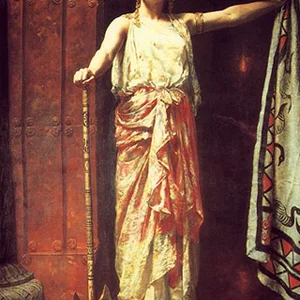

A figure from Greek mythology, wife of Odysseus and mother of Telemachus. During her husband's twenty-year absence, she fends off her suitors with a famous trick: each night she unravels the shroud she weaves by day. She embodies faithfulness, patience, and female intelligence in the Homeric epic.
Penelope
Penelope
10 min read
Frequently asked questions
Famous Quotes
« "Stranger, the gods destroyed whatever beauty I had when the Argives sailed for Troy." (Odyssey, Book XIX — words attributed by the Homeric tradition)»
Key Facts
- Penelope is the daughter of Icarius and niece of Tyndareus; her marriage to Odysseus, king of Ithaca, is recorded in the Odyssey
- During Odysseus's twenty-year absence (Trojan War and wanderings), she holds off more than a hundred suitors
- Her main ruse: weaving the shroud of Laertes by day and unraveling it each night for three years before being discovered
- She recognizes Odysseus through the secret of their bed, carved from a living olive tree — a test of truth that brings the epic to a close
- Her name has entered the cultural lexicon: "Penelope's web" refers to a never-ending task
Works & Achievements
A foundational epic in twenty-four books in which Penelope is a central figure. She embodies conjugal virtue, cunning, and patience as she faces the suitors besieging her palace.
A fictional verse letter in elegiac couplets in which Ovid gives voice to Penelope, expressing her despair, her hope, and her faithfulness. This text inaugurates a tradition of retelling the Homeric myth from a female perspective.
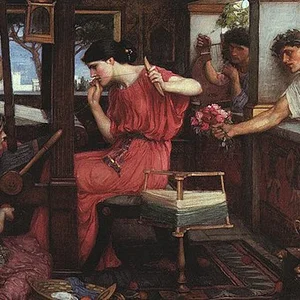
A celebrated Pre-Raphaelite canvas depicting Penelope at her loom, the very symbol of the waiting woman. This work played a major role in fixing the romantic and melancholic image of the character in the modern Western imagination.
A contemporary retelling of the Odyssey from the perspective of Penelope and her twelve handmaids. Atwood offers a feminist and critical reading of the myth, restoring a voice to the female characters marginalized by tradition.
A modernist novel that reinterprets the Odyssey in twentieth-century Dublin. The final chapter (Penelope) is a long interior monologue by Molly Bloom, Penelope's alter ego, and has become one of the most celebrated passages in world literature.
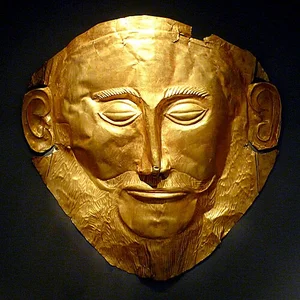
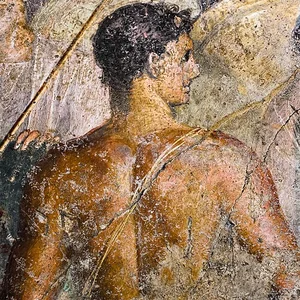
Although not directly linked to Penelope, the frescoes from Mycenaean palaces depicting noblewomen at court illustrate the visual and social world in which the myth of Penelope first took shape.
Anecdotes
The ruse of Laertes' shroud is one of the most famous stratagems in all of ancient literature. To hold off the suitors who were pressing for her hand, Penelope announced that she would choose a husband the day she finished weaving her father-in-law's funeral shroud. But each night, by torchlight, she secretly undid the work she had done during the day. The deception lasted three years, until a maidservant betrayed her secret.
When Odysseus returned to Ithaca disguised as a beggar, Penelope did not recognize him at once. To settle the matter of the suitors, she devised a contest: whoever could string Odysseus's great bow and shoot an arrow through twelve axe-heads lined in a row would win her hand. None of the suitors could do it. The old beggar then asked to try: he strung the bow effortlessly and loosed the arrow with perfect precision. The slaughter of the suitors began.
Even after Odysseus's victory, Penelope was not easily convinced. She put her husband to one final test by asking the maidservant Eurycleia to move their marriage bed out of the bedchamber. But that bed was one of a kind: Odysseus himself had built it around a living olive tree still rooted in the ground, making it impossible to move. By knowing this secret, Odysseus proved his true identity, and Penelope finally accepted him.
In late antiquity and post-Homeric mythology, some authors told that Penelope had been seduced by one of the suitors — or even by the god Hermes — and that she had given birth to Pan. This version, radically at odds with her image of absolute fidelity, shows how deeply the figure of Penelope fueled moral and literary debate from antiquity onward. Homer himself presents her as the supreme model of the virtuous wife.
The name Penelope is itself open to interpretation. Some ancient etymologists linked it to the Greek words pênê (weaver's thread) and lepô (to unravel), making her very name an allusion to her famous stratagem. Others connected it to pênelopê, the barnacle goose (a water bird), suggesting a link to the sea and to waiting. This ambiguity reflects the symbolic richness the character held in Greek culture.
Primary Sources
"But the wise Penelope had devised another stratagem: she had set up a great loom in her chambers and begun to weave a fine and very large shroud. She told us: Young men, my suitors, since the noble Odysseus is dead, wait until I have finished this cloth."
"While you were fighting beneath the walls of Troy, I remained here weeping. My loom, a futile ruse, kept me company. I feared everything, and love magnifies fears."
"At Sparta, a place is pointed out where Penelope, they say, wove her web; the inhabitants venerate her memory as a symbol of conjugal virtue."
A tale transmitted orally by the aoidoi of the Greek Epic Cycle, recounting Penelope's resistance against the suitors in the megaron of the palace of Ithaca, before being set down in writing in the tradition attributed to Homer.
Fragment evoking the fate of Penelope after Odysseus's return, and her supposed connections with Telegonus, son of Odysseus and Circe.
Key Places
A rocky island in the Ionian Sea, kingdom of Odysseus and home of Penelope during the twenty years of her husband's absence. This is where most of the Odyssey takes place, in the royal palace perched on the heights.
The great central hall of the royal palace of Ithaca, where Penelope receives the suitors, where the bow contest takes place, and where the final massacre occurs. A symbolic space of domestic power and dramatic reversal.
The legendary city in Anatolia whose war and fall cause Odysseus's prolonged absence. For Penelope, Troy represents the distant cause of twenty years of solitude, veiled mourning, and waiting.
Telemachus travels here to gather news of his father; Penelope, who was Helen's cousin according to some traditions, is said to have had family ties with this city herself. Sparta venerated the memory of Penelope as a model of conjugal virtue.
The stretch of sea that separates Ithaca from the wider world, upon which Penelope fixes her waiting gaze. The sea is both obstacle and promise — the horizon that the palace's inhabitants scan every day in hope of seeing Odysseus return.
Typical Objects

The central instrument of Penelope's ruse, the upright loom is the object that symbolizes both her intelligence and her faithfulness. It is around this loom that the queen's entire resistance to the suitors is woven.

Traditional attributes of high-born Greek women, the distaff and wool thread signify mastery of the household and domestic life. For Penelope, spinning is at once a royal duty and an act of symbolic resistance.

A cloth Penelope claims to be weaving in preparation for her father-in-law Laertes' funeral. This unfinished shroud is the embodiment of her ruse: it is time held in suspension, a delay wrested from the suitors' impatience.

A great bow of horn that only Odysseus can string, once given to him by the archer Iphitus. Penelope makes it the instrument of the final trial, transforming a weapon of war into a tool of recognition and justice.

A unique marriage bed, carved by Odysseus himself from an olive tree still rooted in the palace floor. Knowledge of this secret is the ultimate sign of recognition Penelope uses to verify her husband's identity.

A veil worn by noble Greek women to cover their face, a symbol of modesty and social standing. Whenever Penelope appears before the suitors, she is always veiled, which reinforces her image of dignity and reserve.

The torch Penelope used at night to quietly unravel her day's work. In the Homeric imagination, this solitary light represents vigil and watchfulness, but also the loneliness of waiting.
School Curriculum
Vocabulary & Tags
Key Vocabulary
Tags
Daily Life
Morning
Penelope rises at dawn in her chambers on the upper floor of the palace, attended by her faithful handmaidens. She performs libations to the gods, especially Athena, goddess of wisdom and guardian of the household. She then gives instructions to her stewardesses for managing the palace stores, ensuring the continuity of the royal estate in Odysseus's absence.
Afternoon
The afternoon is devoted to weaving in the great women's hall. Penelope works at her loom under the eyes of her handmaidens, sometimes receiving news from outside brought by sailors or travelers. She must also endure the unwanted visits of the suitors, whom she answers with diplomacy and caution — careful not to provoke them while still refusing to make a choice.
Evening
In the evening, Penelope sometimes descends into the megaron to make a brief appearance before the suitors, always veiled and accompanied by two handmaidens. She listens to the bard Phemius sing of the deeds of the heroes of Troy, which moves her to tears. Once night falls, she secretly unravels her work by torchlight before returning to her chamber to weep for Odysseus.
Food
The diet at the royal palace of Ithaca draws on the island's own produce and the sea: barley and wheat bread, olives and olive oil, sheep's cheese, figs and dried grapes, salted fish, and roasted meat at banquets. Greek wine, diluted with water as was customary, accompanies meals. The suitors ravage the palace's stores by feasting every day — a source of both shame and deep worry for Penelope.
Clothing
Penelope wears the chiton (a linen or wool tunic fastened at the shoulders) and the peplos (a large piece of draped and pinned wool), dyed in natural colors — ivory white, saffron, ochre. A veil (kaluptre) covers her head when she appears in public, a sign of modesty and rank. Her fibulae (clasps) and jewelry are made of bronze or gold — understated but refined, befitting her status as queen.
Housing
Penelope lives in the great royal palace of Ithaca, a multi-story stone building with a large central hall (megaron) featuring a permanent hearth. Her personal chambers are on the upper floor, separate from the men's areas and the kitchens. The palace has inner courtyards, storerooms for provisions, a women's hall for weaving, and is surrounded by gardens and orchards. The walls are decorated with frescoes and the floors paved with stone.
Historical Timeline
Period Vocabulary
Visual Style
Le style visuel de Pénélope s'inspire de la céramique grecque à figures rouges et des fresques mycéniennes : tons chauds de terre cuite, d'ocre et d'ivoire, drapés élégants, lumière méditerranéenne, avec une atmosphère de solitude digne et de patience mélancolique.
Sound Ambience
L'ambiance sonore du palais d'Ithaque mêle le bruit régulier du métier à tisser, le vent de la mer Ionienne et les rumeurs lointaines des prétendants festoyant dans la grande salle, créant un contraste entre le recueillement de la chambre de Pénélope et le tumulte qui menace son foyer.
Liens externes & ressources
Références
Œuvres
L'Odyssée — Homère
VIIIe siècle av. J.-C.
Les Héroïdes, Lettre I (Pénélope à Ulysse) — Ovide
entre 25 et 16 av. J.-C.
Pénélope — tableau de John William Waterhouse
1849–1917 (période de l'artiste)
The Penelopiad — Margaret Atwood
2005
Ulysse — James Joyce
1922
Fresque du palais de Tirynthe (art mycénien)
XIIIe–XIIe siècle av. J.-C.