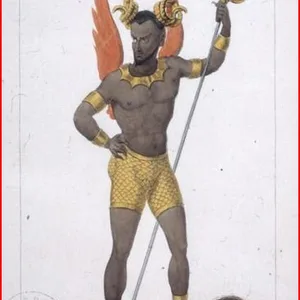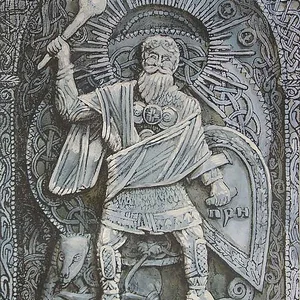

Perun is the supreme god of thunder and lightning in Slavic mythology. Master of the celestial elements, he is eternally opposed to Veles, deity of the underworld and waters. He is the Slavic equivalent of Zeus or Thor in the Indo-European pantheons.
Perun
Péroun
9 min read
Frequently asked questions
Key Facts
- Perun is the principal deity of the pre-Christian Slavic pantheon, venerated by Eastern, Western, and Southern Slavs
- He is associated with the oak, lightning, rain, and war
- His eternal rival is Veles, god of the underworld, waters, and wealth — their cosmic conflict structures Slavic mythology
- During Christianization (9th–12th c.), his attributes were partly absorbed by the prophet Elijah (Saint Elijah the Thunderer) in the Orthodox tradition
- He is mentioned in medieval Russian chronicles, notably in the Primary Chronicle (12th c.)
Works & Achievements
Foundational mythological cycle of Slavic religion, recounting the eternal battle between Perun (celestial order) and Veles (chthonic chaos). Reconstructed by scholars from Slavic folklore and Indo-European parallels, it structures the entirety of Slavic cosmology and worldview.
The first attempt at Slavic religious unification under Vladimir I, placing Perun at the head of a pantheon of six deities. This political and religious monument is the most explicit testimony to his role as supreme god in the Kievan state religion.
A ritual symbol ubiquitous in Slavic folk art — a six-spoked wheel representing Perun's protection. Its persistence in traditional Slavic craftsmanship for centuries after Christianization testifies to the depth of the god's cultural rootedness.
After Christianization, the ancient rituals of Perun became associated with the feast of Saint Elijah (July 20). These songs and rural practices, in which Elijah “rides his chariot across the sky and causes thunder,” are living fossils of the original cult of Perun.
These epics, sung by professional storytellers, preserve traces of the thunder god through the hero Ilya Muromets, who directly inherits the warrior and celestial attributes of Perun, illustrating the continuity between pagan myth and Christian epic.
Anecdotes
Perun and Veles clash endlessly in a cosmic battle that structures the Slavic universe. Veles, the underworld deity, periodically rises from the depths to steal the livestock and souls of the living that Perun protects. Perun pursues him across the sky and strikes him with his lightning, forcing Veles to retreat back into the depths. This eternal cycle explained, for the ancient Slavs, the alternation of the seasons and the birth of storms that fertilize the earth.
In 980, Prince Vladimir I of Kyiv had a wooden statue of Perun erected on the hill overlooking the Dnieper, its head adorned with silver and its moustache with gold. Flames burned there permanently, tended by devoted priests. Eight years later, having converted to Christianity, Vladimir ordered that very idol to be thrown into the Dnieper — a highly symbolic gesture to mark the official death of Slavic paganism.
The oak was Perun's sacred tree. The Slavs believed that an oak struck by lightning became a place of divine power, and lit ritual fires there to draw his favour. Pieces of this wood were kept in homes as amulets against illness and malevolent spirits. This belief survived Christianization in the form of peasant superstitions still very much alive in the 19th century.
After the Christianization of the Slavic peoples (9th–12th centuries), Perun's attributes were gradually transferred to the Prophet Elijah (Saint Ilya). The Slavic people continued to imagine that thunder was produced by Elijah's chariot crossing the sky — a direct survival of the Perun cult within Orthodox Christian culture, carefully documented by 19th-century folklorists.
In Serbian and Croatian, the iris bears the name 'pérunika', derived directly from the thunder god. This flower in its shades of violet and blue was consecrated to him and used in rituals of protection against lightning. The persistence of this botanical name illustrates how deeply Perun had taken root in the daily life of the Slavs long before being absorbed into Christian folklore.
Primary Sources
And Vladimir set up idols on the hill outside the palace: one of Perun made of wood with a silver head and golden mustache, and of Khors, Dazbog, Stribog, Simargl, and Mokosh. Sacrifices were offered to them and they were called gods.
We have sworn by Perun, our god, and by Veles, god of cattle. If we break this oath, may we be struck down by the gold we carry, may we be cut to pieces by our own swords.
Vladimir ordered Perun to be cast into the Dnieper. He was dragged to the river and thrown into the water. The people wept still, for they had not yet received holy baptism. Then he was seen drifting away and vanishing around the bend of the river.
They offer sacrifices to Perun and Khors, to Mokosh and Simargl; they pray in sacred groves and near wells, invoking the ancient gods that their forefathers worshipped before holy baptism.
Key Places
On this height overlooking the Dnieper, Vladimir I erected the great idol of Perun in 980. The center of official Slavic worship before the Christianization of 988, it was the site of sacrifices, oaths, and major ritual gatherings of Kievan Rus.
The great river of Kievan Rus witnessed oaths sworn upon Perun during the treaties of 907 and 944, and then became the site of the symbolic destruction of his idol in 988. Its slow current carried the statue into oblivion, heralding the end of Slavic paganism.
An important center of Perun's worship, Novgorod had its own sanctuary on the banks of the Volkhov River. Archaeological excavations there have uncovered artifacts linked to the thunder god's cult, confirming the wide geographic reach of his veneration.
Numerous peaks and hills bear the name of Perun in Slovenia, Serbia, and Croatia, bearing witness to the wide geographic spread of his cult. These heights were regarded as divine residences or favored sites of sacrifice.
Throughout the Slavic world, groves of oak trees served as natural temples to Perun. Seasonal rituals were performed there, especially at the summer solstice, and eternal flames were kept burning as a sign of divine presence.
Typical Objects

Prehistoric flint axe found in fields after a storm, considered the 'arrow of Perun' fallen from the sky. Slavic peasants collected them carefully and kept them as amulets to protect homes and crops against lightning.

Six-branched rotating symbol carved or painted on houses and barns to invoke Perun's protection. This ritual ornament survived Christianization and can still be observed in traditional Slavic folk art.

Perun's emblematic weapon, with which he strikes Veles during their cosmic battles. Slavic warriors invoked Perun before battle and adorned their axes with thunder symbols to benefit from his divine power.

Flower with purple and blue hues evoking lightning, sacred to Perun. Used in protection and healing rituals, it retains the god's name in Serbian and Croatian to this day.

Perun's sanctuaries were marked by permanent flames tended day and night by priests. These fires symbolized celestial lightning and divine presence — their extinction was considered a very bad omen.

Perun's tree par excellence, especially large oaks struck by lightning. Offerings were hung from them, ritual fires were lit beside them, and their acorns were kept as magical protection against illness and malevolent spirits.
School Curriculum
Vocabulary & Tags
Key Vocabulary
Daily Life
Morning
In Slavic cosmology, Perun opens each day by driving his chariot of fire across the sky, separating the darkness of the underworld from the light of the living. At dawn, priests entered the sanctuaries to rekindle the sacred flames and offer the first prayers, asking the god to protect men, livestock, and crops from the subterranean forces of Veles.
Afternoon
At the height of the day, when the sun reigned at its zenith, Perun held undivided dominion over the sky. This was the time for public sacrifices — animals, precious objects — accompanied by ritual dances around the sacred oak. During periods of drought, the faithful implored Perun to unleash the purifying storms that would restore fertility to the earth.
Evening
Sunset was a time of vigilance: Veles would then attempt to rise from the underworld to sow disorder. Evening rites involved tracing protective signs (*gromovoi znak*) on the doors of houses and stables, and keeping fires burning to signal Perun's watchful presence and ward off malevolent spirits.
Food
Perun fed symbolically on the sacrifices offered by men: oxen, black roosters whose red crests evoke lightning, honey, and mead (the sacred Slavic drink). The collective ritual feast that followed the sacrifice allowed the faithful to “share the meal” with their god and absorb a measure of his divine power.
Clothing
Perun is described in folk traditions with a majestic appearance: hair and beard silver as storm clouds, clad in a tunic of gold or copper evoking flashes of lightning. He wears a stone belt symbolizing the power of the mountains, and wields a battle axe or club with which he makes the thunder roar.
Housing
Perun resides at the summit of the cosmic oak that sustains the Slavic universe — the *Vyriy*, a celestial paradise beyond the reach of mortals. The earthly sanctuaries dedicated to him were built on high ground, surrounded by ancient oaks and marked by eternal flames, visible signs of his presence among men.
Historical Timeline
Period Vocabulary
Liens externes & ressources
Références
Œuvres
Le mythe de Perun et Veles (tradition orale slave)
Transmis de l'Antiquité au Moyen Âge
Panthéon de Vladimir Ier (Kiev)
980
Gromovoi znak (signe du tonnerre)
IXe-XIIe siècles et au-delà
Chants du Jour de saint Élie (Ilyin den')
Tradition orale attestée dès le XIe siècle
Byliny (épopées orales russes)
Recueillies aux XIXe-XXe siècles