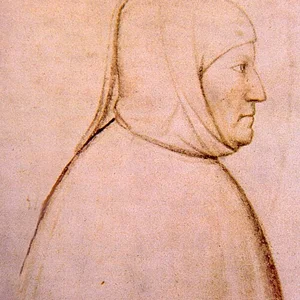

An Italian poet and humanist of the 14th century, Petrarch is considered the father of humanism. Deeply passionate about ancient Latin authors, he rediscovered and copied numerous forgotten manuscripts. His poetic work, particularly the Canzoniere dedicated to Laura, profoundly influenced European literature.
Petrarch(1304 — 1374)
Petrarch
République florentine
9 min read
Frequently asked questions
Famous Quotes
« Who does not love books does not love wisdom.»
« Silence is the safest language.»
Key Facts
- Born on July 20, 1304, in Arezzo (Tuscany)
- Crowned poet laureate on the Capitoline Hill in Rome in 1341 — the first poet to receive this honor since Antiquity
- Composed the Canzoniere, a collection of 366 poems in Italian dedicated to Laura de Noves
- Rediscovery of Cicero's letters to Atticus (1345), a founding moment for humanist philology
- Died on July 18, 1374, in Arquà (Veneto)
Works & Achievements
A collection of 366 poems in Tuscan, mainly sonnets dedicated to Laura. Considered the masterpiece of Italian lyric poetry, it influenced all of European poetry until the 17th century (Petrarchism).
An imaginary dialogue in Latin between Petrarch and Saint Augustine, in the presence of Lady Truth. Petrarch uses it to examine his own contradictions — his love for Laura, his desire for fame, and his spiritual aspirations.
A grand Latin epic recounting the exploits of Scipio Africanus against Hannibal. Petrarch hoped it would make him immortal; it was partly on the strength of this poem that he was crowned poet laureate in Rome in 1341.
A Latin treatise in two books in praise of retreat from crowds and court life. Petrarch develops the humanist ideal of the wise man withdrawn into nature, free to read, write, and think.
An allegorical poem in terza rima depicting six triumphs — of Love, Chastity, Death, Fame, Time, and Eternity. Hugely popular during the Renaissance, it inspired iconography and the decorative arts.
A collection of 350 Latin letters addressed to friends, princes, and even ancient figures such as Cicero and Livy. An exceptional document on the intellectual life of the 14th century and the birth of humanism.
Anecdotes
In 1327, on a Good Friday, Petrarch catches sight of Laura for the first time in the Church of Saint Clare in Avignon. The encounter marks him forever: he dedicates more than 300 poems to her in his Canzoniere, even though he most likely never spoke a word to her. The true identity of Laura remains a mystery to historians to this day.
In 1336, Petrarch climbed Mont Ventoux in Provence, driven by nothing more than curiosity and a love of nature. At the summit, he opened Saint Augustine's Confessions at random and landed on a passage about human vanity. He took the moment as a sign from above and wrote a famous letter describing the ascent — one of the earliest texts in which a person describes a mountain as a place for inner reflection.
Petrarch would spend hours in monastery libraries, rummaging through dusty old cabinets and chests in search of forgotten ancient manuscripts. It was in this way that, in Verona in 1345, he rediscovered Cicero's personal letters to Atticus — revealing a very human side of Cicero, far removed from the perfect image people had of him. Petrarch even wrote replies to the letters, as though the great Roman orator were still alive.
In 1341, Petrarch was crowned Poet Laureate on the Capitoline Hill in Rome — the first time such an honor had been granted since Antiquity. He planned the ceremony carefully, personally choosing the symbolic date of Easter Sunday. The event was organized by King Robert of Anjou of Naples, who had questioned Petrarch for three days to satisfy himself of his worthiness.
Petrarch despised the physicians of his day and their methods, which drew on Avicenna rather than the ancient Greeks. He wrote a scathing pamphlet titled Invectives Against a Physician in four books, defending the literary arts against a brand of medicine he considered obscure and pedantic. When his own doctor advised him not to read at night, he carried on doing so for the rest of his life.
Primary Sources
Voi ch'ascoltate in rime sparse il suono / di quei sospiri ond'io nudriva 'l core / in sul mio primo giovenile errore / quand'era in parte altr'uom da quel ch'i' sono.
I am a man of no great importance, neither very distinguished by my birth nor very humble. My family is of respectable standing and, as they say, of middling rank. I was born in Arezzo, in exile, of a father who had been driven from his homeland.
Moved by nothing but the desire to see its famous height, I climbed today the highest mountain in this region, which they call Ventoux. Ten years have passed since I left Bologna.
Solitude is the great remedy for mankind, the source of all freedom, the foundation of rest, and the condition of all serious study. Far from the crowd, the mind recovers its own measure.
Arma canunt alii bellisque ingentia facta, / nos tecum, Caesar, Romanaque tempora laudum / percurrimus.
Key Places
The city where Petrarch spends most of his youth and studies law. It is in Avignon that he meets Laura in 1327 and frequents the papal court, which he will admire and then sharply criticize.
Petrarch's solitary retreat on the banks of the Sorgue river, where he regularly withdraws between 1337 and 1353 to write away from the noise of the world. It is here that he composes much of his major work, including the Canzoniere.
The iconic peak of Provence (1,912 m) that Petrarch climbs on April 26, 1336, accompanied by his brother Gherardo. This ascent is regarded as one of the first symbolic expressions of the modern sensibility toward nature.
The Eternal City where Petrarch is crowned poet laureate in 1341. For him, Rome represents the ideal of ancient civilization that he dreams of reviving; he returns there several times to study the ruins and inscriptions.
A small village in the Euganean Hills (Veneto) where Petrarch settles in his final years. He dies there in 1374; his house is today preserved as a museum and has borne his name since the nineteenth century.
Liens externes & ressources
Références
Œuvres
Canzoniere (Rerum vulgarium fragmenta)
1327–1374
Secretum (Mon secret)
1342–1353
Africa
commencée vers 1338
De vita solitaria (De la vie solitaire)
1346
Triumphi (Les Triomphes)
1351–1374
Epistolae familiares (Lettres familières)
1325–1366