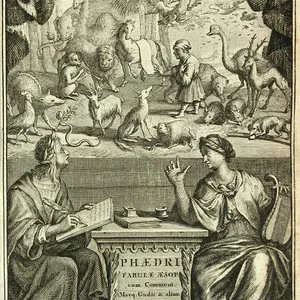

Phaedrus was a Latin fabulist of the 1st century AD, a freedman of Emperor Augustus. He was the first author to render Aesopian fables in Latin verse, leaving behind a collection in five books that had a lasting influence on European literature.
Phaedrus(20 av. J.-C. — 50)
Phaedrus
Rome antique
9 min read
Frequently asked questions
Famous Quotes
« Utilem rem vobis quaero, non gloriam. (I seek to be of use to you, not to seek glory for myself.)»
Key Facts
- Born around 15 BC in Macedonia, probably a slave of Thracian origin
- Freed during the reign of Augustus (27 BC – 14 AD)
- Wrote five books of Fabulae Aesopiae in Latin verse (iambic senarii)
- Persecuted by Sejanus, minister of Tiberius, for political allusions in his fables
- Died around 50 AD; his work was rediscovered and widely disseminated during the Renaissance
Works & Achievements
The first collection of 31 fables in Latin verse, including foundational texts such as The Wolf and the Lamb and The Frog Who Wished to Be as Big as an Ox. Here Phaedrus acknowledges his debt to Aesop while asserting his own poetic originality.
A shorter collection (8 fables) in which Phaedrus responds to his critics and defends the moral and literary value of his work. He denounces social injustice and the arrogance of power in a veiled but pointed manner.
The third book (19 fables), with the most personal prologue, composed after the fall of Sejanus: Phaedrus speaks of the persecution he endured and claims his right to free expression through allegory. It is the collection most charged with political criticism.
The fourth book of 25 fables, dedicated to a certain Particulo, in which Phaedrus broadens his sources beyond Aesop by incorporating Roman historical anecdotes and tales inspired by Menander's Greek comedies. He asserts his literary maturity and independence.
The fifth and final book, likely incomplete or fragmentary (10 fables survive), which confirms Phaedrus's ambition to establish Latin fable as a fully independent literary genre, free from the Greek model that had originally inspired him.
Anecdotes
Phaedrus was born a slave in Macedonia, in the region of Pieria at the foot of Mount Olympus, around 15 BC. Brought to Rome, he was freed by Emperor Augustus himself — an exceptional fate that earned him the official designation 'Phaedrus Augusti libertus.' This extraordinary rise from slavery to imperial freedom left a lasting mark on his view of the human condition and fueled his passion for fables about the powerful and the powerless.
Phaedrus was the first author to transpose Aesop's fables into Latin verse, adopting the elegant iambic senarius meter. Where Aesop wrote in brief Greek prose, Phaedrus crafted true poems complete with a prologue and a moral epilogue. He proudly claimed this invention in his prologues, aware that he was opening an entirely new path in Latin literature.
During the reign of Tiberius, Phaedrus drew the anger of Sejanus, the all-powerful Praetorian prefect. In the prologue to his third book, he admits to having been 'put on trial' and 'made to suffer' at the hands of a man in power, without ever naming him. Scholars believe his fables criticizing the abuse of the strong over the weak were deemed seditious by the feared minister, who governed Rome with an iron fist.
Phaedrus's work met a paradoxical fate: almost entirely ignored by his contemporaries — Martial and Quintilian barely mention him — he was rediscovered during the Renaissance thanks to the humanist jurist Pierre Pithou, who in 1596 published a printed edition based on a Carolingian manuscript known as the 'Codex Pithoeanus.' This manuscript contained 94 fables that would go on to influence generations of European writers, including La Fontaine in the seventeenth century.
Unlike Aesop, who confined himself to animal tales in prose, Phaedrus added to each fable a verse moral and touching autobiographical prologues. In his most famous fable, The Wolf and the Lamb, he states this bitter truth: the powerful condemn the weak without just cause — a formula that La Fontaine would echo almost word for word seventeen centuries later in 'The reason of the strongest is always the best.'
Primary Sources
Aesopus auctor quam materiam repperit, hanc ego polivi versibus senariis. Duplex libelli dos est: quod risum movet et quod prudenti vitam consilio monet.
Ad rivum eundem lupus et agnus venerant, siti compulsi. Superior stabat lupus, longeque inferior agnus. Tunc fauce improba latro incitatus iurgii causam intulit.
Nunc, ut proposui, curam conteram, quoniam in hac me Seianus petiit… sed absit invidia verbo: expertus loquor.
Phaedri libellos legere si desideras, vaces oportet, Particulo, a negotiis. Non quia difficilis labor est, sed ut placeat animus remissus.
Fabellas quoque Aesopi, quas Phaedrus exornavit, enarrare sermone puro et nihil se supra modum extollente, prima illa exercitatio incipientium potest.
Key Places
A region of Macedonia at the foot of Mount Olympus, the mythical cradle of the Muses, where Phaedrus was born around 15 BC. This land steeped in Greek culture accounts for his deep familiarity with the Aesopic tradition and his command of the Greek language.
The hill in Rome where Augustus had his residence. As a freedman of the emperor, Phaedrus lived and worked within the circle of the imperial household, at the very center of Roman power and culture.
The political, legal, and commercial heart of Rome, where booksellers kept their stalls and where Phaedrus could observe the power dynamics between the mighty and the humble that fuel his fables. This was the stage for all the social tensions he brought to life in his writing.
A major public library founded by Augustus near the Temple of Apollo, housing both Greek and Latin collections. Phaedrus, as an imperial freedman, likely had access to it and used it to consult the fables of Aesop and the works of Menander that served as his inspiration.
Hubs of intellectual and social life where scholars and ordinary citizens gathered to discuss ideas and sometimes recite their work aloud. Like any Roman citizen, Phaedrus frequented these establishments, which formed a vibrant core of the city's cultural life.
Typical Objects

Common writing surfaces in Rome, consisting of a wooden frame coated with wax on which one inscribed with a stylus. Phaedrus likely composed and revised his verse fables on these tablets before having them copied onto papyrus scrolls.

The form of the ancient book: a long roll of papyrus or parchment unrolled for reading. Phaedrus's five books of fables took this form, copied by scribes and distributed by booksellers (bibliopolae) in the Roman Forum.

A writing instrument made of metal or bone, pointed at one end for inscribing in wax and flattened at the other for erasing. The everyday tool of every Roman man of letters, it symbolizes the patient craft of writing at which Phaedrus excelled.

A small terracotta lamp fueled by olive oil, essential for working and reading after sunset. The image of the poet laboring by the glow of a lucerna to polish his verses is a classic topos of Latin literature.

The distinctive garment of the free Roman citizen, which Phaedrus gained through his manumission by Augustus. Wearing the toga meant belonging to free Roman society — a powerful symbol for a man born into slavery.

A counting instrument used in administrative and commercial functions. As an imperial freedman, Phaedrus likely carried out administrative duties in the household of Augustus before devoting himself entirely to writing.
School Curriculum
Vocabulary & Tags
Key Vocabulary
Daily Life
Morning
Phaedrus rose at dawn (prima lux), as all Romans did. As an imperial freedman, he likely attended the morning salutatio at the home of an influential patron — an indispensable social ritual in Rome. He would then spend the cool early hours reading and composing his fables, before the heat made concentration difficult.
Afternoon
After the light midday meal (prandium), Phaedrus might visit the public baths — centers of intellectual and social life — or the Palatine Library to consult the Greek fables of Aesop and the works of Menander. The afternoon was also a time to dictate his compositions to a scribe or revise them on wax tablets.
Evening
The evening began with the cena (main meal), shared with friends or clients. Phaedrus may have taken part in literary circles where authors recited their works before educated audiences. As night fell, by the light of his lucerna, he would quietly refine his verses, searching for the most precise and concise moral formulation.
Food
Like most freedmen of modest means, Phaedrus ate mainly bread (panis), vegetables (olera), legumes (lentils, chickpeas), and olives drizzled with oil. Meat and fish were reserved for formal occasions; heavily watered-down wine accompanied meals daily.
Clothing
As a Roman freedman and citizen, Phaedrus wore the toga (toga pura) — the white garment that distinguished the free citizen — draped over a linen tunic. His sandals (calcei) were those of a free man. This attire symbolized his new status, wrested from the slavery into which he had been born.
Housing
Phaedrus most likely lived in an apartment in an insula (tenement building) in a neighborhood near the Palatine or Trastevere, given his ties to the imperial household. His lodgings were modest but functional: a bed (lectus), a writing table, chests for his volumina, and the oil lamp essential for his late-night studies.
Historical Timeline
Period Vocabulary
Visual Style
Style visuel romain impérial du Ier siècle : fresques aux ocres et rouges chauds, architecture de marbre blanc, atmosphère de bibliothèque antique avec rouleaux et tablettes de cire.
Sound Ambience
Ambiance sonore de Rome impériale au Ier siècle : brouhaha du Forum, fontaines d'aqueduc, stylet sur tablette de cire et récitation poétique dans les portiques ombrés.
Liens externes & ressources
Références
Œuvres
Fabulae Aesopiae, Livre I
vers 25-30 ap. J.-C.
Fabulae Aesopiae, Livre II
vers 30-31 ap. J.-C.
Fabulae Aesopiae, Livre III
vers 31-37 ap. J.-C.
Fabulae Aesopiae, Livre IV
vers 40-45 ap. J.-C.
Fabulae Aesopiae, Livre V
vers 45-50 ap. J.-C.