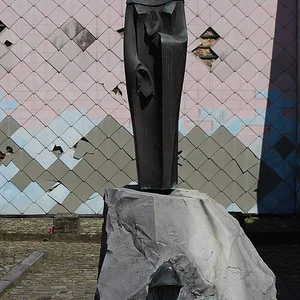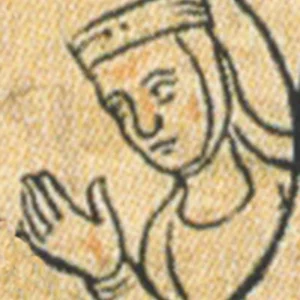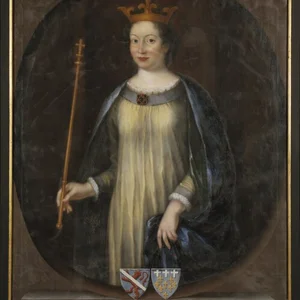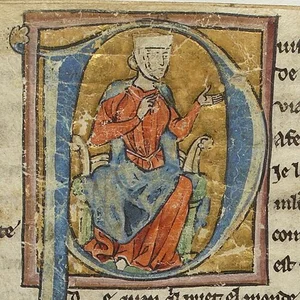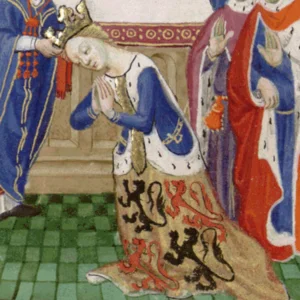

Queen of England through her marriage to Edward III in 1328, Philippa of Hainaut was a respected sovereign, known for her clemency and benevolent influence. She played an important role in the English court and was a patron of the arts and letters.
Philippa de Hainaut(1310 — 1369)
Philippa de Hainaut
royaume d'Angleterre
9 min read
Frequently asked questions
Key Facts
- Born around 1314 in the County of Hainaut (present-day Belgium)
- Married Edward III of England in 1328
- In 1347, interceded to save the Burghers of Calais, condemned to death by Edward III
- Protected and financed the chronicler Jean Froissart
- Died in 1369 at Windsor Castle
Works & Achievements
A landmark act of clemency through which Philippa secured the pardon of the six prominent citizens of Calais who had been condemned to death by Edward III. This episode, recorded by Froissart, has endured through the centuries as a symbol of her compassion and her influence over her husband.
By welcoming Froissart to her court and funding his travels, Philippa enabled the writing of the *Chronicles*, a foundational historical source on the fourteenth century. Her patronage ensured that the memory of the Hundred Years' War was passed down to future generations.
Philippa lent her royal support to the founding of The Queen's College, contributing to the development of higher education in England. The college still bears her name symbolically and keeps her memory alive in Oxford.
While Edward III was away waging war in France, Philippa served as regent of the Kingdom of England and helped rally forces against the Scottish invasion. The victory at the Battle of Neville's Cross and the capture of King David II of Scotland were due in part to her governance.
Philippa's tomb, carved in alabaster by the sculptor Jean de Liège, is one of the earliest realistic funerary portraits of a queen consort in England. It stands as an exceptional artistic testament to the International Gothic aesthetic of the fourteenth century.
Anecdotes
In 1347, after the long and exhausting resistance of Calais against the armies of Edward III, the king decided to have six burghers of the town executed — men who had surrendered themselves to spare their fellow citizens. Philippa, then pregnant, knelt before her husband in tears and begged him to grant clemency to the condemned. The king, moved by her intercession, relented: the six burghers were spared. This scene is immortalized in Froissart's Chronicles and later in Rodin's famous sculpture.
Philippa was the patron of the chronicler Jean Froissart, who entered her service around 1361. She enabled him to travel across Europe to gather accounts of the great events of his time. Thanks to this royal generosity, Froissart was able to write his celebrated Chronicles, which today stand as a major historical source on the Hundred Years' War and the chivalric society of the fourteenth century.
In 1346, while Edward III was fighting in France during the campaign that led to the victory at Crécy, King David II of Scotland seized the opportunity to invade England. Philippa, acting as regent, helped mobilize England's defenses. English forces crushed the Scots at the Battle of Neville's Cross and captured King David II. This double victory in a single year considerably enhanced the prestige of the royal couple.
Philippa of Hainault played a key role in the founding of The Queen's College, Oxford, in 1341. The queen's chaplain, Robert de Eglesfield, established the college in her honour and placed it under her royal protection. Philippa contributed to its financial support, thereby helping advance higher education in England at a time when universities were institutions reserved for clergymen and the elite.
Philippa gave birth to twelve children, several of whom played a central role in English history. Her eldest son Edward, known as the Black Prince, became one of the most celebrated knights of his age, victorious at Poitiers in 1356. Her son John of Gaunt was the father of the future King Henry IV. Philippa thus ensured the dynastic continuity of the Plantagenets, and her descendants left a profound mark on medieval English history.
Primary Sources
The queen of England, who greatly loved these burghers of Calais, fell to her knees before the king her lord and said: 'Ha, gentle sire, since I crossed the sea at great peril, I have asked you for neither gift nor favour; now I humbly beseech you and ask as my own boon that, for love of me, you will deign to have mercy upon these six men.'
This college is founded in honour of God, the Virgin Mary, and the most illustrious Queen Philippa, wife of our lord King Edward III, whose royal grace and favour have made possible the establishment of this house of learning.
The queen our lady Philippa interceded on behalf of the Flemish merchants arrested at Southampton, securing their release by royal grace and the return of their goods, bearing witness to her solicitude towards the king's subjects.
Item, I bequeath to my dear lord and husband the king all my gowns, jewels, precious stones and movable goods, humbly praying him to provide for the settlement of my debts and for the endowment of my ladies-in-waiting according to their merit and faithful service.
Key Places
Philippa's birthplace and capital of the County of Hainaut, located today in northern France. It was here that she grew up and received a princess's education before her marriage to the future king of England.
The site of Philippa and Edward III's wedding on 24 January 1328. This Gothic cathedral, one of the largest in England, was the setting for the union that made Philippa Queen of England.
Philippa's favourite royal residence, where she spent much of her life and died on 15 August 1369. This royal castle on the banks of the Thames was the heart of court life under Edward III.
The French town besieged by Edward III in 1346–1347, where Philippa secured the pardon of six burghers condemned to death. This episode remains the most celebrated act of clemency of her reign.
The site of Philippa's coronation (1330) and burial (1369). Her alabaster funeral effigy, one of the earliest realistic portraits of an English queen consort, is still on display in the abbey.
A university college founded in 1341 under Philippa's patronage by her chaplain Robert de Eglesfield. This support for learning illustrates the queen's role as a patron of English intellectual life.
Typical Objects

A collection of prayers illustrated with miniatures, the queen's daily devotional object. Philippa, a pious and learned woman, owned several illuminated manuscripts inherited from the Flemish artistic tradition of her native region.

Insignia of royal power worn during official ceremonies. Philippa was crowned Queen of England on 4 March 1330 at Westminster Abbey, consolidating her status as a sovereign in her own right.

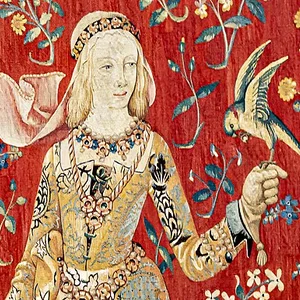
Wall hanging woven in wool and silk depicting court or hunting scenes, emblem of the Flemish refinement from which Philippa came. She helped introduce the taste for Flemish textile arts to the English court.

A wax matrix used to authenticate the queen's official documents and correspondence. Philippa's seal depicts her enthroned in majesty, surrounded by the arms of Hainaut and England.

A portable devotional object made of precious beads used to count prayers. Royal inventories from the 14th century record several rosaries belonging to Philippa, testament to her personal piety.

Ceremonial dress typical of a medieval queen, adorned with precious furs and embroidered with gold thread. Philippa was renowned for the elegance of her court and the influence of Flemish fashion she brought with her to England.
School Curriculum
Vocabulary & Tags
Key Vocabulary
Tags
Daily Life
Morning
Philippa began her day with prayer and morning Mass in the royal chapel, accompanied by her ladies-in-waiting. She then devoted time to administering her royal household: receiving petitions, managing the finances of her dower lands, and overseeing the many servants attached to her court.
Afternoon
Afternoons were often devoted to court affairs: audiences, receiving ambassadors or nobles, and overseeing the education of her many children. Philippa also had a keen interest in reading illuminated manuscripts and would receive chroniclers and scholars such as Froissart to discuss their work.
Evening
Evenings at the court of Edward III were marked by solemn banquets where minstrels and jesters entertained the assembly. Philippa presided over these festivities alongside the king, ensuring courtly etiquette was observed, before retiring for the evening prayers — compline — and then rest in the royal apartments.
Food
The royal table featured roasted meats (venison, wild boar, swan), fish on fast days, and Oriental spices (pepper, ginger, cinnamon) imported at great expense. Banquets also included honey-sweetened pastries and wines from Gascony or the Rhine, served in gilded cups.
Clothing
Philippa wore long gowns of velvet or silk damask, often in the colours of the royal arms, trimmed with precious furs such as ermine reserved for royalty. She wore headdresses and veils fastened with gold brooches and diadems, and her fingers were adorned with gemstone rings in keeping with the Flemish and English fashion of her time.
Housing
Philippa resided primarily in the royal castles of Windsor, Westminster, and Woodstock — vast complexes of stone buildings comprising great halls, a chapel, kitchens, and gardens. Her private apartments were furnished with canopied beds draped in fine linen sheets, carved wooden chests for clothing, and Flemish tapestries that warmed the stone walls.
Historical Timeline
Period Vocabulary
Liens externes & ressources
Références
Œuvres
Intercession pour les Bourgeois de Calais
1347
Patronage de Jean Froissart et des Chroniques
1361-1369
Protection et soutien au Queen's College d'Oxford
1341
Régence lors de la campagne de France (1346)
1346
Gisant funéraire à l'abbaye de Westminster
vers 1367