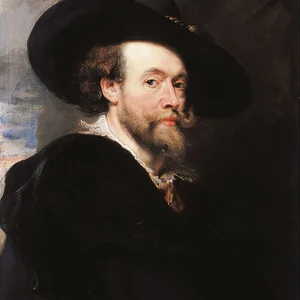

A Flemish painter of the 17th century, Rubens is one of the masters of the European Baroque. As much a diplomat as an artist, he worked for the greatest courts of Europe. His monumental body of work, rich in color and movement, had a lasting influence on Western painting.
Peter Paul Rubens(1577 — 1640)
Peter Paul Rubens
Pays-Bas espagnols
8 min read
Frequently asked questions
Key Facts
- 1577: born in Siegen (Westphalia), grew up in Antwerp
- 1600–1608: stay in Italy, discovery of Michelangelo, Titian, and Caravaggio
- 1622–1625: completion of the Marie de' Medici cycle (24 paintings, Louvre)
- 1629–1630: diplomatic mission to England and Spain to negotiate peace
- 1640: dies in Antwerp, leaving a body of work of more than 1,500 paintings
Works & Achievements
A triptych commissioned for the Cathedral of Our Lady in Antwerp, this monumental work reveals Rubens's mastery in depicting bodies in motion and Baroque dramatization. It remains in place to this day.
Considered one of Rubens's masterpieces, this triptych painted for Antwerp Cathedral showcases his absolute command of light and anatomy. It established Rubens as the defining reference for religious painting in Northern Europe.
A series of 24 paintings commissioned by the Queen Mother of France for her Luxembourg Palace in Paris. Blending historical fact with mythological allegory, this cycle is the most dazzling demonstration of Rubens's narrative and decorative genius.
This painting in the Prado, serene in its sensuality, depicts the three goddesses of beauty in a bucolic landscape. It exemplifies Rubens's later, more intimate style and his fascination with feminine beauty as embodied by Hélène Fourment.
A grand allegorical composition celebrating courtly love and the joyful life, peopled with elegant figures in a Baroque garden. Rubens depicted himself alongside Hélène Fourment, a testament to the happiness he found after his remarriage.
Painted during his diplomatic mission to London and presented to King Charles I, this canvas is a pictorial plea for peace in Europe. It perfectly illustrates Rubens's dual role as artist and diplomat in service of the great causes of his time.
Anecdotes
Rubens was as skilled a diplomat as he was a painter: in 1629, he was sent on a secret mission to London by the Spanish court to negotiate peace between England and the Spanish Netherlands. King Charles I was so impressed that he knighted him personally, presenting him with the sword himself.
His Antwerp studio operated like a true workshop: dozens of apprentices and collaborators, including the young Anthony van Dyck, worked there. Rubens designed the compositions and painted the faces and principal figures, leaving the rest to his assistants — an arrangement he openly acknowledged and that his patrons were well aware of.
Rubens remarried at 53 to Hélène Fourment, a young woman of 16 whom he deeply loved. He painted her many times, most notably in the work known as 'Het Pelsken' ('The Little Fur'), in which she poses nude wrapped in a fur coat. In his will, he requested that this painting never be put on public display.
Afflicted by gout in his later years, Rubens suffered so badly in his hands that he could barely hold a brush. Yet he continued to paint and run his studio until his final years, still producing works of outstanding pictorial quality.
His library held more than a thousand volumes in several languages — Latin, Greek, Italian, Spanish, French, and Flemish. Rubens corresponded with the leading scholars of his day and was regarded by his contemporaries as an accomplished humanist no less than a painter of genius.
Primary Sources
I am a man of peace and I detest war above all things; I know that it never concludes without the ruin of both parties. Yet there are necessities that cannot be resisted.
The Ancients painted with such truth that birds came to peck at the grapes painted by Zeuxis. This is no fable, but a testimony to the perfect imitation of nature they had achieved.
The said Mr. Rubens undertakes to paint with his own hand twenty-four pictures representing the life and glorious deeds of the most high and most illustrious Queen Marie de' Medici.
I bequeath to my beloved wife Helena Fourment the painting known as 'Het Pelsken', so that it may never be seen or shown in public, and that it remain in the hands of my family.
Key Places
Rubens had this magnificent residence built between 1610 and 1616, blending Flemish and Italian architecture. It was here that he maintained his large studio, where he worked and trained generations of painters, including Anthony van Dyck.
It was for the great gallery of this palace that Marie de' Medici commissioned Rubens's most ambitious cycle: 24 monumental paintings chronicling her life and reign, now housed in the Louvre.
Rubens stayed in Rome between 1601 and 1608, studying the frescoes of Michelangelo and Raphael, ancient sculptures, and the works of Caravaggio. This formative period shaped his Baroque style.
On a diplomatic mission in 1628, Rubens was received at the court of Philip IV of Spain. There he met the young Velázquez and spent months copying the Titians in the royal palace, deepening his mastery of color.
Rubens acquired this rural estate in 1635, seeking tranquility away from the city. It was here, in the final years of his life, that he painted his sweeping landscapes of Flanders — a genre that was new to him.
Liens externes & ressources
Références
Œuvres
L'Élévation de la Croix
1610-1611
Le Jardin de l'Amour
vers 1633