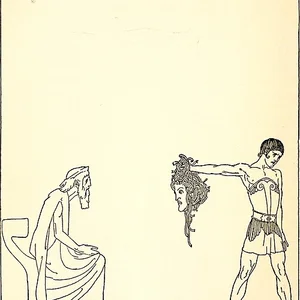

King of the island of Seriphos in Greek mythology, son of Magnes. Consumed by desire for Danaë, he sent her son Perseus to retrieve the head of the Gorgon Medusa in order to get rid of him. Upon his return, Perseus turned Polydectes to stone by showing him Medusa's head.
Polydectes
Polydectes
8 min read
Frequently asked questions
Key Facts
- King of the island of Seriphos, son of Magnes or Peristhenes depending on the source
- Welcomed Danaë and her son Perseus after they washed ashore on his island following their drift at sea
- Inflamed with desire for Danaë, he sent Perseus to bring back the head of Medusa in order to be rid of him
- Perseus returned victorious and turned Polydectes and his court to stone by showing them Medusa's head
- His brother Dictys, a more benevolent man, became king of Seriphos in his place
Works & Achievements
The most complete mythographic account of Polydectes, describing his tyranny, the banquet ruse, and the final petrification. The reference source for all modern mythographers.
A lyric ode celebrating Perseus and his feat against Medusa, in which Seriphos and the mission imposed by Polydectes are invoked as the starting point of the heroic adventure.
The Latin narrative version of Perseus's adventures, including the return to Seriphos and the transformation of Polydectes into stone, written in an elegant style that proved highly influential on Western culture.
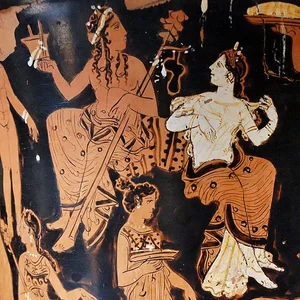
Several Attic ceramics depict Perseus brandishing the head of Medusa, illustrating the petrification scene that directly references the myth of Polydectes.
A Neoclassical masterpiece depicting Perseus holding the head of Medusa — the very gesture by which he turned Polydectes to stone, a timeless symbol of the hero's victory over tyranny.
Anecdotes
When Danaë and her young son Perseus arrived on the island of Seriphos — locked in a chest thrown into the sea by King Acrisius of Argos — it was the fisherman Dictys who took them in. Dictys happened to be the brother of King Polydectes, and so Danaë found herself, against her will, drawn into the dangerous orbit of the island's ruler.
Polydectes organized a banquet and asked each guest to bring a horse as a gift, knowing full well that Perseus, the son of a penniless foreigner, could not comply. Cornered, Perseus rashly promised to bring whatever the king desired — which was exactly what Polydectes had been waiting for, so he could demand the head of the Gorgon Medusa, a quest considered both deadly and impossible.
During Perseus's absence, Polydectes intensified his pressure on Danaë to force her into marriage. The hero's mother had to seek refuge in a sacred temple to escape the king. It was upon finding his mother in such a desperate state that Perseus, returning from his long journey, decided to punish Polydectes without mercy.
Upon his return, Perseus found Polydectes openly mocking his arrival before the entire court. The hero turned his gaze away, drew the head of Medusa from his bag, and held it up before the king and his courtiers: in an instant, Polydectes and all his men were turned to stone statues for eternity. Dictys, the kindhearted brother who had once sheltered them, was then chosen as king of Seriphos.
Primary Sources
Polydectes, enamored of Danaë, sent Perseus to fetch the head of Medusa. Perseus, having returned with the head, showed Medusa to Polydectes and his companions, and turned them all to stone.
Perseus, who cut off the head of the serpent-haired Gorgon and brought petrifying death to the island of Seriphos.
Danaë, adrift in the chest cast upon the waves, holding her child Perseus close, implored Zeus to take pity on them and save them.
Perseus drew the terrible head from his sack and thrust it before Polydectes and his men, who were instantly turned to stone.
Polydectes summoned the inhabitants of Seriphos to a banquet and demanded a horse from each guest, knowing full well that Perseus would be unable to provide one.
Key Places
A small Cycladic island ruled by Polydectes. It is here that Danaë and Perseus wash ashore after drifting at sea, and where the heart of the myth plays out: the king's tyranny, the trap of the banquet, and the final petrification.
The hometown of Danaë and King Acrisius. Polydectes' fate is bound to the prophecy of Argos: it was to escape this oracle that Acrisius cast Danaë adrift at sea, which eventually brought her to Seriphos.
The mythical seat of royal power and the site of the treacherous banquet. It is in this hall that Polydectes demands the head of Medusa, and here that he is turned to stone forever upon Perseus' return.
The chest carrying Danaë and Perseus washes up on the rocky coast of Seriphos, where Dictys finds them and takes them in at his fisherman's hut — unwittingly setting off his brother the king's obsessive desire.
Typical Objects

The emblem of Polydectes' power over the island of Seriphos, it symbolizes the tyrannical authority he wields over the island's inhabitants and over Danaë, whom he seeks to force into marriage.

It is at a royal feast that Polydectes sets his trap for Perseus, demanding the head of Medusa as a gift. The cup and the banquet are here the instruments of cunning and betrayal.

Polydectes asks his guests to bring horses as gifts to his banquet. This demand is a calculated pretext to ensnare Perseus, who, having no wealth, cannot provide one.

A symbol of Polydectes' ultimate fate, turned to stone by the gaze of Medusa's severed head. His petrified body becomes a lasting sign of his hubris, punished by the gods.

An object tied to the fate of Danaë and Perseus — it was the chest cast into the sea by Acrisius that carried them to Seriphos, bringing them directly into the dangerous orbit of Polydectes.

When Polydectes intensifies his pressure on Danaë to force her into marriage, she takes refuge within the sacred precinct of a temple. This place of sanctuary sets piety against the tyrant king's violence.
School Curriculum
Vocabulary & Tags
Key Vocabulary
Daily Life
Morning
Polydectes begins his day with libations at the royal hearth in honor of the Olympian gods, surrounded by his advisors and personal guard. He then receives reports from officials, merchants, and fishermen of the island, managing the affairs of the small kingdom from his stone megaron.
Afternoon
In the afternoon, the king presides over assemblies or settles disputes among the inhabitants of Seriphos. He may also oversee the activities of the harbor — the island's main economic resource — and inspect offerings destined for the altars of the kingdom's patron gods.
Evening
Polydectes' evenings are filled with banquets where he receives nobles and distinguished guests. Wine mixed with water is served alongside barley bread, olives, cheese, and sacrificial meat. It is at one of these very feasts that he sets his fatal trap for Perseus.
Food
Like all Greek kings of the mythic age, Polydectes eats barley bread, meats (goat, pork, and beef at sacrificial ceremonies), fish and seafood from the Aegean, olives, figs, and wine diluted with water. Royal banquets are far more lavish than the simple meals of an ordinary fisherman on Seriphos.
Clothing
Polydectes wears a white linen chiton fastened at the shoulder with bronze fibulae. Over it, he dons a wool himation dyed purple — a color reserved for rulers and great occasions. On his head, he wears a diadem or crown of precious metal, a visible mark of his kingship over the island.
Housing
Polydectes' palace is a stone megaron built around a large central hall, with a circular hearth at its center and painted wooden columns. The walls are adorned with geometric frescoes and the floors are paved with stone slabs. The palace overlooks the harbor of Seriphos, visible from the sea, proclaiming the king's authority over the island and its people.
Historical Timeline
Period Vocabulary
Visual Style
Style céramique grec à figures rouges et ocre, représentant un roi tyrannique dans son palais cycladique blanc dominant la mer Égée, culminant en une scène de pétrification dramatique.
Sound Ambience
L'ambiance sonore de Sériphos mêle les bruits de la mer Égée, le tumulte d'une cour royale grecque archaïque et le silence soudain et minéral de la pétrification.
Liens externes & ressources
Références
Œuvres
Pseudo-Apollodore, Bibliothèque (Bibliotheca), II, 4
Ier-IIe siècle apr. J.-C.
Pindare, Odes Pythiques, XII
490 av. J.-C.
Ovide, Métamorphoses, Livres IV-V
8 apr. J.-C.
Peintures sur vases grecs à figures rouges
VIe-Ve siècle av. J.-C.
Antonio Canova, Persée tenant la tête de Méduse (sculpture)
1804-1806