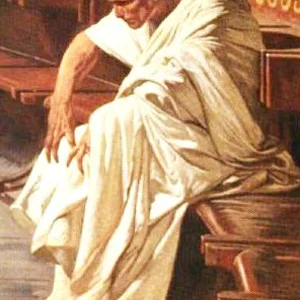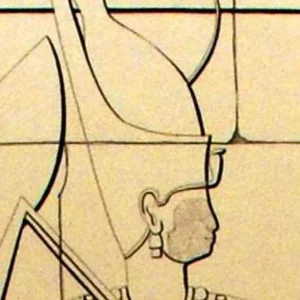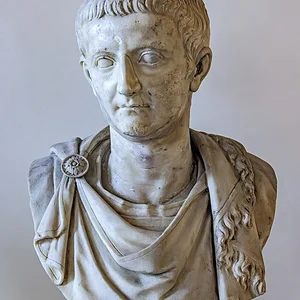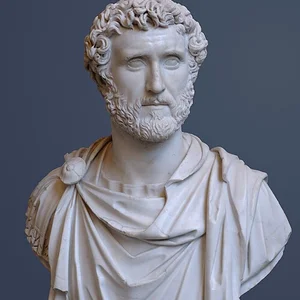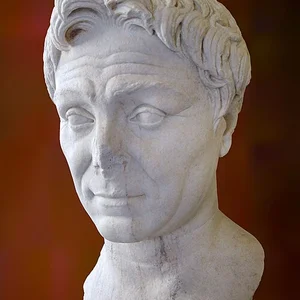

Pompey (106–48 BC) was a Roman general and statesman who distinguished himself through his military victories in the East. A rival and later enemy of Caesar, he was one of the key figures in the fall of the Roman Republic.
Pompey(105 av. J.-C. — 47 av. J.-C.)
Pompey
Rome antique
8 min read
Frequently asked questions
Key Facts
- Born in 106 BC, he earned the nickname Magnus (the Great) after his early military victories
- In 67–66 BC, he cleared the Mediterranean of pirates and defeated the kingdom of Pontus under Mithridates VI
- In 60 BC, he formed the First Triumvirate with Caesar and Crassus to dominate Roman political life
- Consul three times: in 70, 55, and 52 BC
- Defeated by Caesar at the Battle of Pharsalus in 48 BC, he was assassinated in Egypt that same year
Works & Achievements
Under the Lex Gabinia, Pompey was granted an extraordinary imperium over the entire Mediterranean and its coastlines. In 49 days, he cleared the western seas of pirates, securing Rome's grain supply.
Pompey defeated Mithridates VI, king of Pontus, and Tigranes of Armenia, then established the Roman provinces of Bithynia-Pontus and Syria. This administrative reorganization of the East generated enormous revenues for Rome.
The first permanent entertainment venue in Rome, it included a temple to Venus Victrix, a curia, and colonnaded porticos adorned with artworks brought back from the East. It stood as a symbol of Pompey's personal power and civic generosity.
Celebrated over two days, this triumph for his victories in the East was the most spectacular Rome had ever seen. Pompey paraded defeated kings, treasures, and representatives of 14 nations, proclaiming his dominion over three continents.
An informal political alliance with Caesar and Crassus that reshaped Roman public life for a decade. Pompey sought ratification of his settlements in the East and land grants for his veterans.
Appointed sole consul by the Senate to restore order following the murder of Clodius, Pompey wielded near-monarchical power. This exceptional office illustrates the deep crisis facing Rome's republican institutions.
Anecdotes
At just 25 years old, Pompey raised an army at his own expense in Italy to support Sulla, earning him the ironic nickname "adulescentulus carnifex" (the teenage butcher) for the brutality of his campaigns. Sulla, impressed, greeted him with the title Magnus — "the Great" — which he kept for the rest of his life.
In 67 BC, the Senate granted Pompey full powers to rid the Mediterranean of Cilician pirates who were strangling Roman trade. In just 49 days, he cleared all the western seas, and within three months, the entire Mediterranean basin — a feat his contemporaries considered almost miraculous.
During his great triumph in 61 BC, Pompey paraded captive kings, hundreds of captured ships, and representatives of fourteen defeated nations through Rome. It is said he had wanted to enter the city on a chariot drawn by four elephants, but the animals could barely fit under the triumphal arch, and he was forced to abandon the idea.
After his defeat at Pharsalus in 48 BC, Pompey fled to Egypt, hoping for support from the young pharaoh Ptolemy XIII. But no sooner had he stepped onto a small boat to reach the shore than he was treacherously murdered. His head was presented to Caesar who, according to ancient sources, turned away in tears — he had wanted a defeated rival, not a dead enemy.
Pompey was one of the first Romans to build a permanent theater in Rome, inaugurated in 55 BC. To circumvent the law prohibiting such structures, he had a temple to Venus Victrix built at the top of the seating tiers, effectively turning the whole complex into a place of worship. The theater could hold around 10,000 spectators and remained an iconic monument of Rome for centuries.
Primary Sources
Sulla saw Pompey advance, a young man, bringing with him an intact army and soldiers in good health, and he received him with the greatest distinction, rising to meet him and bestowing upon him the title of Magnus, that is to say, the Great.
Pompey distinguished himself through lightning campaigns against the pirates who plagued the entire Mediterranean; in less than three months, he had restored the safety of the seas and the free supply of grain to Rome.
Pompey is a man whose ambition knows no bounds, but whose military talent surpasses all others of our generation; he carries within him the greatness of a commander and the prudence of a strategist.
Standing at the prow, Pompey gazed upon Rome as it receded from view — he who had ruled over land and sea — and he saw that all he had conquered was now denied him by fortune.
Pompey had resolved to face Caesar in pitched battle; his officers, brimming with confidence, were already discussing the consulship and the provinces to be distributed after the victory.
Key Places
The first permanent theatre in Rome, built by Pompey in 55 BC. This colossal monument, capable of holding 10,000 spectators, symbolized the power and glory of its patron.
Site of the decisive battle of 48 BC, where Caesar crushed Pompey's forces. This defeat marked the end of the oligarchic Roman Republic and sealed Pompey's fate.
The city where Pompey sought refuge after Pharsalus, and where he was treacherously assassinated on the orders of the young pharaoh Ptolemy XIII, on September 28, 48 BC.
Pompey captured Jerusalem in 63 BC after a three-month siege and entered the Temple, though he did not plunder it. This episode brought Judea into the Roman sphere of influence.
The residence of Cornelia, Pompey's third wife, during the civil war. Pompey rejoined her there after Pharsalus before fleeing to Egypt.
Typical Objects

A short, double-edged sword carried by legionaries and their generals. Pompey, who rose through the military world, took the gladius as a symbol of his martial authority and his countless campaigns.

The purple or scarlet cloak worn by Roman generals on campaign. Pompey displayed it during his triumphs and his entries into conquered cities, a visible sign of his military imperium.

A bundle of rods bound around an axe, symbol of supreme authority in Rome. Having served as consul and been granted extraordinary powers, Pompey was surrounded by lictors bearing these insignia.

A writing surface used for military and diplomatic correspondence. From his campaigns in the East, Pompey managed a vast administration through couriers and orders written on such tablets.

A combat vessel with three banks of oars, the spearhead of the Roman navy. His campaign against the pirates made Pompey the undisputed master of the Mediterranean fleet, commanding more than 500 ships.

The symbol of military victory in Rome, worn during triumphs. Pompey celebrated three triumphs over the course of his career — a record for his era — which earned him exceptional prestige.
School Curriculum
Vocabulary & Tags
Key Vocabulary
Daily Life
Morning
Pompey rose before dawn at his headquarters or his villa, surrounded by his lictors and secretaries. He received reports from his legates on the state of the troops, dictated dispatches to his scribes, and consulted the augurs before any major military decision.
Afternoon
Afternoons were devoted to troop reviews, war councils with his officers, or — when in Rome — political audiences at his estate on the Esquiline Hill. On campaign, he inspected fortifications and planned the movements of his legions using rudimentary maps.
Evening
In the evenings, Pompey hosted dinners (cena) for clients, allies, and foreign delegations. These banquets served as occasions for political negotiations dressed up as socializing. A cultured man, he enjoyed philosophical readings and conversation with Greek rhetoricians.
Food
Like any Roman aristocrat, Pompey ate wheat in the form of bread and porridge (puls), olive oil, wine diluted with water, legumes, and roasted meats at feasts. On campaign, he would sometimes share the standard military ration (frumentum) to boost his soldiers' morale.
Clothing
In the city, Pompey wore the toga praetexta with its purple border, a mark of his senatorial dignity. On campaign, he donned a bronze muscled cuirass (lorica), greaves, and the scarlet paludamentum, the distinctive cloak of Roman generals. During his triumphs, he wore the costume of Jupiter in gold and purple.
Housing
Pompey owned a large villa on the Esquiline in Rome and several estates across Italy. His Roman residence included a library, Greek-style gardens, and reception halls adorned with trophies and works of art brought back from the East. On campaign, he stayed in a praetorium — a large command tent at the center of the camp.
Historical Timeline
Period Vocabulary
Visual Style
Style visuel ancré dans le réalisme romain de la fin de la République : portraits de marbre austères, scènes militaires épiques, palettes de rouge impérial, d'ocre et de bronze sous la lumière méditerranéenne.
Sound Ambience
L'univers sonore de Pompée mêle le fracas des camps militaires romains, les fanfares de bronze annonçant les batailles et le brouhaha des ports méditerranéens de la fin de la République.
Liens externes & ressources
Références
Œuvres
Campagne contre les pirates ciliciens
67 av. J.-C.
Conquête et réorganisation de l'Orient
66-63 av. J.-C.
Construction du Théâtre de Pompée à Rome
61-55 av. J.-C.
Troisième Triomphe de Pompée
61 av. J.-C.
Premier Triumvirat
60 av. J.-C.
Consulat unique (consul sine collega)
52 av. J.-C.