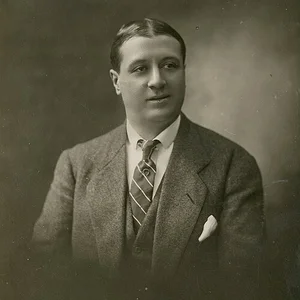

Raimu (1883-1946) is one of the greatest French actors of the 20th century, celebrated for his roles in Marcel Pagnol's Marseille trilogy (*Marius*, *Fanny*, *César*). His expressive acting and inimitable voice made him an icon of French cinema and theatre.
Raimu(1883 — 1946)
Raimu
France
9 min read
Frequently asked questions
Famous Quotes
« I don't act — I live my characters.»
Key Facts
- Born on 17 December 1883 in Toulon under the name Jules Auguste Muraire
- Started out in café-concerts and music halls before conquering Parisian theatre
- Played César in Marcel Pagnol's trilogy (*Marius* 1931, *Fanny* 1932, *César* 1936)
- Orson Welles considered him the greatest actor in the world
- Died on 20 September 1946 in Neuilly-sur-Seine
Works & Achievements
The first installment of the Marseille trilogy adapted from Marcel Pagnol's play, this film introduced Raimu to the wider cinema-going public in the role of César Olivier, Marius's father. His performance, blending authority and tenderness, immediately established a new dramatic register in French cinema.
The second installment of the trilogy, 'Fanny' deepens the character of César, caught between pride and paternal love. Raimu demonstrates an exceptional emotional range here, shifting from anger to tenderness with a fluidity that impressed every critic of the time.
The third installment of the trilogy, directed by Pagnol himself, 'César' is considered Raimu's masterpiece. The reunion scene between César and his son Marius is unanimously cited as one of the pinnacles of screen acting in the history of French cinema.
In this film adapted from a short story by Jean Giono, Raimu plays a Provençal baker inconsolable since his wife left him for a shepherd. His solo performance in the bakehouse scene was cited by Orson Welles himself as an absolute benchmark of cinematic acting.
A film in which Raimu plays opposite the young Michèle Morgan in her first major role. He portrays a good-natured, naïve juror whose kindness is taken advantage of, delivering a dramatic comedy steeped in humanity.
A satirical comedy about the world of cinema, in which Raimu shares the screen with Fernandel. The film humorously explores the illusions of fame and the harshness of the artistic world — two themes Raimu knew intimately after decades in the profession.
Anecdotes
Orson Welles, one of the greatest filmmakers of the 20th century, once declared: “Raimu is the greatest actor in the world, and I know no equal to him.” This statement, made by a man who had worked alongside the finest Hollywood talents, captures the universal admiration that the Toulon-born actor inspired, even beyond French borders.
Raimu, whose real name was Jules Auguste César Muraire, began his career in the café-concerts of Toulon around 1900, mimicking and singing before working-class audiences. Nothing predisposed him to becoming a national star: a child of poverty with no formal training, he learned his craft by watching and improvising, building his art through sheer force of character.
Marcel Pagnol wrote the character of César specifically for Raimu, convinced that no other actor could embody this Marseilles café owner who was at once gruff, tender, and comic. Raimu was initially reluctant to play a supporting role in *Marius* (1929), feeling that his status as a music-hall star deserved top billing — he eventually agreed, and César became his most celebrated role.
On set, Raimu was notorious for his volcanic temperament: he could halt a scene mid-take and demand they start over from scratch if a single detail displeased him, or unleash his fury on a co-star who had flubbed a line. Yet his fellow performers consistently agreed that this uncompromising perfectionism produced scenes of rare dramatic intensity.
During the German Occupation (1940–1944), Raimu continued to make films in France, which drew sharp criticism after the Liberation. Worn down and deeply affected by the reproaches, his health deteriorated rapidly. He died on September 20, 1946, in Neuilly-sur-Seine, leaving behind a filmography of some forty films accumulated in fewer than twenty years of cinema.
Primary Sources
I wrote César for Raimu. I could not conceive of that character without him, without that voice, without that face across which anger, tenderness, and mischief could pass within seconds.
I don't pretend to act. I am the character — I live with him, I suffer with him. If I don't believe it myself, how can you expect the audience to believe it?
Raimu was impossible and brilliant at the same time. He would look at you with burning eyes, and all you could do was respond truthfully, because he would accept nothing less.
Raimu is the greatest actor in the world, and I know no equal to him in any country.
My dear Marcel, I am willing to play César, but only if you promise me that this old fellow has some nobility. The people of Marseille are not clowns — they have heart.
Key Places
Raimu's birthplace (born Jules Muraire on July 17, 1883), Toulon is a Provençal port city where he cut his teeth in local café-concerts. The southern accent and sensibility he developed during his Toulon youth left their mark on his entire career.
The iconic setting of Pagnol's trilogy, the Old Port of Marseille is the imaginary backdrop for the Bar de la Marine where César holds court. Although filming took place partly in the studio, Marseille is the symbolic city of Raimu's greatest work.
It was in Paris, on the stages of the Folies Bergère and the Théâtre de Paris, that Raimu built his national reputation during the 1910s and 1920s. The stage premiere of *Marius* in 1929 at the Théâtre de Paris was the springboard for his film career.
Raimu settled in this prosperous suburb of Paris in his later years, and it was there that he died on September 20, 1946, at the age of 63, worn out by years of intense work and by the strains of the postwar period.
Several of Raimu's films, including those produced by Marcel Pagnol, were shot at La Victorine Studios in Nice, the major filmmaking center in the south of France during the 1930s and 1940s.
Typical Objects

The quintessential symbol of southern France, pétanque balls are inseparable from the world of Raimu and the Provençal characters he portrayed. In *César*, the card game at the bar on the Old Port evokes the spirit of pétanque as a popular male pastime of the interwar years.

Heavy greasepaint, kohl, and lipstick made up the stage makeup worn by theatre and music-hall actors, essential for expressions to read from the back of the house. Raimu, trained in the café-concert tradition, had mastered this art of expressive masking before adapting it to the subtler demands of the camera.

The emblematic anise-flavoured drink of Marseille and Provence, pastis is ever-present in the world of Pagnol's trilogy. At the counter of César's bar, it embodies Mediterranean conviviality and the working-class way of life that Raimu brought to the screen with striking authenticity.

The arrival of talking pictures in the 1930s revolutionised the film industry and brought actors with distinctive voices to the fore. Raimu, whose Provençal accent and deep timbre were immediately recognisable, became one of the great voices of French cinema precisely because of this technology.

In the role of César, owner of the Bar de la Marine in Marseille, Raimu wore the white apron characteristic of French bistros. An ordinary object of everyday working-class life, it became under his performance the costume of a character of profound dignity — somewhere between paternal authority and Mediterranean generosity.

Card games at the café are a recurring motif in Pagnol's trilogy, reflecting a central pastime of Provençal male sociability. The card-playing scene in *César* has become an absolute reference point in French cinema, immortalising the verbal jousting between friends around a game.
School Curriculum
Vocabulary & Tags
Key Vocabulary
Daily Life
Morning
Raimu rose late, a habit inherited from nights in music halls and theatres. His mornings began with a careful reading of the newspapers — he followed the press passionately, especially the cultural and political pages. He would have a strong Provençal coffee before learning or reviewing his lines, often aloud, testing inflections and silences.
Afternoon
Afternoons of filming or rehearsal were intense: Raimu arrived on set with his lines perfectly mastered but often demanded numerous takes to find the version that felt right to him. On days off, he enjoyed meeting friends for a card game, drawn out by lively discussions about theatre, politics, or football.
Evening
On performance evenings, Raimu underwent a complete transformation: focused and exacting, he took to the stage with a power that electrified the audience. After the show, he would often meet friends at Parisian or Marseille brasseries, relishing generous meals, wide-ranging conversation, and trade anecdotes shared with his peers.
Food
Raimu was a devoted fan of Provençal and Mediterranean cuisine: bouillabaisse, aïoli, brandade de morue, and slow-cooked stews were his favourites. He appreciated Provence rosé wine and, of course, pastis, the anise-flavoured drink that embodied for him the conviviality of the south of France. The table was for him a space of pleasure and sociability as much as sustenance.
Clothing
Off stage, Raimu dressed with the sober bourgeois restraint of a man of the people who had risen to fame: dark suit, felt hat, tie — the image of the respected actor. He had no taste for fashion excesses and retained something of the serious southern manner in the way he dressed, far removed from the affectations of certain Parisian stars.
Housing
Raimu lived for many years in comfortable Parisian apartments, particularly in the more affluent districts of the capital. Towards the end of his life, he settled in Neuilly-sur-Seine in a quiet residence. He never forgot his Toulon roots and kept a deep affection for the family home in the south, which he would recall with nostalgia in interviews.
Historical Timeline
Period Vocabulary
Liens externes & ressources
Références
Œuvres
Fanny (film de Marc Allégret)
1932