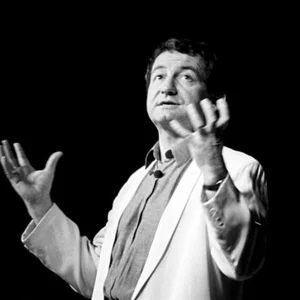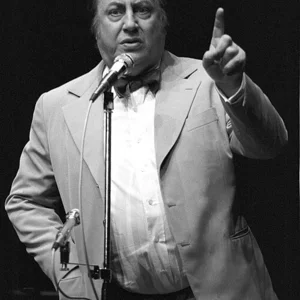

Raymond Devos (1922-2006) was a French comedian and stage performer of Belgian origin. A virtuoso of language, he built a unique body of work founded on wordplay, paradoxes, and verbal absurdity, performed on the greatest stages.
Raymond Devos(1922 — 2006)
Raymond Devos
France
6 min read
Frequently asked questions
Famous Quotes
« My God, grant that I may make people laugh.»
« Nothing is already something... the proof is that you can subtract it.»
« When you have nothing to say, you should say so right away.»
Key Facts
- Born on 9 November 1922 in Mouscron (Belgium)
- Rose to prominence in the 1950s and 1960s as a master of the sketch and the comic monologue
- Performed at the Olympia and on the greatest French stages throughout his career
- Elected to the Royal Academy of French Language and Literature of Belgium in 1998
- Died on 15 June 2006 in Saint-Rémy-lès-Chevreuse (France)
Works & Achievements
An iconic sketch playing on the homophony between the city of Caen and the French adverb “quand” (“when”). A model of verbal humor pushed to the absurd.
A philosophical and slapstick monologue on human restlessness, which became one of his most frequently revived routines.
A sketch that dissects the redundancies of the French language with relentless, hilarious logic.
A routine built on a sustained pun, showcasing his virtuosity at derailing the meaning of words.
His breakthrough on stage, which firmly established him among the great figures of the French one-man show.
A volume gathering all of his texts, bringing his work into the literary heritage.
Institutional recognition of his work on language, a rare honor for a stage comedian.
Anecdotes
Born in Mouscron, Belgium, in 1922, Raymond Devos grew up in a modest family ruined by the 1929 crash. As a teenager, he moved from one odd job to the next — warehouse hand, dockworker, apprentice in a grocery store — before finding his calling on the stage.
Devos was a true one-man band: he played some fifteen instruments, including the clarinet, the piano, the guitar and the trumpet. He often slipped musical interludes into his shows, blending the clown, the mime and the juggler with his gift for words.
His most famous sketch, “Caen,” plays on the confusion between the town of Caen and the French adverb “quand” (“when”), which sound identical: “À Caen, les vacances?” This pun on homophones became a textbook example of his art of the play on words and the misunderstanding pushed to the point of absurdity.
In 1978, the admiring American star Jerry Lewis invited him to perform on Broadway. Devos, whose entire art rests on the French language, rose to the challenge by adapting some of his routines, proving that his mime gestures could cross the language barrier.
A compulsive perfectionist, Devos could work on a single sketch for months, even years, before judging it worthy of the stage. He jotted down his verbal discoveries in notebooks and claimed that his best ideas came to him at night or while walking.
Primary Sources
The other day I was in Caen on business. Coming out of the station, I saw a train pulling away. I'd have loved to take it... It was leaving for Caen, at the same time as me.
Where are they running? Every time I see someone running in the street, I wonder: where is he running to? Is he running after something, or running away from something?
I who am speaking to you, one day it happened that I climbed up to the top of a tree. You'll tell me: you can't climb down to the top! Of course not! But you can climb down to the bottom!
Dear God, let me succeed, for it's not easy to make intelligent people laugh; fools, that's too easy.
Key Places
Raymond Devos's hometown, right next to the French border. He was born here in 1922 into a modest family.
The legendary Parisian music hall where Devos triumphed from 1963 onward. His appearances there became eagerly awaited events for his audience.
A town in the Chevreuse valley where Devos lived and worked on his property. He died here in 2006.
In 1978, at the invitation of Jerry Lewis, Devos performed here and introduced his art to the United States.
The Belgian institution that welcomed him among its members in 1989, a recognition of his mastery of language.
Typical Objects

The indispensable tool of the stage monologuist, around which Devos built his movements and his silences. He played with it as if it were a partner in the act.

One of the many instruments Devos played on stage. He slipped his musical numbers between the sketches, a true one-man band.

In them Devos recorded his verbal finds, puns and paradoxes, often jotted down at night. They were the laboratory of his writing.

Devos appeared in a plain costume, often black, a plump silhouette that contrasted with the agility of his mime. A neutral outfit that left all the room to the word.

A clown's and mime's accessory that he used in certain numbers, a nod to the burlesque tradition. As much an object of play as of silhouette.

Devos also handled percussion and marching band instruments for his one-man-band interludes. They underlined the clownish and musical side of his shows.
School Curriculum
Vocabulary & Tags
Key Vocabulary
Daily Life
Morning
A man of the night and the stage, Devos rose late and often devoted his mornings to rest and reading. On waking, he jotted down the ideas and puns that had surfaced during his sleep.
Afternoon
The afternoon was given over to writing and rehearsing: he chiseled his texts over months, played his instruments, and tested the musicality of each sentence out loud.
Evening
The evening belonged to the audience: entering the stage, mastered silences, mime, and music. A perfectionist, he analyzed his performances once the curtain had fallen.
Food
A bon vivant, Devos enjoyed generous, convivial cooking, a reflection of his roots in the North of France and Belgium. His plump figure was part of his stage persona.
Clothing
On stage, he wore a plain, often dark suit, leaving all the room to words and gesture. In everyday life, he kept the discreet air of a craftsman of language.
Housing
He lived on an estate in Saint-Rémy-lès-Chevreuse, in the Chevreuse valley, surrounded by his instruments and his notebooks. A calm setting well suited to his long work of writing.
Historical Timeline
Period Vocabulary
Liens externes & ressources
Références
Œuvres
« Caen »
années 1960
« Sens dessus dessous » (« Où courent-ils ? »)
années 1970
« Le pléonasme »
années 1960-1970
« La mer démontée »
années 1970
Triomphe à l'Olympia
1963
« Matière à rire », l'intégrale
1991
Élection à l'Académie royale de Belgique
1989