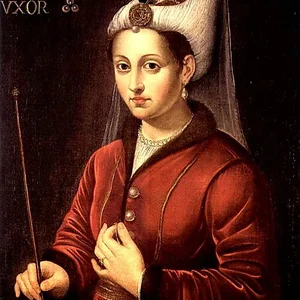

A slave of Ukrainian origin, she became the legal wife of Suleiman the Magnificent — the first concubine ever to be officially freed and married by an Ottoman sultan. Her influence over the politics of the Sublime Porte was considerable throughout the 16th century.
Roxelane
Roxelane
Empire ottoman
8 min read
Frequently asked questions
Key Facts
- Born around 1502 in Ruthenia (present-day Ukraine), captured and enslaved around 1515–1520
- Became Suleiman the Magnificent's favorite, was freed, and then officially married around 1534
- First concubine to be legally married by an Ottoman sultan, breaking a long-standing dynastic taboo
- Exercised direct influence over Ottoman politics, particularly in appointments and the question of succession
- Died in 1558 in Constantinople; her son Selim II succeeded her on the throne
Works & Achievements
A vast charitable complex in Istanbul financed by Hürrem, one of the first great Ottoman complexes commissioned by a woman. It bears witness to her immense personal wealth and her place within the tradition of imperial patronage.
Hürrem had this public bathhouse built near the great mosque of Hagia Sophia to serve the needs of worshippers. It is today a listed historic monument and still bears her name.
A pious foundation funded by Hürrem in the holy city to shelter and feed pilgrims. This act of generosity strengthened her image as a devout sovereign and lent legitimacy to her exceptional status.
Hürrem maintained a personal correspondence with several foreign rulers, most notably the King of Poland. These letters form a unique corpus attesting to an active role in Ottoman diplomacy — unprecedented for a woman of the harem.
Anecdotes
Captured during a Tatar raid in Ruthenia (present-day Ukraine) around 1515–1520, the young slave was given the Turkish nickname “Hürrem” (“the joyful one”) for her infectious laughter and quick wit — rare qualities in a harem accustomed to discretion. The nickname would stay with her until her death.
In 1533–1534, Suleiman the Magnificent did the unthinkable: he officially freed Hürrem and married her in a formal ceremony, breaking a centuries-old Ottoman tradition that forbade sultans from taking a legal wife from among their concubines. European ambassadors were astonished and immediately reported the news to their governments.
Hürrem corresponded directly with European rulers, most notably the King of Poland Sigismund II Augustus, to whom she sent diplomatic gifts in 1549 — a fur coat and embroidered shirts — demonstrating her active role in Ottoman diplomacy, something unprecedented for a harem woman.
She obtained from Suleiman the exceptional permission to leave the Old Palace, where favorites were traditionally confined, and move permanently into her own apartments at Topkapi Palace. This symbolic move allowed her to exert daily influence over the sultan and over affairs of state.
Hürrem commissioned the construction of a large charitable complex in Istanbul known as the Haseki Sultan, comprising a mosque, a madrasa, a hospital, and a public kitchen, completed around 1551. This complex attests to her immense personal wealth and her determination to place herself within the great Ottoman tradition of imperial philanthropy.
Primary Sources
“My spring, my being of joy, my day and my night... My city of Istanbul, my Anatolia... You who are everything to me...” Suleiman expresses in these verses his deep and exclusive devotion to Hürrem, signing under the poetic name Muhibbi.
Hürrem expresses her wishes for peace and friendship between the Ottoman Empire and the Kingdom of Poland, accompanying the sending of diplomatic gifts on her own initiative — an act unique for a woman of the Ottoman court.
“Sultana Hürrem holds an authority over the sultan's mind that no one before her had ever possessed. It is said she has bewitched him. She meddles in everything, court affairs as well as appointments.”
The pious foundation deeds drawn up in the name of “Hürrem Haseki Sultan” detail the revenues allocated in perpetuity to the mosque, the hospital, the madrasa and the imaret of the complex, attesting to her autonomous legal standing.
Key Places
A town in present-day Ukraine believed to be Roxelana's birthplace according to historical sources. She was captured there during a Tatar raid around 1515–1520 before being sold into slavery and sent to Constantinople.
The main residence of the Ottoman sultans, where Hürrem lived for several decades — first in the imperial harem, then in apartments adjacent to the sultan's own quarters. It was from this palace that she wielded her considerable political influence.
An architectural ensemble commissioned by Hürrem between 1539 and 1551, comprising a mosque, a hospital, a madrasa, and a public kitchen. Still standing today, this complex represents her most visible philanthropic legacy.
The traditional residence of Ottoman concubines and favorites. Hürrem lived here before obtaining the exceptional right to move to Topkapi and reside alongside the sultan — a major symbolic break with tradition.
Hürrem funded the construction of a pilgrims' inn (*imaret*) here, demonstrating the reach of her philanthropy well beyond the Ottoman capital and her public devotion to the Holy Sites.
Typical Objects

A garment of state worn by high-ranking women at the Ottoman court, Hürrem's kaftan was woven with gold thread and precious silk. Several kaftans from the period are preserved at the Topkapi Palace Museum.

Hürrem mastered the art of correspondence and personally wrote diplomatic letters addressed to foreign rulers. The inkwell and calamus (reed pen) were her instruments of political influence.

As Haseki Sultan, Hürrem possessed her own official seal, which she affixed to her correspondence and administrative documents — a tangible sign of her recognized legal authority.

The ritual bath (hammam) was a crucial social occasion in the lives of harem women. Trays, ewers, and bath clogs in chased silver were markers of status that Hürrem used throughout the spaces she controlled.

A legal document by which Hürrem dedicated her assets to perpetual charitable works. Several of these deeds are preserved in the Ottoman archives and attest to her autonomous philanthropic activity.

Pendants, bracelets, and head ornaments in gold, rubies, and emeralds formed the daily adornment of women of imperial rank. These jewels also served as stores of value that the sultanas managed in their own name.
School Curriculum
Vocabulary & Tags
Key Vocabulary
Tags
Daily Life
Morning
Hürrem began her day with the dawn prayer (fajr), an unavoidable religious obligation at the Ottoman court. She then devoted her mornings to the education of her children — five sons and a daughter — and to overseeing her household staff, comprising several dozen servants and slaves organized in a strict hierarchy.
Afternoon
Her afternoons were spent managing her diplomatic correspondence, overseeing her charitable foundations, and holding informal audiences with dignitaries seeking to influence the sultan through her. Sessions of poetry reading and music regularly enlivened these hours.
Evening
In the evenings, Hürrem joined Suleiman for shared meals — a rare and precious intimacy within the rigid Ottoman protocol — accompanied by music and the recitation of verse. It was during these moments that her influence over the sultan's decisions was most direct.
Food
The imperial harem's table was extraordinarily lavish: roasted lamb, saffron pilaf, stuffed vegetables, dairy dishes, honey-and-pistachio pastries (baklava), fresh fruits, and sherbets. Rose-scented water accompanied the meals, as alcohol was formally prohibited at the Ottoman court.
Clothing
Hürrem wore richly embroidered silk kaftans threaded with gold, fastened with gemstone buttons. Her head was adorned with a band set with rubies and emeralds; soft leather slippers completed the ensemble. The color and quality of the fabric immediately signaled her rank within the harem.
Housing
Within Topkapi Palace, Hürrem occupied a private apartment adjacent to the sultan's quarters, comprising several rooms decorated with blue-and-white Iznik tiles, embroidered hangings, and low divans covered in silk cushions. An enclosed inner garden allowed her to walk freely, sheltered from outside eyes.
Historical Timeline
Period Vocabulary
Liens externes & ressources
Références
Œuvres
Complexe Haseki Sultan — mosquée, madrasa, hôpital, imaret
1539-1551
Hammam Haseki Hürrem Sultan (près de Sainte-Sophie, Istanbul)
1556
Auberge des pèlerins (imaret) à Jérusalem
vers 1552
Correspondance diplomatique avec les cours européennes
1540-1558