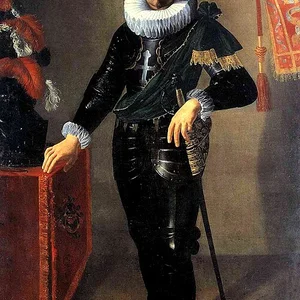

A close friend of Jesus of Nazareth, Lazarus of Bethany was raised from the dead by Christ according to the Gospel of John (chapter 11). His resurrection is one of the foundational miracles of the New Testament and a central symbol of Christian faith in eternal life.
Saint Lazarus
Saint Lazarus
9 min read
Frequently asked questions
Key Facts
- Lived in Bethany, a village near Jerusalem, in the 1st century AD.
- Dead for four days, he was raised by Jesus according to John 11 — an episode that hastened the authorities' decision to condemn Jesus
- Brother of Mary and Martha, both important figures in the Gospel narrative
- Eastern tradition identifies him as a bishop of Cyprus; Provençal tradition credits him with bringing Christianity to Marseille
- His feast day is celebrated on December 17 in the Roman Catholic Church
Works & Achievements
The miracle of the resurrection of Lazarus is the seventh and last “sign” performed by Jesus in the Gospel of John. It represents the theological culmination of this gospel and the direct prelude to the Passion: it is this act that triggered the death sentence against Jesus.
After his own resurrection, Lazarus became a living witness to Jesus's power over death. Many Jews came to Bethany solely to see him, and his very existence prompted conversions — to the point that the chief priests considered having him put to death a second time.
According to the tradition of the Cypriot Church, recognized by the Church Fathers, Lazarus governed the Christian community of Kition (Larnaca) as its first bishop for approximately thirty years, contributing to the evangelization of the island of Cyprus.
Built by the Byzantine emperor Leo VI following the discovery of the tomb of Lazarus, this Orthodox cathedral preserves his relics and is a major pilgrimage site. It illustrates the enduring importance of Lazarus in the Eastern Christian tradition.
The scene of the resurrection of Lazarus is one of the earliest Christian images: it appears as far back as the 2nd century in the Roman catacombs. It has inspired thousands of works of art (Giotto, Rembrandt, Van Gogh) and stands as a founding visual archetype of Western art.
Anecdotes
According to the Gospel of John (chapter 11), Lazarus was Jesus's closest friend outside of his apostles. When Jesus learned of his death, he wept openly before the crowd — one of the rare moments in the New Testament where Jesus displays such visible emotion. This passage contains the shortest verse in the Bible: “Jesus wept.” (John 11:35).
Lazarus had been dead for four days and his body had already begun to decompose when Jesus ordered the stone removed from his tomb. His sister Martha warned him: “Lord, by this time he stinketh” (John 11:39). Jesus then called out in a loud voice: “Lazarus, come forth!” — and Lazarus emerged from the tomb, still wrapped in his burial cloths.
The resurrection of Lazarus had an immediate political effect: it triggered the decision of the chief priests and Pharisees to have Jesus arrested. The Great Sanhedrin convened and concluded that Jesus had to be eliminated before the entire population rallied to him. Some Jewish leaders even considered putting Lazarus to death a second time in order to silence the living testimony of the miracle.
The tradition of the Cypriot Church holds that Lazarus, after the death of Jesus, was forced to flee Palestine. He is said to have sailed to Cyprus and become the first bishop of Kition (present-day Larnaca). According to legend, he lived another thirty years after his resurrection, never once smiling — haunted, it is said, by what he had witnessed in the afterlife.
A popular medieval tradition, particularly developed in Provence, claims that Lazarus, Mary Magdalene, and their sister Martha were set adrift on a rudderless boat by the Roman authorities and miraculously drifted to the shores of Gaul. Lazarus thus became the first bishop of Marseille. This legend, historically unattested, served to legitimize the city’s religious prestige from the Middle Ages onward.
Primary Sources
“Jesus said: Take away the stone. Martha, the sister of him that was dead, said to him: Lord, by this time he stinketh, for he has been dead four days. [...] He cried out with a loud voice: Lazarus, come forth! And he that was dead came forth, bound hand and foot with graveclothes.”
“Six days before the Passover, Jesus came to Bethany, where Lazarus was, whom Jesus had raised from the dead. There they made him a supper; Martha served, and Lazarus was one of those reclining at table with him.”
“Lazarus, after being raised by the Lord, lived in Cyprus, where he was consecrated bishop by the apostles and governed the Church of Citium.”
“After the Passion of the Lord, Lazarus was set adrift at sea together with his sisters Martha and Mary Magdalene, without pilot or oar, by unbelievers who wished them to perish. He landed at Marseille and became its bishop.”
Key Places
Village located about 3 km east of Jerusalem, on the eastern slope of the Mount of Olives. This is where Lazarus, Martha, and Mary lived, and where the miracle of the resurrection took place. The site is still open to visitors today.
A cavity cut into limestone rock, identified since antiquity as the site of Lazarus's resurrection. Christian pilgrims have been visiting it since the 4th century. A mosque was built above it in the 16th century, but the tomb remains accessible.
The religious capital of Judea, where Jesus traveled shortly after the resurrection of Lazarus, triggering his triumphal entry (Palm Sunday). It was in this city that the chief priests made the fateful decision to have Jesus arrested.
According to the tradition of the Orthodox Church of Cyprus, Lazarus took refuge here after the death of Jesus and was consecrated bishop of the city. The Cathedral of Saint Lazarus, built in the 9th century, houses his tomb and is one of the most important sites of Orthodox Christianity.
According to a medieval Provençal legend, Lazarus is said to have landed in Marseille after a miraculous crossing of the Mediterranean and to have become the city's first bishop. This tradition, unconfirmed by historical evidence, is the origin of the cult of Saint Lazarus in Provence.
Typical Objects

Lazarus came out of the tomb still wrapped in these linen strips soaked in spices, used to wrap bodies according to Jewish tradition in the 1st century. Jesus commanded those nearby: “Loose him, and let him go.”

A large round stone sealed the rock-hewn tomb where Lazarus had been buried, following Jewish funerary custom of the time. Jesus commanded that it be moved before calling Lazarus, despite Martha's objection that the smell of decomposition would be overpowering.

During the meal at Bethany held in honor of the risen Lazarus, his sister Mary poured pure nard perfume of great value (about 300 denarii, equivalent to a year's wages) over Jesus's feet. This gesture of deep symbolic significance took place six days before the Passion of Christ.

According to Cypriot tradition, Lazarus became after Pentecost the first bishop of Kition (Larnaca). The crosier is the pastoral staff symbolizing a bishop's office, charged with guiding his flock of the faithful.

A large linen sheet in which Lazarus's body had been wrapped for burial, in accordance with Jewish practice requiring swift interment, ideally before sunset on the day of death.

An indispensable everyday object in a 1st-century Palestinian home, used for lighting inside rock-hewn tombs and in dwellings without windows. Light is a powerful symbol in the Gospel of John, which continually sets light against darkness.
School Curriculum
Vocabulary & Tags
Key Vocabulary
Tags
Daily Life
Morning
Lazarus, a pious Jew from Bethany, began his day with the Shema Israel prayer at sunrise, recited facing Jerusalem, visible from the heights of the Mount of Olives. He put on his linen tunic and leather sandals before joining in the domestic or communal tasks of the village.
Afternoon
Life in Bethany revolved around farming (vineyards, olive groves, fig trees) and small-scale trade with nearby Jerusalem. Lazarus was probably a man of comfortable means — his home was large enough to host Jesus and his disciples, and his sister Mary owned perfume of nard worth a small fortune. He took part in meetings at the local synagogue and in religious discussions.
Evening
In the evening, the family gathered for a simple meal eaten on the floor on mats. Shared meals with Jesus were occasions for intense discussion about the Scriptures and the Kingdom of God. Jewish law requiring Sabbath rest from Friday evening to Saturday evening gave a deep rhythm to the week.
Food
Lazarus's diet followed the rules of kashrut (Jewish dietary laws): barley or wheat bread, olives and olive oil, figs, dates, lentils, chickpeas, and dried fish. Meat was rare and reserved for religious festivals (the Passover lamb in particular). Water and wine diluted with water were the main drinks.
Clothing
Lazarus wore a tunic (kuttonet) of linen or wool reaching to the knees or ankles, belted with a leather strap. Over it, a cloak (tallit) served as clothing, a nighttime covering, and a prayer shawl all in one. Braided leather sandals protected his feet. At his death, his body was wrapped in linen strips soaked in spices, following Jewish custom.
Housing
The family home in Bethany was probably a one- or two-story limestone dwelling, typical of prosperous Judean villages. It had an inner courtyard, a cistern to collect rainwater, and separate rooms for men and women. Nearby stood a family tomb cut into the rock — Jews generally buried their dead close to the house in hypogea carved into the hillside.
Historical Timeline
Period Vocabulary
Liens externes & ressources
Références
Œuvres
La Résurrection de Lazare (Jean 11)
vers 30 apr. J.-C.
Témoignage vivant de la résurrection (Jean 12)
vers 30 apr. J.-C.
Épiscopat de Kition (Chypre)
vers 33-63 apr. J.-C.
Cathédrale Saint-Lazare de Larnaca
890 apr. J.-C.
Iconographie de la résurrection de Lazare
IIe siècle apr. J.-C. — présent