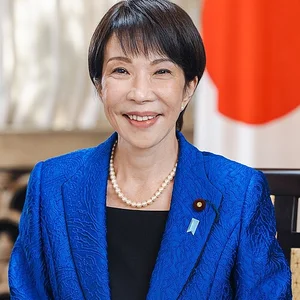

Japanese politician born in 1961, member of the Liberal Democratic Party. She has held several ministerial positions in Japan, including Minister of Internal Affairs and Communications. Known for her conservative views and interest in Japanese pop culture.
Sanae Takaichi(1961 — ?)
Sanae Takaichi
Japon
7 min read
Frequently asked questions
Key Facts
- Born on March 14, 1961, in Nara, Japan
- First elected to the House of Representatives in 1993
- Minister of Internal Affairs and Communications on several occasions (2014–2017, 2021)
- Candidate for the presidency of the Liberal Democratic Party in 2021, finishing in second place
- Appointed Minister of Finance and Minister of State for Economic Affairs in 2024
Works & Achievements
As Minister of Internal Affairs, Takaichi undertook a reform of the regulatory framework governing Japanese broadcast media, sparking debate over the editorial independence of public broadcaster NHK.
During her time in the Suga government, Takaichi spearheaded reforms aimed at digitizing Japanese public services and reducing reliance on the administrative stamp (hanko), a symbol of the state's digital lag.
Takaichi finished second in the Liberal Democratic Party leadership election, behind Fumio Kishida. This historic result cemented her status as a leading figure of Japan's conservative right.
Takaichi published her views on the need for Japan to revise Article 9 of its pacifist Constitution in order to allow the Japanese military to exercise the right to collective self-defense.
Takaichi advanced to the runoff of the LDP leadership election, further consolidating her position as the leading representative of the party's conservative and nationalist wing.
Anecdotes
Before entering politics, Sanae Takaichi worked as a television presenter after studying at Nara University. This media experience gave her confidence in front of cameras and the ability to communicate clearly — valuable assets in her later political career.
Sanae Takaichi is a passionate fan of Japanese pop culture, particularly anime and manga. She has no hesitation appearing at public events dressed as video game or anime characters, which has earned her particular popularity among younger generations, who are unaccustomed to seeing politicians openly embrace such hobbies.
An amateur musician, Takaichi plays bass guitar in informal bands made up of political figures. This passion for music, in an environment as serious as Japanese politics, is often cited as a sign of her unconventional personality within the Liberal Democratic Party.
In 2021, Sanae Takaichi ran in the Liberal Democratic Party leadership race, which effectively determines Japan's Prime Minister. She finished second, winning the support of a significant faction of the party despite her strongly conservative positions on defense and constitutional revision.
Takaichi is one of the few women to have reached ministerial positions in Japan, a country regularly criticized for its low representation of women in political life. She was appointed Minister of Internal Affairs and Communications on several occasions, notably in 2014–2015 and again in 2020–2021, becoming a key reference point in debates on the digital transformation of Japanese public administration.
Primary Sources
I wish to revise the Constitution to allow Japan to fully assume its responsibilities in defense and collective security, in order to protect the life and liberty of every Japanese citizen.
The editorial independence of broadcast media must be preserved, but the regulatory framework must evolve to account for the new realities of the digital age and ensure quality information for all citizens.
The digital transformation of Japanese public administration is a national priority. Simplifying procedures, reducing red tape, and modernizing public services will save every Japanese citizen time and rebuild their trust in institutions.
Japan must acquire the capabilities necessary to ensure its own defense without relying exclusively on the American alliance, in keeping with the pacifist values enshrined in our Constitution.
Key Places
Sanae Takaichi's hometown and a former imperial capital of Japan (7th–8th centuries), now famous for its free-roaming deer and temples. It has been her electoral constituency since 1993.
Japan's bicameral parliament, located in the Nagatacho district of Tokyo. It has been the center of Takaichi's political activity since her election to the House of Representatives.
The LDP's main office, located in Nagatacho near the National Diet. The site of all internal negotiations and party leadership elections, in which Takaichi has competed on several occasions.
The ministry Takaichi has headed multiple times, overseeing telecommunications, broadcasting, and digital transformation policies within the Japanese government.
The higher education institution where Takaichi studied before becoming a television presenter and later entering politics.
Typical Objects

Sanae Takaichi plays electric bass guitar as a hobby, including in informal bands with other politicians. The instrument has become a symbol of her unconventional personality in the Japanese political world.

Takaichi does not hesitate to dress up as anime or video game characters at cultural events, which has earned her widespread popularity on Japanese social media.

The hanko — a personal stamp carved from wood or stone — is an indispensable tool for any Japanese administrative official. One of Takaichi's major projects at the ministry was precisely to reduce administrative dependence on this stamp in favor of electronic signatures.

As minister in charge of digital transformation, Takaichi is associated with modern communication tools and championed reforms aimed at digitizing Japanese public services.

The distinctive badge worn by members of the Japanese parliament (the Diet) has accompanied Takaichi since her election in 1993, symbolizing more than thirty years of political commitment.

In contrast to the typically understated dress of Japanese female politicians, Takaichi often wears colorful outfits — red in particular — which contributes to her recognizable image in the media.
School Curriculum
Vocabulary & Tags
Key Vocabulary
Tags
Daily Life
Morning
Sanae Takaichi starts her day very early, like most Japanese politicians, by reading the major national newspapers (Yomiuri Shimbun, Asahi Shimbun) and reviewing briefings from her staff. She has a traditional Japanese breakfast — rice, miso soup, pickled vegetables — before heading to her parliamentary offices.
Afternoon
Her afternoons are devoted to plenary sessions or committee meetings at the National Diet, meetings with interest groups and ministry officials, or trips to her constituency in Nara to meet residents and local elected officials.
Evening
Japanese political evenings are often filled with working dinners, diplomatic receptions, or faction meetings within the LDP. Takaichi also finds time for personal hobbies: playing bass guitar with musician friends, or immersing herself in video games and anime.
Food
Like most Japanese women of her generation, Takaichi follows a predominantly Japanese diet: fish, tofu, seasonal vegetables, rice, and miso soup. When traveling to Nara, she enjoys local specialties such as kakinoha-zushi, sushi wrapped in persimmon leaves.
Clothing
In official settings, Takaichi wears sharp-cut suits in bold colors — red, purple, or pink — which stand out against the usual grey sobriety of Japan's political class. For cultural events or informal outings, she readily dons outfits inspired by anime characters or video games.
Housing
Like most Japanese parliamentarians, Takaichi has an apartment in Tokyo, close to the National Diet, and a residence in her Nara constituency. Contemporary urban Japanese housing is characterized by well-organized, functional spaces with traditional decorative elements.
Historical Timeline
Period Vocabulary
Visual Style
Un style visuel qui marie la rigueur institutionnelle du Japon politique — bois sombre, marbre, tenues sobres — aux couleurs vives et à l'énergie de la culture pop japonaise dont Takaichi est une ambassadrice assumée.
Sound Ambience
Un mélange de solennité parlementaire japonaise et de modernité pop, entre les délibérations feutrées de la Diète nationale, les cloches des temples de Nara et les échos de la culture contemporaine japonaise.