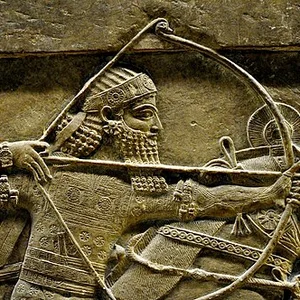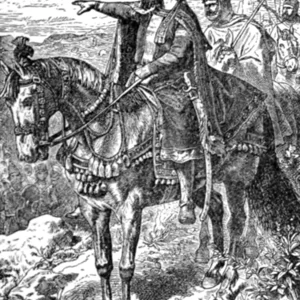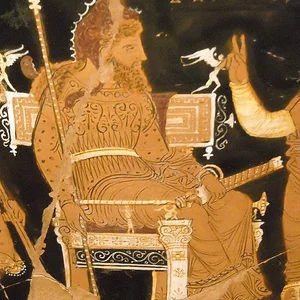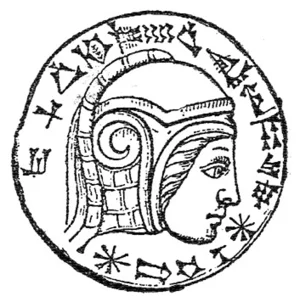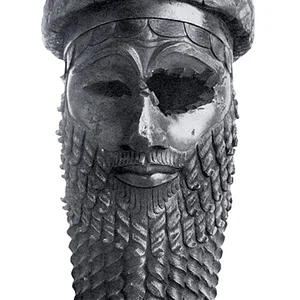

Sargon of Akkad (c. 2334–2279 BCE) was the founder of the first empire in history, the Akkadian Empire. Rising from humble origins according to legend, he unified Mesopotamia under his rule and governed a territory stretching from the Persian Gulf to the Mediterranean.
Sargon of Akkad(2350 av. J.-C. — 2300 av. J.-C.)
Sargon of Akkad
9 min read
Frequently asked questions
Key Facts
- Around 2334 BCE: Sargon defeated Lugalzagesi of Sumer and took control of Mesopotamia
- He founded the city of Akkad and established the first centralized empire in history
- He reigned for approximately 55 years according to the Sumerian King List
- His empire stretched from the Mediterranean to the Persian Gulf, encompassing much of the ancient Near East
- His birth legend — an abandoned child raised by a water-drawer — foreshadows later mythological narratives
Works & Achievements
By unifying Mesopotamia under a single authority for the first time, Sargon created the first empire in human history. This political model — a vast territory administered from a single capital by an all-powerful monarch — would influence every civilization that followed.
Sargon defeated Lugalzagesi in open battle and led him in chains before the god Enlil at Nippur. This victory allowed him to subjugate thirty-five Sumerian city-states and impose Akkadian as the language of administration, gradually replacing Sumerian.
According to his inscriptions, Sargon maintained 5,400 soldiers who 'ate bread before him every day' — one of the earliest known professional, permanent armies. This military innovation, funded by imperial tribute, allowed him to hold his conquests together across several decades.
Sargon unified systems of weights and measures across his empire and installed Akkadian governors (shakkanakku) in conquered cities. This centralized administration stands as one of the earliest models of imperial governance in history.
Sargon led expeditions as far as the 'Cedar Forest' (Lebanon) and the 'Silver Mountain' (the Taurus range in Anatolia), establishing trading posts along the way. These distant campaigns aimed to secure timber, copper, and tin — resources absent from the Mesopotamian plain.
Anecdotes
According to a legend that Sargon himself is said to have dictated, he was born to a priestess mother who placed him in a basket of reeds and set him adrift on the Euphrates River — much like a hidden child. A gardener named Aqqi found and raised him. This tale of an abandoned child saved by the waters is one of the oldest known — it predates the biblical story of Moses by several centuries.
Before conquering Mesopotamia, Sargon was a simple cupbearer at the court of Ur-Zababa, king of Kish. His meteoric rise — from servant to master of an empire — made him a legendary figure even in ancient times. Later scribes held him up as the symbol of a man who rises through merit rather than birthright.
Sargon's daughter, Enheduanna, was appointed High Priestess of the moon god at Ur. She is considered the first known author in history: she is credited with hymns to the goddess Inanna and liturgical poems written in cuneiform and signed with her own name. Thanks to her father, a woman signed a literary work for the very first time more than 4,000 years ago.
According to his own royal inscriptions, Sargon defeated fifty-six kings and 'washed his weapons in the sea' — meaning he reached the Persian Gulf to the east and likely the Mediterranean to the west. He boasted of having crossed the 'Upper Sea' and planted his victory steles at the four corners of the known world, reflecting an imperial vision unlike anything seen before in his era.
His Akkadian name, Sharru-kin, literally means 'the king is legitimate.' This was likely a regnal name he chose for himself to assert his right to rule — since he was not of royal blood. This need for legitimacy runs through all of his propaganda: he claimed to be the chosen one of the goddess Ishtar and the god Enlil, presenting his seizure of power as the will of the gods.
Primary Sources
"My mother was a priestess, I did not know my father… She conceived me, bore me in secret, placed me in a basket of reeds, sealed its opening with bitumen, and set me on the river, which did not swallow me."
"Sargon, king of Akkad, overseer of Ishtar, king of the four corners of the world, high priest of Anu, king of kings, defeated Uruk and tore down its walls."
"After Uruk was smitten with weapons, its kingship was carried off to Akkad. In Akkad, Sargon, whose father was a gardener… exercised kingship for 56 years."
"I am Enheduanna, the high priestess. I have carried the ritual basket, I have sung the song of lamentation… Inanna, light of heaven, look upon me with favor."
"Sargon, king of Akkad, arose, had no rival, crossed the sea to the east and to the west; in his eleventh year he subjugated the western lands as far as the sea."
Key Places
The city founded by Sargon as the capital of his empire, whose exact location remains unknown despite a century of archaeological excavation. It was most likely situated near present-day Baghdad, in Iraq, in the region where the Tigris and Euphrates rivers converge.
It was at Kish that Sargon served as cupbearer at the court of King Ur-Zababa before seizing power. Kish was one of the most prestigious city-states in Mesopotamia, and the title 'King of Kish' was an honorary designation synonymous with supreme rulership.
Nippur was the religious heart of Mesopotamia and the seat of Enlil, chief of the Sumerian gods. Sargon had his spiritual authority recognized there and commissioned commemorative inscriptions of his victories to be deposited in the city. Several of his royal tablets were later discovered at this site.
Uruk, one of the greatest Sumerian city-states, was ruled by Lugalzagesi when Sargon attacked and 'tore down its walls,' according to his inscriptions. His victory over Uruk marked the end of Sumerian dominance and the dawn of the Akkadian era.
Susa, capital of Elam (in present-day western Iran), was conquered by Sargon, who thereby extended his empire well beyond Mesopotamia. Akkadian victory steles discovered at Susa — including that of Naram-Sin — stand as evidence of this imperial presence in the east.
Typical Objects

Sargon erected carved steles after each conquest to commemorate his victories. These official monuments, decorated with battle scenes and cuneiform inscriptions, served to broadcast his glory and legitimize his power in the eyes of gods and men alike.

High officials and the Akkadian king used cylinder seals engraved in semi-precious stones to authenticate documents and contracts. These small rollers, pressed into soft clay, were the equivalent of an official signature and testify to the administrative sophistication of the empire.

The administration of the Akkadian Empire relied on thousands of clay tablets inscribed in cuneiform, used to record food rations, troop lists, royal orders, and diplomatic correspondence. It is thanks to these archives that we know Sargon's name and deeds.

Sargon's army was among the first to make large-scale, standardized use of bronze weapons. These swords and spears gave his soldiers a decisive advantage over less well-equipped opponents, contributing to his successive military victories.

Daily religious rituals at the Akkadian palace included libations — drink offerings to the gods — poured from precious cups. As high priest of Anu and favorite of Ishtar according to his royal titles, Sargon personally took part in these ceremonies to maintain divine favor.

According to the legend of his birth, Sargon was abandoned in a reed basket coated with bitumen and set adrift on the Euphrates, in the manner of an exposed child. This symbolic object, featured in his autobiographical text, casts him as a figure of miraculous destiny, chosen by the gods from birth.
School Curriculum
Vocabulary & Tags
Key Vocabulary
Tags
Daily Life
Morning
King Sargon rises at the first light of day and takes part in sacred ablution rituals assisted by priest-washers. He then presides over the morning offering ceremony to the palace gods — chiefly Ishtar and Enlil — placing bread, beer, and scented oils before their statues. Royal scribes read him reports from provincial governors while he takes his first meal.
Afternoon
The afternoon is devoted to royal audiences: foreign ambassadors, petitioners seeking the king's justice, and generals reporting on their campaigns. Sargon also oversees major administrative decisions — allocating rations to soldiers, organizing royal construction projects, and managing the imperial granaries. Reports from spies and informants on tributary cities are regularly brought to his attention.
Evening
The evening brings the court together for a royal banquet at which 5,400 palace guards eat 'before the king,' according to his own inscriptions. Musicians play the lyre and reed flute, while poets recite epics in Akkadian. Sargon holds council with his sons and generals, planning forthcoming military campaigns before retiring to his apartments under the protection of the goddess Ishtar.
Food
The Akkadian royal diet is built around barley and emmer wheat bread, beer (the everyday drink of all Mesopotamians), legumes (lentils, chickpeas), and dates and figs from the palm. Mutton, beef, and pork are reserved for royal feasts and divine offerings. Fish from the Tigris and Euphrates rounds out the diet, along with sesame oil and onions.
Clothing
Sargon wears the kaunakes, a long-fringed woolen garment characteristic of Mesopotamian elites, belted at the waist with an ornate sash. In royal and ritual settings, he wore a cylindrical tiara of precious metal, a symbol of his divine sovereignty. His body was adorned with necklaces of lapis lazuli, carnelian, and gold, and his wrists with twisted bracelets that proclaimed his imperial wealth.
Housing
The royal palace of Akkad — whose ruins have yet to be located — was likely a vast fired-brick complex featuring inner courtyards, columned audience halls, royal apartments, and private temples. Built along lines similar to known Sumerian palaces (such as those at Kish or Eridu), it would have included storehouses for tribute, royal workshops, and a scribal school training the empire's administrators.
Historical Timeline
Period Vocabulary
Visual Style
Esthétique de l'art akkadien : sculptures réalistes en diorite et cuivre, stèles gravées en bas-relief, palette de terres chaudes et bleu lapis-lazuli, lumière désertique dramatique soulignant l'autorité impériale.
Sound Ambience
Ambiance sonore d'Akkad vers 2300 av. J.-C. : chants liturgiques akkadiens, bruit des scribes gravant l'argile, forge des armes en bronze et rumeur d'une grande cité fluviale mésopotamienne.
Liens externes & ressources
Références
Œuvres
Fondation de l'Empire d'Akkad
vers 2334 av. J.-C.
Défaite de Lugalzagési et conquête de Sumer
vers 2334-2330 av. J.-C.
Création de la première armée permanente
vers 2330 av. J.-C.
Réforme administrative et standardisation des mesures
vers 2320 av. J.-C.
Campagnes vers la Méditerranée et l'Anatolie
vers 2320-2300 av. J.-C.