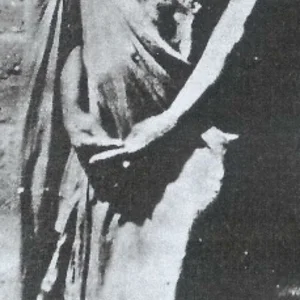

Queen and spiritual leader of the Azna (animist Hausa people of Niger), Sarraounia successfully resisted the French military mission of Voulet-Chanoine in April 1899. A symbol of anti-colonial resistance, she was immortalized by Abdoulaye Mamani's novel (1980) and Med Hondo's film (1986).
Sarraounia
Sarraounia
8 min read
Frequently asked questions
Key Facts
- Toward the end of the 19th century, Sarraounia was recognized as queen and high priestess of the Azna people in the Lougou region (present-day Niger)
- On April 16, 1899, she confronted and repelled the troops of the Voulet-Chanoine mission at Lougou, inflicting significant losses on the French colonial army
- Her resistance drew as much on her warrior abilities as on her spiritual authority: according to oral tradition, she possessed magical powers that granted her supernatural protection
- Her story, long passed down orally within Azna communities, was committed to writing by Nigerien author Abdoulaye Mamani in the novel 'Sarraounia' (1980)
- The Voulet-Chanoine mission, notorious for its atrocities, was ultimately stopped not by French military forces but by an internal mutiny in July 1899
Works & Achievements
Sarraounia's military and spiritual stand against the Voulet-Chanoine column. The first documented case of an African female leader achieving a victorious resistance against a modern French military column, celebrated throughout West Africa.
As spiritual leader, Sarraounia presided over and upheld the practices of Bori, a Hausa animist religion combining spirit possession, healing, and social cohesion. Her role as guardian of this tradition placed her at the heart of Azna cultural identity.
The first novel to give the resistant queen a literary voice, drawing on Nigerien oral traditions. This work is now studied in several African and French-speaking countries as a founding text of decolonization literature.
A film adaptation of Mamani's novel, directed by Mauritanian filmmaker Med Hondo. Winner of the FESPACO 1987 Grand Prix Étalon de Yennenga, the film brought Sarraounia to international attention as a symbol of anti-colonial resistance.
Anecdotes
In April 1899, the French military columns led by Voulet and Chanoine — notorious for their brutality — attacked the fortified village of Lougou, stronghold of Sarraounia. Against all odds, her Azna warriors stood their ground against European soldiers armed with modern rifles. The queen had been preparing the defense for weeks, drawing on her knowledge of the terrain and her powers as a healer to galvanize her fighters.
French soldiers reported with dread that Sarraounia seemed impervious to bullets. In reality, she had coated her warriors with preparations made from plants and sacred ashes, instilling in them a belief in their own invulnerability. This spiritual dimension of the resistance was a political weapon as powerful as any arms — the faith of her troops multiplied their courage tenfold in battle.
After the clash at Lougou, Sarraounia refused to surrender despite the partial destruction of her village. She withdrew into the bush with her loyal followers, waging a guerrilla campaign that haunted the French columns. Her retreat was interpreted not as a defeat but as a moral victory: she had not submitted, and the French could not parade her as a trophy of conquest.
Captain Voulet, whose mission descended into murderous madness to the point that he was shot by his own officers in July 1899, had never managed to capture Sarraounia. His failure to subdue the Azna queen was seen throughout the region as a sign that the spiritual forces of resistance were stronger than Western weaponry.
Long erased from official memory by colonial and then post-colonial administrations who saw her as a symbol of paganism, Sarraounia was rediscovered thanks to Nigerien writer Abdoulaye Mamani, who gathered the oral traditions of her people. His novel, published in 1980, gave this resistance fighter a literary and political dimension that made her known far beyond Niger.
Primary Sources
The resistance songs passed down by the griots of the Lougou region celebrate Sarraounia as the one who 'made the white sun retreat.' These accounts, collected by ethnologists in the 1960s–1970s, describe the battle of April 1899 and the queen's spiritual invincibility.
French military reports mention unexpected resistance at Lougou in April 1899, led by a 'fetishist queen' whose men fought with remarkable energy. The officers note the impossibility of capturing the chief after the battle.
Several testimonies from African soldiers serving under French command speak of the terror inspired by Sarraounia and her spiritual powers. They report that her warriors shouted her name as a protective invocation during battle.
Songs in Hausa and Zarma commemorate Sarraounia's refusal to surrender. One of them says: 'She did not kneel before the stranger, she kept the head of the ancestors.' These songs are still performed during ritual ceremonies in Lougou.
Key Places
Fortified village in Niger, seat of the Azna kingdom and residence of Sarraounia. It was here that the battle of April 1899 took place against the Voulet-Chanoine column. Lougou remains an important site of memory for the Azna people.
Geographic area of western Niger inhabited by the Azna, a Hausa people who practiced traditional animist religion (bori). Sarraounia held spiritual and political authority over several villages throughout this region.
Vast semi-arid territory crossed by the Voulet-Chanoine column. Sarraounia knew this terrain intimately and used it strategically to fall back and wage mobile resistance following the battle of Lougou.
Final destination of the French military mission that attacked Lougou. Sarraounia's determination to block the column's advance toward Lake Chad was part of a broader resistance to colonial penetration across the entire region.
Typical Objects

Sarraounia prepared ointments from medicinal plants and sacred substances in large calabashes. These preparations were applied to warriors to render them, it was believed, invulnerable to bullets.

The traditional weaponry of the Azna warriors included bows and arrows whose tips were treated with substances derived from toxic plants. This technique, mastered by Sarraounia, helped offset their numerical disadvantage against French rifles.

As the spiritual leader of the Azna, Sarraounia wore a ceremonial headdress adorned with feathers and beads symbolizing her authority over invisible forces. This headdress distinguished her role as queen-priestess from that of an ordinary warrior.

The amulets crafted by Sarraounia, containing herbs, bones, and inscriptions in ajami script (Arabic adapted to Hausa), were worn by her soldiers in battle. They embodied the fusion of Azna animist spirituality with the Islamic influences of the region.

The ritual drums served both to communicate among the defenders of Lougou and to invoke protective spirits during battle. The particular rhythm played during the 1899 resistance was preserved in the musical memory of the Azna people.

The compacted clay walls (banco) and palisades of the village of Lougou formed the defensive system that Sarraounia had reinforced before the arrival of the French. These structures, suited to traditional warfare, effectively slowed the advance of colonial troops.
School Curriculum
Vocabulary & Tags
Key Vocabulary
Tags
Daily Life
Morning
Sarraounia began her day before dawn with invocation rituals to the spirits (iskoki) of the Bori, burning aromatic resins and reciting formulas in Hausa. She would then consult with elders and war chiefs about the state of the territory, receiving messengers from neighboring villages.
Afternoon
The afternoon was devoted to administering her kingdom: settling disputes, organizing the harvest of millet and sorghum, and overseeing the village's defensive preparations. Sarraounia also supervised the training of her warriors and the preparation of medicinal and ritual remedies.
Evening
Evenings were shaped by communal ceremonies: Bori possession music, stories passed down by griots, and ritual dances around fires. Sarraounia presided over these gatherings as spiritual leader, reinforcing the cohesion of her community through the sharing of collective memory and shared beliefs.
Food
The staple diet of the Azna people centered on millet and sorghum, prepared as porridge (kunu) or flatbreads. Peanut sauce, dried okra, and smoked fish from the Niger River rounded out the meals. During ceremonies, goat or sheep meat was sacrificed and ritually shared.
Clothing
Sarraounia wore large boubous of woven cotton dyed with indigo, a color associated with spiritual power in Hausa tradition. Her ceremonial adornments included necklaces of amber and coral, bronze bracelets, and an elaborate feathered headdress. For everyday wear, she dressed in simpler white or ecru cotton garments.
Housing
Sarraounia's residence in Lougou was a large compound built in banco (a mix of clay and straw), made up of several round thatched-roof huts surrounding a central courtyard. The main hut, reserved for rituals, was decorated with geometric paintings in ochre and white, and held sacred objects kept from those who had not been initiated.
Historical Timeline
Period Vocabulary
Visual Style
Illustration épique de la résistance africaine : reine-prêtresse en parure cérémonielle dans la savane sahélienne, entre village fortifié et guerriers Azna, lumière chaude et palette ocre-indigo.
Sound Ambience
Ambiance sonore de la savane sahélienne nigérienne : tambours rituels, chants guerriers Azna et cérémonies Bori entremêlés aux sons naturels du Sahel au crépuscule.
Liens externes & ressources
Références
Œuvres
Résistance de Lougou (avril 1899)
1899
Organisation du culte Bori des Azna
fin XIXe siècle
Sarraounia (roman d'Abdoulaye Mamani)
1980