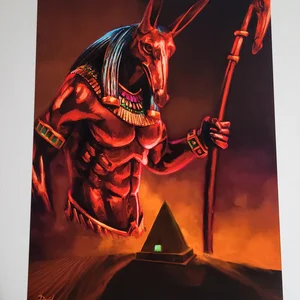

Egyptian god of chaos, storms, and the desert, Seth is one of the most complex deities in the Egyptian pantheon. Brother of Osiris, whom he murdered, he embodies primal violence but also the protective force necessary for cosmic order.
Seth(3873 av. J.-C. — 2957 av. J.-C.)
Seth
10 min read
Frequently asked questions
Key Facts
- Seth is attested from the Egyptian Predynastic period, around 3200 BC, making him one of the oldest known deities
- He murders his brother Osiris and dismembers his body, triggering the great Osirian myth of death and resurrection
- He battles Horus in a mythological conflict symbolizing the rivalry between Upper and Lower Egypt
- Seth protects the solar barque of Ra against the serpent Apophis each night, embodying an ambivalent cosmic force
- His cult was progressively marginalized from the 1st millennium BC onward, with Seth becoming a figure of absolute evil
Works & Achievements
Every night, Seth battles the serpent Apophis at the prow of Ra's barque, ensuring the sun rises each morning. This vital role makes him an indispensable god of cosmic order — despite, or perhaps because of, his violent and unpredictable nature.
The central mythological act of Egyptian religion: Seth murders his brother Osiris, setting in motion death, resurrection, and the birth of Horus. This crime underpins the entire Egyptian funerary theology and the cycle of life after death.
The eighty-year conflict between Seth and Horus, judged by the tribunal of the gods, is one of the most fully developed mythological narratives in Egypt. It symbolizes the struggle between chaos and order, and legitimizes pharaonic power as a synthesis of both forces.
Seth is invoked as a tutelary deity in the first great peace treaty in history, concluded between Egypt and the Hittites. His identification with Teshub, the Hittite storm god, reflects his influence beyond Egypt's borders.
A major funerary ritual in which priests burned and cut apart figurines of Apophis to aid Seth in his nightly battle. Documented in the Bremner-Rhind Papyrus, this ritual was recited daily in the great temples.
Anecdotes
Seth murdered his own brother Osiris out of jealousy and cunning. According to the Pyramid Texts, he crafted a magnificent chest made to Osiris's exact measurements, then hosted a banquet where he promised to give it as a gift to whoever fit inside it perfectly. Osiris lay down in it, and Seth sealed the lid, drowning him in the Nile. This founding act of the Osirian myth is one of the oldest narratives in Egyptian mythology, attested as far back as 2400 BCE.
According to the Chester Beatty Papyrus I, the conflict between Seth and Horus for the throne of Egypt lasted eighty years before the tribunal of the gods. Seth, powerful and cunning, challenged his nephew with many contests — including a boat race using stone vessels. He secretly built his own from painted wood, but Horus copied the trick. In the end, the gods ruled in Horus's favor, yet acknowledged that Seth's power was indispensable to the balance of the cosmos.
Despite his reputation as the god of chaos, Seth played a vital protective role in Egyptian cosmology. Each night, he stood at the prow of Ra's solar barque and fought the serpent Apophis with a harpoon, battling the creature that sought to devour the sun. Without Seth's brute strength, the sun could never have risen each morning — even gods of disorder were necessary to cosmic order.
Pharaoh Ramesses II (1279–1213 BCE) held a particular devotion to Seth. His father bore the name Seti I ('man of Seth'), and Ramesses himself invoked Seth as the divine guarantor of the peace treaty signed with the Hittites in 1259 BCE — one of the earliest international treaties in history, inscribed on clay and silver.
Following the expulsion of the Hyksos around 1550 BCE, Seth was gradually demonized. These Asian invaders had adopted him as their chief deity, equating him with Baal, their storm god. When the Theban pharaohs reclaimed power, Seth became increasingly associated with Egypt's enemies, until he was depicted in chains beneath the feet of pharaohs in the relief carvings of the great temples.
Primary Sources
Utterance 215: 'Seth, O Seth, beware, for you have struck Osiris, you have thrown him on his side.' These texts, carved into the pyramids of the Fifth and Sixth Dynasties, are the earliest attested written records of the Osirian myth and Seth's role as murderer.
Seth declares before the tribunal of the Great Ennead: 'Let the kingship be given to me, for as for Horus who stands there, I have performed the work of a virile man against him.' This Ramesside-era papyrus contains the most complete and narrative version of the conflict between the two gods.
Chapter 39: 'Back, Apophis, enemy of Ra! Seth pierces the serpent Apophis with his spear as it seeks to swallow the bark of millions of years.' Seth is here presented in his essential role as protector of the sun god.
Spell 335: 'I am Seth, the great god, lord of Ombos, he who protects the Two Lands, he whose power makes the gods tremble.' These funerary texts reveal the dual nature of Seth — both threatening and protective.
The text invokes Seth, equated with the Hittite god Teshub, as divine guarantor: 'Seth of the sky, Seth of Hatti... let them bear witness to these words.' This is the first international treaty to name Seth as the tutelary god of an alliance between two great powers.
Key Places
The main cult center of Seth in Upper Egypt, whose name means 'the city of gold'. Seth was venerated here as a tutelary god since prehistoric times, long before the unification of Egypt by the first pharaohs.
Capital of the Hyksos pharaohs in the eastern Nile Delta, where Seth was worshipped as the supreme deity in the form of Seth-Baal. Recent excavations have uncovered a colossal temple dedicated to him, along with the bones of sacrificed bulls.
The mythic domain of Seth, god of the desert and arid lands. The Egyptians attributed sandstorms and scorching winds to his anger or his passing, making the desert both a cursed wasteland and a sacred territory.
An oasis regarded as one of the gateways to the desert and to Seth's domain. Temples and inscriptions dedicated to Seth have been found here, bearing witness to his role as master of the desert expanses at the edge of the cultivated land.
One of the greatest religious complexes in Egypt, where Seth is depicted alongside Horus crowning the pharaoh with the double crown. Reliefs of Seti I and Ramesses II show him as a legitimate royal protector.
Typical Objects

A scepter topped with the head of the Seth-animal, emblem of divine power and dominating force. Seth is one of the principal gods depicted bearing the was scepter, a symbol of his mastery over the primordial forces of chaos.

The divine weapon with which Seth pierces the serpent Apophis each night aboard Ra's solar barque. This harpoon symbolizes the raw yet necessary force of Seth in the endless struggle against chaos and primordial darkness.

A fantastical creature that has never been definitively identified — it has the body of a quadruped, tall forked ears, and a long bifurcated tail. It is Seth's heraldic emblem, depicted on his altars and in the hieroglyph that forms his name.

The crown of Upper Egypt, of which Seth was the original protector before unification. On the reliefs of Ramesside temples, Seth and Horus together crown the pharaoh with the double crown, symbolizing the unification of the Two Lands.

A ritual instrument associated with sacrifice and sacred violence. Seth is frequently depicted holding a knife in scenes showing the slaying of Apophis, found in funerary papyri and on temple walls.

The chest in which Seth trapped and drowned Osiris according to the founding myth. Central to the original act of murder, it is invoked in funerary rituals as a symbol of death but also, paradoxically, of resurrection.
School Curriculum
Vocabulary & Tags
Key Vocabulary
Daily Life
Morning
According to mythological texts, Seth begins his divine day by returning to his post after the nightly battle against Apophis, once again victorious. Dawn marks his renewed triumph over the serpent of chaos. In the temples dedicated to him, most notably at Ombos, priests would recite hymns of triumph in his name from the very first light of day.
Afternoon
Seth reigns over the scorching desert beneath the midday sun, the supreme domain of the hot winds and sandstorms that the Egyptians attributed to him. In his sanctuaries, priests performed libations and offerings of red meat — Seth's symbolic color — to secure his favor and keep him in his protective rather than destructive role.
Evening
As the sun sets, Seth takes up his battle station at the prow of the bark of millions of years, harpoon in hand, facing Apophis as it rises from the depths. During funerary rituals, priests would recite in hushed tones formulas drawn from the Book of Overthrowing Apophis to aid Seth in his nightly task, which was essential to the survival of the universe.
Food
Seth received offerings of gazelle, donkey, and oryx meat — desert animals associated with his wild domain. The donkey was particularly sacred to Seth; some later texts depict him in the form of a red donkey. Offerings of bread, beer, and water were also placed in his frontier and desert sanctuaries.
Clothing
Seth is depicted wearing the royal kilt of pure white linen (shendyt), paired with a red belt — the color of the desert and blood. He wears the white crown of Upper Egypt (hedjet) or the double crown (pschent) in scenes where he crowns the pharaoh alongside Horus. A broad gold collar (usekh) adorns his chest, and his body is almost always painted bright red, the emblematic color of his desert nature.
Housing
Seth's mythical domain is the desert (desheret, 'the red land'), the exact opposite of the fertile black earth of the Nile (kemet). His celestial palace stands at the edges of the known world, where storms are born and desert winds die out. His principal earthly temple was at Ombos in Upper Egypt, though sanctuaries were also dedicated to him in the oases and along the desert frontiers of cultivated Egypt.
Historical Timeline
Period Vocabulary
Visual Style
Style pictural égyptien antique de la période ramesside, Seth représenté à tête d'animal fantastique sur fond de désert nocturne et de tempête, dans une palette de rouges intenses, d'ocres brûlants et de noirs profonds rehaussés d'or.
Sound Ambience
Un paysage sonore dominé par les vents violents du désert et les grondements orageux, ponctués de tambours rituels et de chants sacerdotaux sombres, évoquant la présence inquiétante mais puissante du seigneur du chaos.
Liens externes & ressources
Références
Œuvres
Combat nocturne contre Apophis sur la barque solaire
Mythe cosmique éternel, attesté dès 2400 av. J.-C.
Meurtre et démembrement d'Osiris
Mythe fondateur, attesté avant 2400 av. J.-C.
Les Joutes d'Horus et de Seth — conflit pour le trône d'Égypte
Mythe attribué à l'ère prédynastique, mis par écrit vers 1160 av. J.-C.
Garant du Traité de Qadesh
1259 av. J.-C.
Rituel du Livre pour Renverser Apophis
Attesté dès la XVIIIe dynastie, vers 1550 av. J.-C.