
Shango is the orisha of thunder and lightning in the Yoruba religion of West Africa. A warrior deity associated with divine justice, he is depicted wielding a double axe (oshe) and rules over storms. His cult spread to the Americas through the African diaspora.
Shango
Shangô
9 min read
Frequently asked questions
Key Facts
- Shango is one of the most powerful orishas in the Yoruba pantheon, associated with thunder, lightning, and fire
- His primary attribute is the oshe, a double axe symbolizing both his destructive power and his justice
- Shango's cult was carried to the Americas through the slave trade, giving rise to syncretic practices (candomblé in Brazil, santería in Cuba)
- In some traditions, Shango is identified with Saint Barbara in African-Catholic syncretism
- He is sometimes regarded as an ancient deified king of Oyo, the medieval Yoruba empire
Works & Achievements
A body of founding myths recounting the life, exploits, and deification of Shango. Passed down orally from generation to generation by priests (babalawo) and Yoruba griots, these narratives form the 'sacred biography' of the orisha and the theological foundation of his cult.
A Yoruba poetic genre dedicated to celebrating the attributes and exploits of Shango. Recited during ritual ceremonies, these poems function simultaneously as prayers, hymns, and mnemonic devices for transmitting Yoruba theology.
A body of songs, prayers, and rituals developed by the Yoruba diaspora in Cuba to perpetuate the worship of Shango under the name Changó. This syncretic corpus blends the Yoruba language (lucumí), Catholic chants, and African ritual practices, bearing witness to an extraordinary act of cultural resistance.
The codification of the ceremonies, chants (pontos), and ritual dances of Xangô (Shango) in Brazilian Candomblé. These practices, preserved in the terreiros of Bahia, have been recognized as part of Brazil's intangible cultural heritage and studied by researchers worldwide.
A play by future Nigerian Nobel laureate Wole Soyinka, weaving Yoruba mythological figures — including Shango — into a reflection on postcolonial African identity. This landmark work of African literature helped bring Yoruba mythology to international attention.
Anecdotes
Before becoming a deity, Shango was a historical king (Alaafin) of the Oyo Empire, in present-day Nigeria. According to Yoruba traditions, he ruled with such power and brutality that his subjects feared him as much as they admired him. Upon his death, he was deified and incorporated into the pantheon of orishas, becoming the lord of thunder and lightning.
Shango has three divine wives, each associated with a natural element: Oya, mistress of winds and storms; Oshun, goddess of rivers and love; and Oba, linked to stagnant waters. This mythological triangle illustrates the Yoruba vision of nature as a balance of divine forces in constant tension.
In Yoruba tradition, chipped stone axes from the Stone Age (found in the soil after storms) are called “thunderstones” and considered projectiles hurled by Shango during storms. These lithic objects, in reality prehistoric tools, are collected and preserved as sacred relics in temples dedicated to the orisha.
During the transatlantic slave trade (16th–19th centuries), millions of Yoruba were deported to the Americas. They brought their faith with them: Shango became Changó in Cuba (in Santería), Xangô in Brazil (in Candomblé), and kept his name in Trinidad. This clandestine cultural survival is one of the most remarkable in the history of the African diaspora.
The batá drums — three double-headed drums of Yoruba origin — are the sacred instrument par excellence of Shango. Their distinctive rhythm is said to “call” the orisha during ceremonies. These drums are still used today in Yoruba religious ceremonies in Nigeria as well as in Afro-Cuban Santería rites, inscribed on UNESCO’s Intangible Cultural Heritage list in 2008.
Primary Sources
Shango, the third king of Oyo, was a man of great power and cruel disposition, who could emit fire and lightning from his mouth. He was deified after his death and worshipped as the god of thunder.
Oba Koso! The king did not hang himself. He ascended to the heavens in thunder and lightning. Shango, the mighty, whose anger burns like fire, whose eyes flash with flames.
In the odu (chapters) dedicated to Shango, he is described as the one who punishes liars and wrongdoers with lightning. Only the honest man can hope for his protection during storms.
Each orisha has its own colors, animals, foods, and taboos. Shango's colors are red and white; his animal is the ram; his festivals are always accompanied by the thunder of bata drums.
The Shango myths collected in Cuba and Nigeria show a remarkable consistency despite three centuries of separation, testifying to the power of African oral memory within the diaspora.
Key Places
Ancient capital of the Oyo Empire and historical cradle of the Shango cult. It is here that Shango is said to have reigned as king before being deified. The city still houses the main Yoruba shrine dedicated to the orisha of thunder.
Sacred city of the Yoruba, considered the spiritual center of the Yoruba universe and the birthplace of all orishas according to Yoruba cosmogony. Ile-Ife is home to the oldest ritual objects associated with the Shango cult.
Capital of the state of Bahia and the first major port of arrival for Yoruba Africans (known as Nagô) in Brazil. Candomblé, the Afro-Brazilian religion in which Shango is venerated under the name Xangô, was born here — most notably at the Terreiro de Casa Branca, founded in the 19th century.
The main hub of Cuban Santería (Lucumí), where Shango is venerated under the name Changó and associated with the Catholic saint Barbara. Afro-Cuban initiatic societies (cabildos) have ensured the survival and transmission of the cult since the 18th century.
Center of the Shango religion of Trinidad, an Afro-Caribbean religious community that has preserved the name and rituals of the Yoruba orisha. The Spiritual Baptist faith of Trinidad blends Christianity with Yoruba traditions in a syncretic form unique to the Caribbean.
Typical Objects

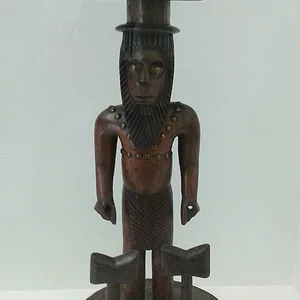
Shango's iconic attribute, the double-bladed axe (oshe) symbolizes his bilateral justice: he can strike in both directions, punishing the aggressor and the victim alike if the latter is also at fault. Statues and altars of Shango always depict him holding this instrument.

Knapped stone axes from the Stone Age, discovered after storms in West African soils, are venerated as 'thunderstones' sent by Shango. They are kept on altars as sacred relics and serve as objects of prayer.

A set of three double-headed drums (iya, itotele, okonkolo), the bata are Shango's quintessential ritual instruments. Their codified rhythms are meant to invoke the orisha during ceremonies and to establish communication between the human world and the realm of the divinities.

Shango's sacred colors are red (symbolizing fire and virile power) and white (symbolizing the purity of divine justice). His priests and priestesses wear red-and-white striped garments during ceremonies.

A carved wooden vessel used on Shango's altars to hold thunderstones and offerings. Its shape evokes the pestle and mortar, symbols of transformative energy and the raw force tamed by the deity.

Shango's sacred animal is the ram, whose horns evoke lightning and warrior strength. Ram sacrifices are the most prized offering at major festivals held in his honor, especially during the annual festival of Oyo.

According to Yoruba myths, Shango possessed a magical calabash from which he could hurl flames. This legendary weapon is depicted in ritual iconography and serves as a reminder of his power to destroy liars and traitors with heavenly fire.
School Curriculum
Vocabulary & Tags
Key Vocabulary
Daily Life
Morning
In Yoruba myths, Shango begins his divine day by traversing the sky from his celestial palace (Orun). Morning storms are interpreted as a sign of his awakening and vigilance. Priests (onisango) dedicated to his cult begin their day with ritual ablutions and offerings of kola and white honey on the altar.
Afternoon
The afternoon is the time of African tropical storms: this is when Shango is said to be most active. In mythology, he roams the villages on his celestial horse, hurling his thunderstones at liars and the unjust. His priests use this time for oracular consultations and divination rituals.
Evening
In the evening, according to Yoruba traditions, Shango returns to his celestial palace to join his three divine wives. Ceremonies in his honor often begin at sunset: the bata drums are beaten, songs and dances follow one another, and initiates enter a trance to welcome the orisha into their bodies.
Food
Shango's sacred foods are akara (fried black-eyed pea fritters), amala (cassava flour paste), and oka (corn). Red palm wine is his preferred ritual drink. These foods, placed on his altar, are consecrated to him during festivals and may only be consumed after being blessed by the priest.
Clothing
Shango is depicted wearing red and white, his sacred colors. He wears a royal loincloth with red and white stripes, a beaded necklace alternating the two colors (élégé), and a crown-shaped headdress (ade) adorned with cowrie shells. His waist is girded with a war belt, a reminder of his status as a deified warrior-king.
Housing
Shango's divine palace is located in Orun, the Yoruba sky, atop the storm clouds. On earth, his sanctuaries (ile orisha) are generally built away from dwellings, on elevated ground or near large iroko trees (considered his sacred trees). The interior is decorated in red, contains the altar with the thunderstones, and may only be entered by initiates.
Historical Timeline
Period Vocabulary
Liens externes & ressources
Références
Œuvres
Itan Shango (Récits mythologiques yoruba)
Tradition orale, depuis l'Antiquité
Oriki Shango (Poèmes de louange)
Tradition orale yoruba, collectée à partir du XIXe siècle
Corpus liturgique de la Santería cubaine (Changó)
XVIIIe-XIXe siècles, Cuba
Rituels de Xangô dans le Candomblé (Brésil)
XIXe siècle, Bahia (Brésil)
Danse de la forêt (Wole Soyinka)
1963