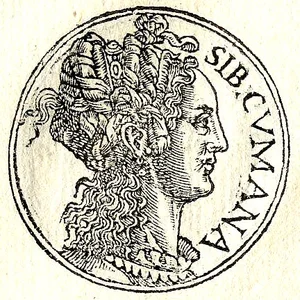

A legendary prophetess of Antiquity, she presided over Apollo's oracle at Cumae, in Campania. According to tradition, she lived for a thousand years and sold the Sibylline Books to King Tarquin. Virgil makes her the guide of Aeneas in the Underworld in the Aeneid.
Sibyl of Cumae
Sibyl of Cumae
9 min read
Frequently asked questions
Famous Quotes
« Volo mori. (I want to die.) — attributed by Petronius, Satyricon, 48»
Key Facts
- According to legend, Apollo granted her as many years of life as grains of sand she could hold in her hand — a thousand years.
- She reportedly offered nine books of prophecies (the Sibylline Books) to King Tarquin the Proud, ultimately selling only three after he refused her price.
- Virgil makes her the guide of Aeneas in his descent into the Underworld (Aeneid, Book VI, ~29–19 BCE).
- Her cave at Cumae (the Cave of the Sibyl) was archaeologically discovered in 1932, near Naples.
- The Sibylline Books were kept on the Capitoline Hill and consulted by the Roman Senate in times of crisis.
Works & Achievements
A collection of nine volumes of oracles in Greek hexameters sold to Tarquin. Kept on the Capitoline Hill, they served as Rome's official prophetic reference for more than five centuries.
Individual prophecies inscribed on leaves and sorted in order by the Sibyl herself — a fragile method that required great diligence from the petitioner to obtain a coherent answer.
In the Aeneid (Book VI), the Sibyl guides the Trojan hero from the cave at Cumae to the Elysian Fields, allowing him to meet Anchises and learn the destiny of Rome — a pivotal scene in Latin literature.
A Sibylline oracle announcing the return of the Golden Age and the birth of a providential child. The Church Fathers interpreted it as a prophecy of the coming of Christ, making the Sibyl a proto-Christian figure celebrated well into the Middle Ages.
A late compilation of twelve books of Greek oracles blending Jewish and Christian prophecies under the Sibyl's name, attesting to the enduring authority of her prophetic voice long after the end of classical antiquity.
Anecdotes
Apollo, enamored of the Sibyl, offered to grant her a wish. She scooped up a handful of sand and asked to live as many years as there were grains in her hand — a thousand in all. But she forgot to ask for eternal youth: she aged without end, shrinking until she was nothing more than a voice in a hanging jar, longing only to die.
The Sibyl appeared before Tarquinius Superbus, the last king of Rome, carrying nine books containing the fates of the Empire. When he refused to pay the exorbitant price, she burned three of them, then three more, and finally sold the remaining three for the same price she had originally asked for all nine. These Sibylline Books were kept on the Capitoline Hill and consulted during Rome's gravest crises.
In Book VI of Virgil's Aeneid, the Sibyl guides Aeneas into the Underworld so that he may meet the shade of his father Anchises. She shows him how to pluck the Golden Bough — the essential talisman needed to cross the gates of the realm of the dead while still alive — and accompanies him all the way to the Elysian Fields.
The cave of the Sibyl at Cumae is a trapezoidal tunnel 131 meters long, carved into the volcanic rock of Cape Misenum. Archaeologists rediscovered it in 1932. Its lateral galleries bathed in natural light give it an atmosphere that is both awe-inspiring and mysterious — exactly as Virgil describes it.
According to Ovid, the Sibyl would show anyone who cared to look a handful of dust, saying: 'See how many years I have left to live.' She had grown so tiny and withered that children would tease her by asking what she desired. Her answer, always the same, was: 'I want to die.'
Primary Sources
"There is a deep and yawning cave, vast, rocky, guarded by a dark lake and the shadowy forest. The Sibyl, great priestess of Apollo, dwells there."
"I showed him the dust gathered in my hand: 'As many grains as there are here, so many years of life were granted to me — but I had forgotten to ask for youth.'"
"It is said that an old foreign woman brought the king nine books of oracles. After he refused her price, she burned three and asked the same sum for the remaining six."
"Varro distinguishes ten Sibyls; the most celebrated is the Cumaean, whom the Romans honored above all the others on account of the Books."
"I myself with my own eyes saw the Sibyl of Cumae hanging in a jar; and when the boys asked her, 'Sibyl, what do you want?' she answered, 'I want to die.'"
Key Places
A 131-meter trapezoidal tunnel carved into the volcanic rock of Cape Misenum, with lateral galleries that allow light to filter in. This is where the Sibyl delivered her oracles and where Virgil places the entrance to the underworld.
A volcanic lake with sulfurous vapors, regarded in Antiquity as one of the entrances to the Underworld. Birds that flew over it fell dead, giving it its Greek name 'aornos' (without birds) — the Sibyl guides Aeneas to this very place.
The mythical kingdom of the dead ruled by Hades/Pluto, located beneath the earth. The Sibyl is its foremost guide: she knows the paths to the Elysian Fields, Tartarus, and the Palace of Proserpine.
The sacred hill of Rome where the Sibylline Books were kept in a vault beneath the Temple of Jupiter. Consulted during major crises by a specialized college of priests, they guided the religious policy of Rome for five centuries.
A sanctuary built atop the acropolis of Cumae, dedicated to the god Apollo, of whom the Sibyl was the high priestess. Pilgrims traveled from across the Mediterranean world to consult the oracle before making major decisions.
Typical Objects

The Sibyl wrote her prophecies on oak leaves, which she arranged in order at the entrance to her cave. If anyone opened the door before she returned, the wind would scatter the leaves and the oracle would become unreadable.

A plant talisman with golden sheen, hidden in the forest near Lake Avernus. The Sibyl demands that Aeneas find and pluck it as a safe-conduct for crossing the Underworld alive — only those destined by the gods can tear it free.

The three-legged seat upon which the prophetess sat during oracular sessions to receive the divine breath of Apollo. It symbolizes the prophetic trance and the direct bond between the mortal woman and her patron god.

Parchment scrolls containing oracles written in Greek hexameters, said to predict the destiny of Rome. The Sibyl presents them to Tarquin, gradually burns six of them during negotiations, and sells only the last three.

According to Petronius, the Sibyl had grown so old and so small that she could fit inside a hanging amphora — a striking image of immortality without youth, a symbol of the curse of a life stretched too long.

The sacred plant of Apollo, which the Sibyl wore as a crown during ceremonies. The laurel, associated with prophecy and victory, embodies the divine gift of foresight bestowed by the god upon his priestess.
School Curriculum
Vocabulary & Tags
Key Vocabulary
Tags
Daily Life
Morning
At dawn, the Sibyl recites prayers to Apollo at the entrance of her cave, facing the Campanian sea. She inscribes on fresh oak leaves the visions received during the night, then carefully arranges them in order inside the cavern, before the first petitioners arrive.
Afternoon
In the heat of the day, she receives pilgrims who have come from across the Mediterranean world. Seated on her tripod, she falls into a trance under the influence of Apollo's divine breath and delivers her oracles in Greek hexameters. She warns visitors to memorize the order of the leaves carefully before opening the door.
Evening
In the evening, the Sibyl withdraws into the depths of the cave to meditate beside an underground spring. She contemplates the accumulated years of her long existence — already several centuries — feeling her body shrink still further, bearing the weight of a gift that has become a curse.
Food
The prophetess eats sparingly, in keeping with the demands of her sacred role: olives, figs, spelt bread, honey, and wine diluted with water. She partly fasts on oracle days to make her mind more receptive to divine messages.
Clothing
She wears long white linen robes trimmed with purple bands, crowned with a laurel wreath sacred to Apollo. Over the centuries, her garments have grown increasingly oversized on her shrinking body, and she cinches them with belts of woven wool decorated with geometric patterns.
Housing
The Sibyl lives in the deep galleries of the antrum Sibyllae at Cumae, carved into the volcanic tuff. Her inner chambers — inaccessible to ordinary mortals — are lit by oil lamps, lined with scrolls and inscribed leaves, and kept at a constant temperature by the geothermal vapors rising from the Campanian ground.
Historical Timeline
Period Vocabulary
Visual Style
Esthétique oraculaire gréco-romaine dramatique : tunnel trapézoïdal en roche volcanique, clair-obscur aux lampes à huile, vieille prophétesse vêtue de blanc aux yeux illuminés, feuilles inscrites tourbillonnant dans l'ombre.
Sound Ambience
L'atmosphère sonore de l'antre sibyllin mêle l'écho caverneux du tunnel de Cumes, le sifflement des émanations volcaniques du lac Averne et le froissement des feuilles prophétiques dispersées par le vent.
Liens externes & ressources
Références
Œuvres
Les Livres Sibyllins (Libri Sibyllini)
VIe siècle av. J.-C. (tradition légendaire)
Oracles sur feuilles de chêne
Tradition permanente
Guidance d'Énée aux Enfers (récit virgilien)
Récit fondateur de l'épopée romaine
Prophétie du 'Magnus ab integro seclorum nascitur ordo'
Virgile, IVe Bucolique, 40 av. J.-C.
Oracula Sibyllina (Oracles Sibyllins)
IIe–VIe siècle apr. J.-C.