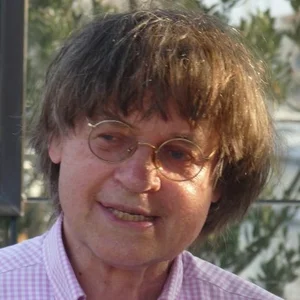

Maurice Sinet (1928-2016), known as Siné, was a French press cartoonist and caricaturist, a figure of anarchism and satirical drawing. His sharp-lined drawings left their mark on the post-war French press, from L'Express to Charlie Hebdo.
Siné(1928 — 2016)
Siné
France
5 min read
Frequently asked questions
Key Facts
- Born on 31 December 1928 in Paris and died on 5 May 2016
- In the 1950s, published a series of illustrated puns built around cats (“Siné”)
- Contributed to satirical newspapers such as Hara-Kiri and later Charlie Hebdo
- Took a stand against the Algerian War and colonialism through his drawings
- Founded his own newspaper, Siné Hebdo, in 2008 after leaving Charlie Hebdo
Works & Achievements
A collection of graphic puns on the word “cat” that reveals his visual humor and makes him famous.
An album of ferocious, anticlerical drawings that established his provocative style.
A satirical, dissenting magazine he created in the wake of May 1968.
Colorful, ribald memoirs in which he recounts his libertarian battles and his countless lawsuits.
A satirical newspaper he founded after being fired from Charlie Hebdo, proving his vitality at 80 years old.
A satirical, libertarian monthly that succeeded Siné Hebdo and which he ran until his death.
Anecdotes
Maurice Sinet chose his pen name “Siné” quite simply by joining together the first letters of his surname, Sinet. He often signed his drawings with a stylized black cat, an animal he adored and which became his trademark in the series “Siné Massacre.”
In the 1950s, Siné published “Complot,” a collection of drawings about cats in which he twisted the word *chat* (“cat”) into absurd visual puns (chat-loupe, chat-grin…). This book made him famous and established his style, both fierce and playful.
A fierce anti-colonialist, Siné took a stand against the Algerian War in the 1950s and 1960s. His scathing drawings earned him prosecutions, seizures of newspapers, and even threats from the OAS, the organization that sought to keep Algeria French through violence.
In 2008, at the age of 80, Siné was fired from Charlie Hebdo after a column deemed antisemitic about the son of Nicolas Sarkozy. Refusing to apologize, he immediately founded his own newspaper, “Siné Hebdo,” proving that he had lost none of his fighting spirit.
Siné loudly proclaimed his anarchism and his atheism. He loved to provoke by attacking all forms of authority — the army, the Church, the State, the police — which earned him countless lawsuits throughout his career.
Primary Sources
A series of graphic puns built around the French word « chat » (cat), revealing the visual humor and nervous line work that characterized Siné's early years.
A collection of ferocious, anticlerical drawings that established Siné as one of the most provocative caricaturists of his generation.
An autobiography in which Siné recounts, without holding back, his battles, his trials, his friendships, and his libertarian convictions.
After being fired from Charlie Hebdo, Siné launched his own satirical weekly to keep drawing in complete freedom, at more than 80 years old.
Key Places
Siné's birthplace and the heart of his career as a press cartoonist, where the editorial offices of the satirical newspapers are located.
Parisian satirical newspaper where Siné worked for a long time before his sensational dismissal in 2008.
Parisian weekly where Siné published his cartoons opposing the Algerian War in the 1950s and 1960s.
Land of the colonial conflict that Siné denounced with fervor; his anti-colonialist commitment earned him threats and prosecutions.
Typical Objects

Siné's favorite tool, whose black, nervous and sharp line gave all their force to his caricatures.

The medium through which Siné's drawings were published, from L'Express to Charlie Hebdo and then Siné Hebdo, blending humor and political commitment.

A recurring animal in Siné's work, it became his emblem and the subject of several collections of graphic puns.

Used to shade his drawings and give them depth, the brush complemented the pen in his technique as a press cartoonist.

The caricaturist's workstation, where Siné produced his topical drawings every day under the pressure of the deadline.

A symbol of the libertarian movement that Siné claimed as his own; it expressed his rejection of all authority — State, army, Church.
School Curriculum
Vocabulary & Tags
Key Vocabulary
Daily Life
Morning
Siné often began his day by going through the newspapers and the news, looking for the idea or the scandal that would inspire his drawing of the day. A lover of good humour as much as of anger, he enjoyed chatting with his fellow cartoonists.
Afternoon
In the afternoon, seated at his drawing table, he worked with pen and India ink, searching for the most cutting line. The pace of a press cartoonist demands producing quickly, under the pressure of the deadline.
Evening
In the evening, Siné gladly frequented the bistros and cafés of Paris, sociable gathering places where artists, journalists and activists came together. The conversation, often political, was fuelled by jazz, which he adored.
Food
A bon vivant, Siné appreciated food and the pleasures of the table as much as wine. Meals among friends, well-lubricated and lively, were part of his libertarian art of living.
Clothing
Siné cultivated a relaxed, nonconformist look, far removed from any bourgeois elegance. His appearance reflected his rejection of codes and conventions.
Housing
He lived in Paris, in the world of the capital's newsrooms and artists' studios. His daily life was shaped by the bohemian lifestyle and the activist ferment of his era.
Historical Timeline
Period Vocabulary
Liens externes & ressources
Références
Œuvres
Siné Massacre
1962
L'Enragé
1968
Ma vie, mon œuvre, mon cul !
1985
Siné Hebdo
2008
Siné Mensuel
2011