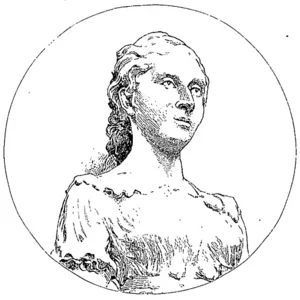

French mathematician and philosopher (1776–1831), a pioneer in science at a time when women were excluded from it. She made contributions to number theory and elasticity, and corresponded with Gauss under a male pseudonym.
Sophie Germain(1776 — 1831)
Sophie Germain
France
8 min read
Frequently asked questions
Famous Quotes
« Algebra is but written geometry; geometry is but drawn algebra.»
Key Facts
- 1776: born in Paris into a cultivated middle-class family
- 1794: begins secretly studying mathematics during the French Revolution
- 1804: begins a correspondence with Gauss under the male pseudonym 'Monsieur LeBlanc'
- 1816: awarded the Grand Prix of the Académie des sciences for her work on the mathematical theory of elastic surfaces
- 1831: dies in Paris, the same year Gauss secures her an honorary doctorate from the University of Göttingen
Works & Achievements
The third version of her memoir on the theory of elasticity, awarded by the Institut de France. Sophie Germain became the first woman to win this prestigious prize, laying the mathematical foundations for the study of material resistance.
Publication of her work on elasticity, a landmark reference that had a lasting influence on mathematical physics and civil engineering throughout the 19th century.
A follow-up to her previous work, in which Sophie Germain refines her equations and responds to Poisson's criticisms of the foundations of her theory.
In a letter to Gauss published by Legendre, she proves that for any prime p such that 2p+1 is also prime, Fermat's equation has no non-zero integer solutions. This result remained the most significant advance on the problem for a long time.
A philosophical essay written near the end of her life, in which Sophie Germain argues for the unity of science and the humanities and reflects on the role of reason in human history.
Anecdotes
Sophie Germain discovered mathematics at age 13 while reading about the death of Archimedes, killed by a Roman soldier while absorbed in his calculations. This death struck her as proof that mathematics was the most fascinating of all disciplines. Confined to her home during the Revolution, she devoured every book in her father's library.
To attend lectures at the École Polytechnique — closed to women — Sophie Germain borrowed the identity of an absent student, M. LeBlanc, and submitted work so brilliant that the director Lagrange asked to meet this prodigy. He was astonished to discover a young woman, but welcomed her with respect and became her mentor.
Sophie Germain corresponded for years with the great German mathematician Carl Friedrich Gauss, signing her letters 'M. LeBlanc'. When Gauss finally learned her true identity, he wrote her an admiring letter, declaring that her achievement was all the more remarkable for defying the prejudices of the era regarding women and science.
During Napoleon's invasion of Prussia, Sophie Germain grew concerned for Gauss's safety in Göttingen. She asked a French general of her acquaintance, Pernety, to look after him — unconsciously echoing the gesture that had cost Archimedes his life, but this time to protect him. It was through this that Gauss discovered his correspondent 'M. LeBlanc' was a woman.
Sophie Germain submitted her memoir on the theory of elastic surfaces to the Institut de France prize competition three times before finally winning in 1816. The first two submissions were rejected for mathematical errors that her rival Poisson never publicly corrected in his own work. She was the first woman to attend sessions of the Académie des sciences during her lifetime.
Primary Sources
Sir, the researches which I have the honor of submitting to you on the theory of numbers have led me to results I would not have dared hope for… I fear you may find the developments too insufficient.
The value of z results from a double integration, and the arbitrary constants introduced by these integrations must be determined by the conditions relating to the edges of the surface.
In seeking to derive from the general principles of mechanics the laws governing the vibrations of bodies, I became convinced that the differential equations of this motion must be of a very high order.
If one examines closely the progress of the sciences, one will be struck to find that very different branches of knowledge have been cultivated simultaneously, and that those who excelled in one had often cultivated the others.
I beg you, General, to kindly arrange for M. Gauss, professor at Göttingen, whose mathematical works are of capital importance to science, to be sheltered from the consequences of the war.
Key Places
It was in the library of this bourgeois townhouse that Sophie Germain, at age 13, discovered mathematics during the upheaval of the Revolution. She conducted her first self-taught research there.
Founded in 1794, this prestigious institution was the scientific heart of the Napoleonic era. Sophie Germain was barred from attending as a woman, but obtained lecture notes by correspondence under the name M. LeBlanc.
Home of the Académie des sciences, where Sophie Germain submitted her memoir on elasticity three times before winning the Grand Prix in 1816. She was the first woman admitted to its public sessions.
University town where Carl Friedrich Gauss worked — a correspondent and admirer of Sophie Germain. It was here that she intervened to protect him in 1806, giving their epistolary friendship its fullest meaning.
Sophie Germain lived in this neighborhood during the final years of her life, where she wrote her philosophical works despite her illness. She died there in 1831.
Typical Objects

A metal plate covered with fine sand and made to vibrate with a bow, revealing geometric patterns. Sophie Germain spent her entire life trying to explain these figures mathematically, and this work formed the core of her prize-winning research.

Sophie Germain maintained an extensive correspondence with the greatest mathematicians of her time, including Gauss and Legendre. These carefully preserved letters are the primary record of her mathematical thinking.

A foundational work that Sophie Germain studied from an early age, which steered her scientific approach toward a rigorous analytical treatment of physical phenomena.

A treatise on number theory published in 1801, read and annotated with great enthusiasm by Sophie Germain, who drew inspiration from it for her own contributions to Fermat's Last Theorem.

Sophie Germain often worked at night to avoid the social obligations imposed on women of her class. For a long time, candlelight was her tool for nighttime study.

To attend certain scientific gatherings or correspond without being dismissed, Sophie Germain adopted a male identity. This stratagem, used by a number of learned women of the era, encapsulates the obstacles she had to work around.
School Curriculum
Vocabulary & Tags
Key Vocabulary
Daily Life
Morning
Sophie Germain often rose after a long night of work, as she preferred to study at night, away from social obligations. Her mornings were spent reading scientific journals and reviewing the calculations she had done the night before. Her family, comfortably well-off, spared her from household chores.
Afternoon
Afternoons were dedicated to writing her memoirs and corresponding with fellow scholars — Legendre, Fourier, or Gauss. She sometimes received scientific visitors in the family drawing room, one of the few spaces where a woman could participate in the intellectual exchanges of the era.
Evening
Parisian bourgeois evenings meant family dinners and salon visits. Sophie played along on the surface, but as soon as social duties allowed, she returned to her notebooks. Once night fell, she lit her candle and resumed her proofs until dawn.
Food
Sophie Germain lived in a prosperous middle-class Parisian family, which ensured she ate well: white bread, roasted meats, seasonal vegetables, cheeses, and table wine. Meals were structured family affairs, in keeping with the habits of the Parisian bourgeoisie during the Directory and Empire periods.
Clothing
Sophie wore the feminine fashions of the Empire period: white muslin dresses with high waistlines, lace fichus, and hair worn in a chignon with a few curls framing the face. She had no particular taste for vanity and favored comfort over showy elegance.
Housing
The Germain family occupied a substantial bourgeois townhouse in central Paris, most likely on the Right Bank. Sophie had a bedroom that doubled as a study, with access to her father's library — a rare and precious resource for a woman of her time who wished to pursue learning. She spent most of her life there.
Historical Timeline
Period Vocabulary
Visual Style
Style néoclassique français Empire, lumière dorée à la bougie, atmosphère studieuse et intime d'une bibliothèque privée parisienne du début du XIXe siècle.
Sound Ambience
L'atmosphère nocturne et studieuse d'un appartement parisien du début du XIXe siècle, où le silence est rythmé par la plume sur le papier et les bruits assourdis de la rue.
Liens externes & ressources
Références
Œuvres
Mémoire sur les vibrations des lames élastiques (Grand Prix de l'Institut de France)
1816
Recherches sur la théorie des surfaces élastiques
1821
Remarques sur la nature, les bornes et l'étendue de la question des surfaces élastiques
1826
Théorème de Sophie Germain (contribution au dernier théorème de Fermat)
1823
Considérations générales sur l'état des sciences et des lettres aux différentes époques de leur culture
1833 (posthume)
See also
Related Characters
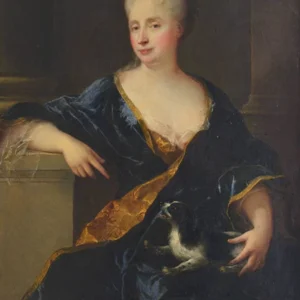
Anne Thérèse de Marguenat de Courcelles, marquise de Lambert
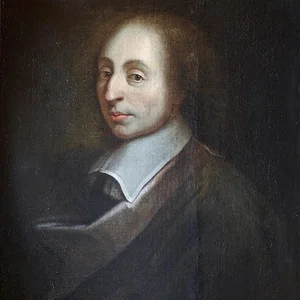
Blaise Pascal
1623 — 1662
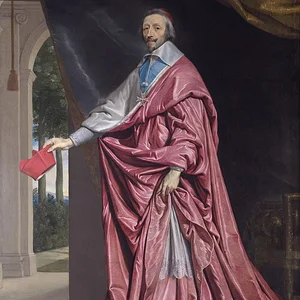
Cardinal de Richelieu
1585 — 1642
Cardinal Mazarin
1602 — 1661
Caroline of Ansbach
1683 — 1737
Charles XII of Sweden