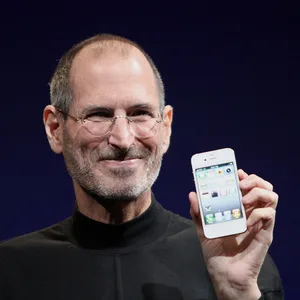

Co-founder of Apple Inc., Steve Jobs revolutionized personal computing, digital music, and mobile telephony. A visionary entrepreneur like no other, he transformed entire sectors of the global economy.
Steve Jobs(1955 — 2011)
Steve Jobs
États-Unis
9 min read
Frequently asked questions
Famous Quotes
« Your time is limited, so don't waste it living someone else's life.»
« Innovation distinguishes between a leader and a follower.»
« Stay hungry, stay foolish.»
Key Facts
- 1976: co-founded Apple Computer with Steve Wozniak and Ronald Wayne
- 1984: launched the Macintosh, the first mass-market computer with a graphical user interface
- 1997: returned to Apple after being ousted in 1985 and led a spectacular turnaround of the company
- 2001: launched the iPod and iTunes, revolutionizing the digital music industry
- 2007: unveiled the iPhone, transforming the mobile phone industry
Works & Achievements
The first personal computer to be mass-produced and successfully sold at scale, it allowed Apple to become a profitable company. It was widely adopted in American schools and helped democratize computing.
The first consumer computer to feature a graphical interface and a mouse, it made computing accessible to non-specialists. Its television advertisement “1984,” directed by Ridley Scott, is considered one of the most influential commercials in history.
Produced under Jobs’s leadership at Pixar, this first feature film made entirely with computer-generated imagery revolutionized the animation industry. The sale of Pixar to Disney in 2006 earned Jobs $7.4 billion.
An all-in-one computer with translucent colors, designed with designer Jonathan Ive, it marked Apple’s spectacular comeback and established a new aesthetic standard across the computing industry.
The iPod and the iTunes Store transformed global music distribution, enabling the legal purchase of individual tracks and dealing a fatal blow to the physical CD. Within five years, Apple became the leading music retailer in the United States.
A full touchscreen smartphone that completely redefined the standards of the global phone industry. In less than ten years, it became the best-selling consumer electronics product in history.
A touchscreen tablet that created a new category of devices between the laptop and the smartphone, quickly adopted in education, publishing, and creative fields. It transformed digital usage across many professional sectors.
Anecdotes
In 1976, Steve Jobs and Steve Wozniak founded Apple Computer in Jobs's parents' garage in Los Altos, California. They hand-assembled the first Apple I computers there, selling them at $666.66 apiece. That garage is now considered a landmark of the computer revolution.
In 1985, at just 30 years old, Steve Jobs was ousted from Apple — the very company he had created — following a conflict with CEO John Sculley. Far from giving up, he founded NeXT and acquired Pixar, two ventures that would pave the way for his triumphant return to Apple in 1997.
At the iPhone unveiling on January 9, 2007 at Macworld in San Francisco, Jobs announced that Apple was about to launch “a revolutionary phone, a widescreen iPod, and an internet communicator.” The audience initially assumed these were three separate devices, before realizing it was one single object. That keynote remains one of the most memorable product presentations in history.
In June 2005, Steve Jobs gave a commencement address to Stanford University graduates in which he shared three personal stories, including his pancreatic cancer diagnosis in 2003. He closed with the phrase “Stay hungry, stay foolish,” which became a mantra of entrepreneurial culture around the world.
Steve Jobs wore the same outfit every day: a black turtleneck made to measure by Japanese designer Issey Miyake, Levi's 501 jeans, and grey New Balance sneakers. He had ordered several hundred of those turtlenecks so he would never waste time choosing what to wear, freeing his mind for questions he considered more important.
Primary Sources
Your time is limited, so don't waste it living someone else's life. Don't be trapped by dogma — which is living with the results of other people's thinking. Stay hungry. Stay foolish.
A year ago, I announced that 1984 would not be like '1984'. Today, I am proud to present you the first Macintosh.
Every once in a while a revolutionary product comes along that changes everything. One is very fortunate if you get to work on just one of these in your career. Apple is very fortunate — it's been able to introduce a few of these into the world.
I want my children to know me. I never wanted to write a biography, but I realized that if I didn't do it now, I might not have another chance to tell my story in my own words.
Flash was created during the PC era — for PCs and mice. Flash is a successful business for Adobe, and we can understand why they want Flash on iPhones, iPads and iPods. But the mobile era is about low power devices, touch interfaces and open web standards.
Key Places
The birthplace of Apple Computer in 1976, where Jobs and Wozniak hand-assembled the first Apple I computers. This garage has become the worldwide symbol of Silicon Valley's entrepreneurial spirit.
Apple's global headquarters, whose design Jobs personally oversaw with architect Norman Foster before his death. This ring-shaped campus, inaugurated in 2017, is nicknamed “the spaceship.”
The college where Jobs enrolled in 1972 before dropping out six months later, unable to afford the tuition. He nonetheless attended calligraphy classes as a drop-in auditor — a direct inspiration for the refined typography of the Macintosh.
The convention center where Jobs held most of his famous keynotes, including the iPhone presentation in January 2007. These annual events drew thousands of journalists and fans from around the world.
The city where Jobs spent most of his adult life, in a craftsman-style house with deliberately sparse furnishings — a reflection of his deep attraction to Japanese Zen aesthetics. He was often spotted walking barefoot through the neighborhood streets.
Typical Objects

Jobs wore this identical outfit every day, having ordered several hundred of them from the Japanese designer. This deliberate choice embodied his philosophy: eliminate trivial decisions to focus energy on what truly matters.

The defining object of the Jobs era, the iPhone combined for the first time a phone, music player, and web browser in a fully touchscreen device with no physical keyboard. Jobs considered it the most complete achievement of his career.

The first personal computer with a graphical interface sold to the general public, it brought the mouse and clickable icons into American homes. Jobs unveiled it himself on stage, pulling it from a cloth bag to thunderous applause.

A digital music player whose scroll wheel let you browse thousands of songs with a simple flick of the thumb. Its tagline "1,000 songs in your pocket" perfectly captured the product's revolutionary promise.

Jobs unveiled it at launch by sliding it out of a standard manila envelope to demonstrate its record-breaking thinness. This laptop redefined the benchmarks for lightness and elegance across the entire computer industry.

Jobs paid obsessive attention to the packaging of every Apple product, convinced that the unboxing experience was an integral part of the product itself. Opening an Apple box was designed as a carefully choreographed ritual.
School Curriculum
Vocabulary & Tags
Key Vocabulary
Tags
Daily Life
Morning
Steve Jobs woke up early and often began his day with a long walk, sometimes barefoot through his Palo Alto neighborhood, which he considered a moment of creative reflection. Each morning, he would ask himself the same question in the mirror: “If today were the last day of my life, would I want to do what I am about to do today?”
Afternoon
His afternoons were structured around intense product reviews in which he examined every design detail with legendary meticulousness, never hesitating to discard months of work if the result did not seem perfect to him. He held his strategy meetings while walking rather than sitting in a conference room, convinced that movement fostered creativity.
Evening
Jobs came home for family dinner almost every evening, firm in his belief in the importance of those shared moments with his children around a screen-free table. He read widely — biographies, history, Zen philosophy, and books on design — and loved listening to Bob Dylan and The Beatles.
Food
Jobs followed extreme diets throughout his life: a committed vegetarian since adolescence, he regularly practiced extended fasting and would sometimes eat nothing but a single food for weeks at a time (carrots, apples). He believed that this pure diet meant he did not need to use deodorant.
Clothing
His outfit was invariable and deliberate: a black Issey Miyake turtleneck, Levi’s 501 jeans, and gray New Balance sneakers, in hundreds of identical copies stored in his wardrobe. This “uniform” was the result of a conscious decision to eliminate unnecessary daily choices, inspired by his encounter with Japanese Zen philosophy.
Housing
Jobs lived in a craftsman-style brick house in Palo Alto that was deliberately sparsely furnished: few chairs, no sofa for years, as he refused to acquire any object he was not absolutely certain deserved to exist in his space. His children slept on mattresses laid directly on the floor in nearly empty rooms.
Historical Timeline
Period Vocabulary
Liens externes & ressources
Références
Œuvres
Apple II
1977
Macintosh 128K
24 janvier 1984
iPod et iTunes Store
2001–2003
iPhone
9 janvier 2007
iPad
27 janvier 2010