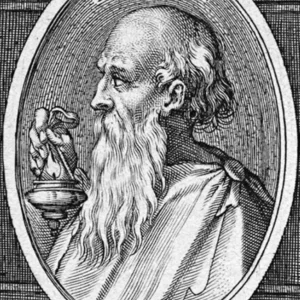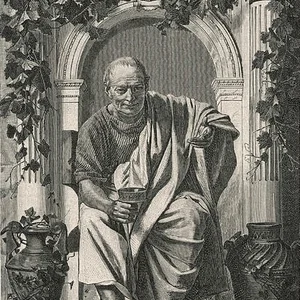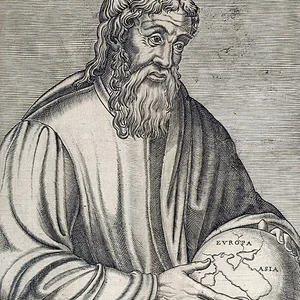

Greek geographer, historian, and philosopher born around 62 BC in Amaseia (modern-day Turkey). He is the author of the Geography in 17 books, a description of the known world of his time. An heir to the Stoic tradition, he traveled extensively throughout the Mediterranean and the East.
Strabo(62 av. J.-C. — 23)
Strabo
7 min read
Frequently asked questions
Famous Quotes
« Geography is a subject that belongs to the philosopher.»
« Travel is the best school in the world.»
Key Facts
- Born around 62 BC in Amaseia in Pontus (modern-day Turkey)
- Wrote the Geography in 17 books, the only work of his to survive in full
- Spent time in Rome and Alexandria, the great intellectual centers of the ancient world
- Described the inhabited world (oikoumene) from Ireland to India
- Died around 23 AD, after a long life devoted to scholarship
Works & Achievements
A monumental work in 17 books describing the entire known inhabited world of the Greeks and Romans, from Ireland to India. It is the only major ancient geographical work to have survived nearly intact to the present day.
A vast historical compilation in 47 books, now almost entirely lost, which served as a continuation of Polybius's work. A few fragments have survived through citations by later authors.
Anecdotes
Strabo traveled from Ethiopia to the shores of the Black Sea, and from the Iberian Peninsula to India — at least according to the sources he compiled. He claimed to have covered more ground than anyone before him, which gave him particular authority to describe the inhabited world, which he called the "oikoumene."
In his Geography, Strabo describes Britain with surprising accuracy for a man who may never have set foot there. He drew on accounts from merchants and Roman soldiers, demonstrating that ancient geography was also a science of gathering human intelligence, not merely direct observation.
Strabo was an ardent admirer of Homer, whom he considered the first geographer in history. He devoted lengthy passages to arguing that the voyages of Odysseus corresponded to real geographical locations, seeking to reconcile Greek mythology with the reality of the Mediterranean world.
Born in Amasia of Pontus (present-day Amasya in Turkey), Strabo grew up in an influential family close to the kings of Pontus. His hometown, perched in the gorges of the Iris River, left a deep impression on him: he produced one of the most detailed urban descriptions in his entire work about it, with a pride that is clearly personal.
Strabo's historical work, his Historical Memoirs in 47 books, has been almost entirely lost. Only his Geography has survived more or less complete, making it one of the major sources for ancient geography — a true miracle of manuscript transmission across the centuries.
Primary Sources
Geography, which I have set out to treat, seems to me, like other sciences, to be a branch of philosophy; it is of particular interest to statesmen.
The inhabited world is an island: for wherever men have been able to advance by land or sea, they have encountered the Ocean.
All of Gaul is divided into three parts: Celtic Gaul, Aquitania, and Belgica. These peoples differ from one another in language, customs, and laws.
Egypt is watered by the Nile from the borders of Ethiopia to the sea; the width of the country scarcely extends beyond the valley the river has carved.
Amaseia, my homeland, is a city admirably fortified by nature; a deep river encircles it with a double barrier, and sheer cliffs rise on all sides.
Key Places
Strabo's hometown, nestled in the gorges of the Iris River (Yeşilırmak). He left a detailed and affectionate description of it in Book XII of his Geography.
The great intellectual center of the ancient world, home to the famous Library. Strabo stayed there around 25 BC and describes its architecture, harbor, and institutions in Book XVII.
Capital of the Empire where Strabo lived for several years and moved in learned circles close to Augustus. The city gave him access to invaluable geographical and historical sources.
A city on the border of Egypt and Ethiopia that Strabo visited during his expedition with Aelius Gallus. There he observed the famous well where the sun is reflected straight down at the summer solstice.
The Greek city rebuilt by Julius Caesar in 44 BC, which Strabo describes as a major commercial crossroads of the eastern Mediterranean in Book VIII of his Geography.
Typical Objects

The primary writing medium in ancient Greece and Rome. Strabo wrote his 17-book Geography on scrolls, annotating and revising them throughout his travels and research.

A rod planted vertically to measure the shadow cast by the sun and calculate latitude. Greek geographers such as Eratosthenes and Strabo used these calculations to estimate distances and draw their maps of the world.

A flat representation of the oikoumene — the inhabited world as the Greeks conceived it. Strabo devoted lengthy discussion to the maps of his predecessors (Eratosthenes, Hipparchus) and proposed his own geographical corrections.

A tool for determining orientation and measuring angles, used by Greek surveyors and sailors. Strabo relied on navigators' records to fill out his descriptions of distant coastlines.

A portable surface for travel notes, used before transcribing onto papyrus. Strabo used these to record the oral accounts of merchants, soldiers, and travelers he encountered along the way.

A metal or bone point used for writing on wax tablets or scratching papyrus. An everyday tool of the Greek intellectual, inseparable from Strabo's work of compilation and composition.
School Curriculum
Vocabulary & Tags
Key Vocabulary
Tags
Daily Life
Morning
Strabo rose at dawn according to Greek custom, performed brief libations to the household gods, then settled into his library from the very first hour to read and annotate the works of his geographical predecessors. He devoted his mornings to the critical reading of Eratosthenes, Polybius, or Hipparchus, taking notes on wax tablets.
Afternoon
The afternoon was reserved for meetings with passing merchants, soldiers, or sailors, from whom he gathered firsthand accounts of distant regions. During his stays in Rome or Alexandria, he took part in philosophical discussions in the porticoes or aristocratic homes, bringing his geographical knowledge to bear on Stoic debates.
Evening
In the evenings, Strabo would dictate or write out sections of his Geography himself, reworking the information gathered during the day. The evening meal (deipnon), shared with close companions or fellow scholars, gave rise to learned discussions on history and Stoic philosophy that indirectly nourished his work.
Food
Strabo followed the typical Mediterranean diet of a Greek man of letters: barley or wheat bread, olive oil, olives, legumes, goat's cheese, and dried fish. Wine diluted with water was his daily drink, consumed in moderation in keeping with the Stoic ideal he professed.
Clothing
Like any Greek intellectual of his era living in Roman territory, Strabo wore a himation (a large draped woolen cloak) over a linen chiton in summer. Through contact with the Roman elite, he may also have adopted the toga for official ceremonies, a sign of his integration into Rome's cultivated circles.
Housing
In Amaseia, Strabo's family owned a comfortable home befitting their local aristocratic standing. During his travels, he lodged with learned hosts or in townhouses (insulae) in Rome and Alexandria. His regular living quarters likely included a workspace with shelves for scroll cases (scrinia) and a reading table positioned to make the most of natural light.
Historical Timeline
Period Vocabulary
Visual Style
Un style visuel mêlant la sobriété hellénistique tardive et la richesse décorative romaine : lumière chaude, marbres crème, cartes tracées à l'encre brune sur fond de parchemin ocre.
Sound Ambience
L'univers sonore de Strabon mêle les bruits des ports méditerranéens qu'il fréquenta et le silence studieux des bibliothèques hellénistiques où il compilait son immense savoir géographique.
Liens externes & ressources
Références
Œuvres
Géographie (Geographica)
vers 7 av. J.-C., révisée jusqu'à 23 apr. J.-C.
Mémoires historiques (Historika Hypomnèmata)
vers 20 av. J.-C.