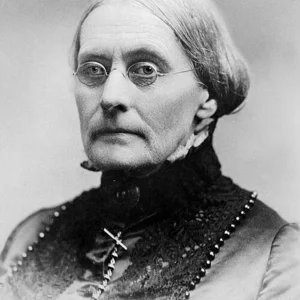

American civil rights activist (1820–1906), Susan B. Anthony is one of the founding figures of the American suffragist movement. She devoted her life to the abolition of slavery and to securing the right to vote for women.
Susan B. Anthony(1820 — 1906)
Susan B. Anthony
États-Unis
9 min read
Frequently asked questions
Famous Quotes
« Men, their rights, and nothing more; women, their rights, and nothing less.»
« I distrust those people who know so well what God wants them to do to their fellows, because it always coincides with their own desires.»
Key Facts
- 1820: born in Adams, Massachusetts, into an anti-slavery Quaker family
- 1848: attends the Seneca Falls Convention, the first women's rights congress in the United States
- 1872: arrested for illegally voting in the presidential election
- 1890: co-founds the National American Woman Suffrage Association (NAWSA)
- 1906: dies without having seen the passage of the 19th Amendment, ratified in 1920
Works & Achievements
A suffragist newspaper founded by Anthony and Elizabeth Cady Stanton, published weekly in New York. Despite its short two-year run, it was the first major media platform for the women's rights movement in the United States.
A monumental work co-written with Elizabeth Cady Stanton and Matilda Joslyn Gage, chronicling the history of the American suffrage movement from its origins. This documentary landmark remains an essential historical source on the struggle for women's rights.
Delivered in the weeks leading up to her trial, this speech — which Anthony gave in twenty-nine cities across New York State — systematically dismantles the legal argument that women had no right to vote. It remains one of the founding texts of American feminist rhetoric.
A text drafted by Anthony, Stanton, and Matilda Joslyn Gage and read aloud during the American Centennial celebrations in Philadelphia, demanding civil and political equality for women. Anthony distributed copies of the text to the official assembly without having been invited.
For forty years, Anthony organized signature drives across every American state, collecting hundreds of thousands of signatures that she personally delivered to Congress. These petitions were an unprecedented tool of political pressure for the time.
Anecdotes
On November 5, 1872, Susan B. Anthony walked into the polling place in Rochester, New York, and successfully cast a ballot in the presidential election, arguing that the Fourteenth Amendment granted her that right as a citizen. Arrested two weeks later, she was fined $100, which she categorically refused to pay, declaring: “I shall never pay a dollar of your unjust penalty.”
During her trial in 1873, Judge Ward Hunt wrote his verdict in advance and prevented the jury from deliberating — a flagrantly illegal act. He directly ordered a guilty verdict. Anthony asked to address the court, and despite repeated attempts by the judge to silence her, she delivered a passionate speech on the injustice done to women that remains a landmark in the history of feminism.
Susan B. Anthony met Elizabeth Cady Stanton in 1851 on a sidewalk in Seneca Falls, and the two women forged a fifty-year friendship that would transform the American suffrage movement. They complemented each other perfectly: Stanton wrote the speeches, while Anthony organized them and carried them to audiences across the entire country.
At her 86th birthday celebration, during her final public appearance in 1906, Anthony declared with absolute conviction: “With such an army of women behind me, how can I fail?” She died a few weeks later, without having seen the ratification of the Nineteenth Amendment — which would finally grant American women the right to vote, fourteen years after her death.
Shaped by her family's Quaker values, Anthony was one of the first activists to draw a direct link between the abolition of slavery and women's rights. She organized massive anti-slavery petitions during the Civil War, and was then horrified when the Fifteenth Amendment (1870) granted the right to vote to Black men while deliberately excluding all women.
Primary Sources
Friends and fellow-citizens: I stand before you tonight under indictment for the alleged crime of having voted at the last presidential election, without having a lawful right to vote. It shall be my work this evening to prove to you that in thus voting, I not only committed no crime, but, instead, simply exercised my citizen's rights.
The prolonged slavery of woman is the darkest page in human history. A survey of the condition of the race through those barbarous periods, when physical force governed the world, when the motto, 'might makes right,' was the law, enables us to account, for the origin of woman's subjection to man without referring the fact to the general inferiority of the female sex.
The Revolution will go for a Republican form of Government, and take no backward step to Monarchy, Oligarchy, or Aristocracy. It will demand equal rights for all, without distinction of sex, color, or nationality. Its motto shall be: Men, their rights and nothing more; Women, their rights and nothing less.
We ask of our rulers, at this hour, no special favors, no special privileges, no special legislation. We ask justice, we ask equality, we ask that all the civil and political rights that belong to citizens of the United States, be guaranteed to us and our daughters forever.
I distrust those people who know so well what God wants them to do to their fellows, because it always coincides with their own desires.
Key Places
Susan B. Anthony's birthplace, where she was born on February 15, 1820, into a Quaker family actively opposed to slavery. Her father Daniel Anthony, a weaver and abolitionist, instilled in her from childhood a deep sense of social justice.
Anthony's primary residence for most of her adult life, where she lived with her sister Mary. It was here that she was arrested in 1872 after casting her vote, and where she died in 1906. The house is today a national museum.
Site of the first Women's Rights Convention (1848), whose ranks Anthony quickly rose to become one of its most iconic figures. The Declaration of Sentiments adopted at that convention inspired her entire activist career.
The federal capital where Anthony traveled regularly to advocate for women's suffrage before the U.S. Congress. It was here that in 1878 the constitutional amendment that would bear her name was introduced for the first time.
The town where Anthony taught as a schoolteacher from 1846 to 1849 — her first professional experience, which opened her eyes to the glaring wage inequality between male and female teachers doing identical work.
Typical Objects

In the final decades of her life, Anthony almost always wore a bright red shawl during her speeches and public appearances, to the point that it became her trademark. This simple yet recognizable garment reflected her Quaker values of humility and practicality.

Anthony produced a vast correspondence — letters, petitions, articles — from the hotel rooms and boarding houses where she stayed during her tours. Her quill and portable writing desk were her most constant tools of the fight.

Anthony organized massive signature-gathering campaigns across the United States to demand women's right to vote. These long sheets of paper bearing hundreds of signatures were solemnly presented before the U.S. Congress.

This weekly newspaper, founded by Anthony and Stanton in 1868, was the suffragist movement's principal press organ for two years. Anthony managed its editorial direction and distribution despite constant financial difficulties.

Anthony traveled tens of thousands of miles by train to attend meetings, lectures, and conventions across the country. She sometimes spent entire weeks on board, sleeping in the cars and preparing her speeches between stations.

Raised in the Quaker faith, which upholds the equality of men and women before God, Anthony maintained a personal relationship with her spirituality. This faith was the ethical foundation of her fight for abolition and women's rights.
School Curriculum
Vocabulary & Tags
Key Vocabulary
Tags
Daily Life
Morning
Anthony rose early, often before dawn, to tackle her voluminous correspondence. She received dozens of letters daily from activists, journalists, and politicians, which she answered by hand. During her many speaking tours, she would board the train in the early hours to reach the next town on her schedule.
Afternoon
Afternoons were devoted to public meetings, lectures, and organizational gatherings. Anthony was a tireless orator who could speak for hours before hostile or enthusiastic crowds alike. She also oversaw the logistical side of campaigns: printing pamphlets, recruiting volunteers, and raising funds.
Evening
In the evenings, Anthony often held private meetings in the homes of abolitionist or suffragist families who hosted her during her tours. She worked on articles, speeches, or chapters of the *History of Woman Suffrage* well past midnight, sleeping little as a matter of militant conviction.
Food
Raised in the Quaker tradition of frugality, Anthony ate simply and without excess. On her travels she ate whatever her hosts served, rarely refusing but never making a show of it. Temperance — abstaining from alcohol — was a principle shared by her family and the reform circles in which she moved.
Clothing
Anthony wore plain Quaker-style clothing: dark gray or black dresses with simple white collars and no unnecessary ornamentation. Her famous red shawl was her one concession to a strong visual signature. She set herself apart from women of her class by rejecting the tight corset and the cumbersome crinoline, both of which restricted movement.
Housing
Anthony shared her house on Madison Street in Rochester with her sister Mary for several decades. The home served as residence, office, and gathering place for visiting activists. There she kept her archives, petitions, and vast correspondence files in a cluttered but functional study.
Historical Timeline
Period Vocabulary
Liens externes & ressources
Références
Œuvres
The Revolution (journal hebdomadaire)
1868–1870
History of Woman Suffrage (6 volumes)
1881–1922
Discours 'Is It a Crime for a Citizen of the United States to Vote?'
1873
Déclaration des droits des femmes
1876
Campagnes nationales de pétitions pour le suffrage
1865–1906