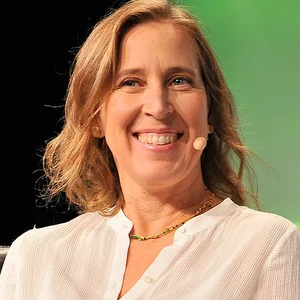

CEO of YouTube from 2014 to 2023, Susan Wojcicki is one of Silicon Valley's pioneers. She was Google's 16th employee, and in 1998 she rented her garage to Larry Page and Sergey Brin to house the company's first servers. Her leadership turned YouTube into the world's leading online video platform.
Susan Wojcicki(1968 — 2024)
Susan Wojcicki
États-Unis
9 min read
Frequently asked questions
Famous Quotes
« Cherish your human connections — your relationships with friends and family.»
« If you're not making mistakes, you're not taking risks, and that means you're not going anywhere.»
Key Facts
- 1998: rents her garage to Larry Page and Sergey Brin for Google's early days
- 1999: joins Google as its 16th employee, develops the AdWords advertising tools
- 2006: oversees Google's acquisition of YouTube for $1.65 billion
- 2014–2023: CEO of YouTube, grows the platform to over 2 billion active users
- 2023: announces her resignation after nine years leading YouTube
Works & Achievements
As Vice President of Advertising at Google, Susan Wojcicki designed the advertising systems that would generate virtually all of Google's revenue, transforming a search engine idea into a financial machine worth hundreds of billions of dollars.
Susan Wojcicki was one of the principal architects of the acquisition of YouTube for $1.65 billion — a bold decision at the time that proved to be one of the greatest technology investments in history.
Over nine years at the helm of YouTube, she grew the platform from 1 to more than 2.5 billion monthly active users, launched YouTube Premium, YouTube Music, and YouTube Kids, and put content moderation policies in place to tackle misinformation.
A dedicated app for children, designed to provide a safe, filtered environment; it represents Wojcicki's effort to make YouTube compatible with the expectations of families and regulators.
YouTube's first paid subscription service, offering an ad-free experience and access to original content, reflecting her ambition to diversify the platform's revenue beyond advertising alone.
Drawing on her own experience as a mother of five, Susan Wojcicki championed and secured an extension of maternity and paternity leave at Google, making the company a benchmark for workplace equality in the tech industry.
Anecdotes
In September 1998, two young computer science students named Larry Page and Sergey Brin were looking for an office for their brand-new company. Susan Wojcicki, who was then working at Intel, rented them her garage in Menlo Park for $1,700 a month. That garage would become Google's first headquarters, and Susan would become its sixteenth employee in 1999.
In 2006, while Google was still hesitant about acquiring YouTube — a video-sharing startup founded just a year earlier — it was Susan Wojcicki who pushed management to finalize the deal for $1.65 billion. Many considered the sum astronomical for a site that was losing money; history proved her right: YouTube is today valued at several hundred billion dollars.
When she was appointed CEO of YouTube in February 2014, Susan Wojcicki was pregnant with her fifth child. She took on her new role just weeks before giving birth, embodying in herself a debate she cared deeply about: professional equality for women. She then actively campaigned for Google to extend its parental leave to eighteen weeks, a measure adopted in 2015.
In 2017, a shooting took place at YouTube's California headquarters in San Bruno, injuring several employees. Susan Wojcicki, deeply shaken, responded publicly with empathy and strengthened workplace security measures. This tragic event illustrates the social tensions that can arise around major digital platforms, particularly those linked to content moderation decisions.
After ten years leading YouTube, Susan Wojcicki announced in February 2023 that she was stepping down to focus on her family and personal projects. Less than a year and a half later, on August 9, 2024, she died of lung cancer at the age of 56. Her death prompted an outpouring of tributes across the global tech world, celebrating a woman who had redefined the way humanity consumes and shares video.
Primary Sources
Every year I write a letter to our creator community outlining my priorities for YouTube. This year, I want to focus on three areas: the creator economy, responsibility, and access.
As a mother of five daughters, the elimination of the constitutional right to abortion is deeply troubling to me. I've talked to my daughters about this ruling, explaining why it matters and how decisions made in courtrooms affect their lives.
As I look at the year ahead, I'm focused on four key priorities: creators' success, original content, living room, and responsibility. These are the areas where I believe YouTube can have the most impact.
I think about the responsibility that comes with scale. When you have billions of users, every decision you make has an enormous impact on society, on culture, on how people learn and communicate.
Key Places
It was in this garage at 232 Santa Margarita Avenue that Susan Wojcicki hosted Google's first servers in 1998, marking the birth of one of the most influential companies in history.
Google's global headquarters where Susan Wojcicki worked for fifteen years, developing Google AdSense and AdWords — the financial engines powering Google's advertising empire.
The YouTube headquarters that Susan Wojcicki led from 2014 to 2023, overseeing the platform's transformation into an indispensable force in global digital culture.
Susan Wojcicki earned her degree in history and literature here in 1990 — a formation that gave her a taste for big ideas and storytelling, qualities she would later bring to the world of digital media.
The city where Susan Wojcicki grew up, the daughter of academics — her father was a physics professor at Stanford. It was in this intellectual epicenter of the future Silicon Valley that she developed her early affinity for science and technology.
Typical Objects

The central tool of a Silicon Valley executive's daily work, it allows real-time monitoring of traffic data, YouTube metrics, and communication with teams spread across the globe.

An emblem of Silicon Valley startup culture, the whiteboard is used in meetings to sketch out ideas, plan features, or debate strategies: Susan Wojcicki used it during creative sessions with her teams at Google and YouTube.

Essential for testing new YouTube mobile features — the primary app consulted by billions of users every day — Susan Wojcicki insisted that every new interface be designed with the phone in mind first.

As early as 1998, Google's very first servers were running in Susan Wojcicki's garage: these metal racks packed with hard drives symbolize the leap from a brilliant idea to a massive industrial infrastructure.

A symbol of the revolution YouTube unleashed: where filming once required expensive professional equipment, a simple camera or phone is now enough to become a content creator and reach millions of people.

As Google's sixteenth employee, Susan Wojcicki held one of the very first campus access badges — an object that embodies her place in the founding circle of the most valuable company in the world.
School Curriculum
Vocabulary & Tags
Key Vocabulary
Tags
Daily Life
Morning
Susan Wojcicki started her days early, often before 7 a.m., checking YouTube's global traffic data and emails from her home in Los Altos Hills. She placed particular importance on family breakfast, a routine she defended despite the packed schedules typical of Silicon Valley CEOs.
Afternoon
Her afternoons were structured around strategic meetings at the San Bruno campus, product reviews with engineering teams, and discussions on content moderation or creator partnerships. She favored short, decision-oriented meeting formats — a legacy of Google's culture built on speed and iteration.
Evening
In the evenings, Susan Wojcicki made a point of coming home to have dinner with her five children, a personal priority she openly acknowledged in public. She would read reports on global video consumption trends and internal memos, staying connected to the platform's broader challenges while protecting family time.
Food
Accustomed to California's wellness culture, she favored a balanced diet rich in fruits and vegetables, typical of Silicon Valley executives who have made healthy eating an extension of their productivity. With Google and YouTube campuses offering free cafeterias with varied menus, business meals often took place on-site.
Clothing
In keeping with Silicon Valley's informal tradition, Susan Wojcicki opted for a relaxed professional style: a colorful blazer or structured jacket over a t-shirt or simple blouse, deliberately avoiding overly formal attire. She embraced this dress code as a way to put people at ease and signal belonging to a flat corporate culture.
Housing
She lived with her family on the San Francisco Peninsula, in a comfortable home in the suburban community of Los Altos Hills or Los Altos — a residential neighborhood favored by tech executives for its proximity to the campuses in Mountain View and San Bruno. Unlike some of her peers, she cultivated an image of comfortable, family-oriented life rather than an ostentatious one.
Historical Timeline
Period Vocabulary
Liens externes & ressources
Références
Œuvres
Développement de Google AdSense et AdWords
2000-2013
Recommandation et supervision du rachat de YouTube par Google
2006
Direction de YouTube (PDG)
2014-2023
Lancement de YouTube Kids
2015
Lancement de YouTube Premium (ex-YouTube Red)
2015
Politique de congé parental étendu chez Google (18 semaines)
2015