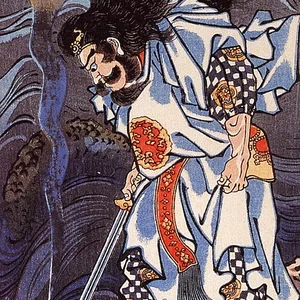

Susanoo is the god of storms in Japanese Shinto, son of Izanagi and brother of Amaterasu. Banished from the heavens, he accomplished the feat of slaying the eight-headed serpent Yamata no Orochi, discovering within its body the sacred sword Kusanagi.
Susanoo
Susanoo
8 min read
Frequently asked questions
Key Facts
- Born from the purification ritual of Izanagi, he is one of the three Noble Children alongside Amaterasu and Tsukuyomi
- Banished from the heavens after causing chaos in the domain of his sister Amaterasu
- Slays the eight-headed serpent Yamata no Orochi in Izumo and discovers the sword Kusanagi-no-Tsurugi
- The sword Kusanagi becomes one of the three Imperial Treasures of Japan
- Venerated notably at the great Izumo Taisha shrine, one of the oldest in Japan
Works & Achievements
Susanoo slays the eight-headed serpent terrorizing the province of Izumo by luring it with sake. This founding feat symbolizes the triumph of divine order over devastating chaos.
While cutting apart Yamata no Orochi, Susanoo discovers a divine sword inside one of the monster's tails. Offered to Amaterasu, it becomes one of the Three Imperial Treasures, a symbol of Japanese imperial power.
Susanoo composes the poem Yakumo tatsu / Izumo yaegaki / tsuma gomi ni... regarded as the first thirty-one-syllable poem in the literary history of Japan.
Susanoo saves the last daughter of the Ashinazuchi family, who was fated to be devoured by the serpent, and marries her. He thereby establishes a new divine lineage at Izumo from which Ōkuninushi will descend.
After his earthly adventures, Susanoo becomes the sovereign of the Root Country, the underworld, passing on his knowledge and trials to his descendants who will build Japan.
Anecdotes
After being banished from the heavens by his father Izanagi, Susanoo wanders weeping so violently that his tears unleash storms and cause the mountains to wither. He declares his wish to join his mother Izanami in the land of the dead — a refusal to accept his fate that leads Izanagi to condemn him to leave the High Heavens forever.
To defeat Yamata no Orochi, the fearsome eight-headed serpent that demands a young girl as sacrifice every year, Susanoo devises a clever trick: he has eight barrels of sake prepared and placed before the monster's eight mouths. The serpent drinks itself into a stupor and falls asleep, allowing the god to cut it down without a direct fight.
Slicing open the body of the defeated serpent, Susanoo discovers inside one of its tails a sword of extraordinary beauty, which he names Kusanagi-no-Tsurugi — the grass-cutting sword. He offers it to his sister Amaterasu as a gesture of reconciliation; this sword would go on to become one of Japan's three sacred Imperial Treasures.
Before his banishment, Susanoo visits his sister Amaterasu in the heavens, but his violent behavior causes widespread panic: he destroys sacred rice paddies, blocks irrigation channels, and defiles her shrine. Terrified, Amaterasu retreats into a celestial cave, plunging the entire world into total darkness until the other gods persuade her to come back out.
Following his victory over Yamata no Orochi, Susanoo marries Kushinadahime, the young woman he had just rescued. He then composes what is considered the very first waka in Japanese literary history — a thirty-one-syllable poem celebrating the clouds rising above Izumo on his wedding night.
Primary Sources
Susanoo wept and wailed without cease, so that the verdant mountains withered and dried, and all the rivers and seas ran dry. He said: 'I wish to go to the land of my mother.' Then Izanagi, enraged, banished him.
Susanoo then said: 'In the province of Izumo, at the place called Torikami, on the banks of the Hi River, there is a monster with eight heads and eight tails. I will prepare sake, and when it falls asleep, I will slay it.'
The offenses committed in the high heavens — breaking the divisions between rice paddies, filling in the irrigation ditches, releasing the water pipes, sowing seed twice over, flaying living sacred animals — may all these offenses be swept away and purified.
It is said that the god Susanoo no Mikoto gave this place its name. After slaying the eight-headed serpent on the banks of the Hi River, he settled in Izumo and established his palace on the river's shores.
Key Places
Celestial dwelling of the kami and domain of the sun goddess Amaterasu, from which Susanoo was permanently banished by Izanagi. A symbolic place of the original divine order that Susanoo disrupts.
Legendary site of the battle against Yamata no Orochi. It is on its banks that Susanoo traps the serpent with sake and discovers the sword Kusanagi — a central scene in Shinto mythology.
One of the oldest and most sacred Shinto shrines in Japan, associated with the divine lineage of Susanoo. Gods from across Japan gather there every tenth lunar month.
The cave in which Amaterasu takes refuge after Susanoo's devastations, plunging the world into darkness. This myth symbolizes an eclipse or the coming of winter in the Shinto tradition.
The underworld over which Susanoo rules after his earthly adventures. His descendant Ōkuninushi travels there to seek his help, symbolizing the transmission of knowledge between divine generations.
The place where Susanoo has his palace built after marrying Kushinadahime — the first palace ever erected by a kami in the Japanese tradition, founding the art of sacred architecture.
Typical Objects

A divine sword discovered by Susanoo inside the tail of Yamata no Orochi. Offered to Amaterasu, it becomes one of the three Imperial Treasures of Japan, a symbol of the emperors' legitimacy.

The long sword Susanoo uses to sever the serpent's heads after lulling it to sleep with sake. It represents the martial power of the storm god.

Eight vessels of rice wine that Susanoo has prepared to intoxicate Yamata no Orochi. This clever ruse illustrates that cunning is as much an attribute of the kami as brute strength.

Susanoo transforms the young Kushinadahime into a comb, which he tucks into his hair to keep her safe during the battle against the serpent, demonstrating his protective ingenuity.

A natural manifestation of Susanoo's power; the first waka poem he composes evokes precisely the layered clouds (yakumo) rising above Izumo on his wedding night.

A sacred object in Shinto, used in purification ceremonies and to communicate with the kami; one of the three Imperial Treasures, it stands alongside the sword and the jewel as part of Susanoo's legacy.
School Curriculum
Vocabulary & Tags
Key Vocabulary
Daily Life
Morning
Susanoo awakens amid the turmoil of the winds and clouds he commands. Each dawn finds him sweeping across the skies or seas, stirring the storms that bring life-giving rain to the rice paddies. His presence announces itself through the dark clouds that gather suddenly on the horizon.
Afternoon
In his role as god of the sea and storms, Susanoo governs sea crossings and weather phenomena. He may appear to punish the impious or protect those who honor him, unleashing the elements or calming them according to his divine will.
Evening
Legend shows him feasting and composing poetry in his palace at Izumo, surrounded by his descendants. The first waka he composed in honor of Kushinadahime was recited at sunset, facing the clouds turning crimson above the mountains of Izumo.
Food
As a kami, Susanoo drinks sake, the sacred beverage of Japanese deities and a central element of his rituals. Offerings made to him at shrines include rice, fish, seafood, and vegetables — foods made possible by the rain his storms bring.
Clothing
Susanoo is depicted wearing the white and indigo court robes (sokutai) of the celestial deities, adorned with cloud and wave motifs. His appearance is often wild and imposing, with black hair whipped by the wind — a physical embodiment of the storms he commands.
Housing
His palace is described in the Kojiki as a majestic cedar-beamed dwelling built at Suga, in the province of Izumo, surrounded by clouds and mountains. This mythical palace is the first ever built by a kami in Japanese tradition, establishing the sacred foundations of Shinto architecture.
Historical Timeline
Period Vocabulary
Visual Style
Style yamato-e dramatique aux encres sombres et rehauts d'or, représentant un dieu guerrier foudroyant dans la tempête nocturne, entre cieux tumultueux et serpent colossal, selon l'iconographie mythologique japonaise classique.
Sound Ambience
Ambiance de tempête déchaînée et de combat épique dans les forêts et vallées de l'ancienne province d'Izumo, entre grondements de tonnerre, cri de guerre du dieu des tempêtes et murmure du premier poème japonais.
Liens externes & ressources
Références
Œuvres
Victoire sur Yamata no Orochi
Temps mythiques
Découverte de l'épée Kusanagi-no-Tsurugi
Temps mythiques
Premier waka de la tradition poétique japonaise
Temps mythiques
Sauvetage et mariage avec Kushinadahime
Temps mythiques
Gouvernance du Ne-no-Kuni
Temps mythiques