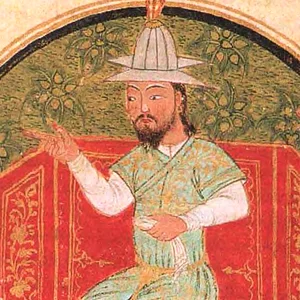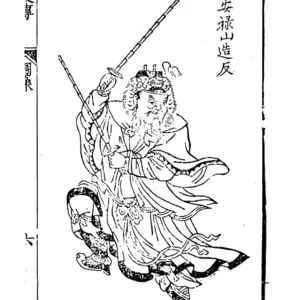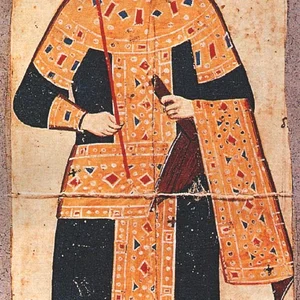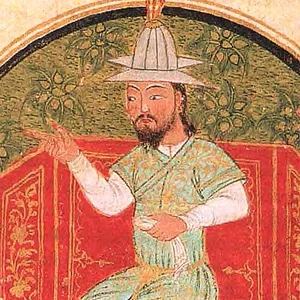

A Turco-Mongol conqueror of the 14th century, Tamerlane founded an empire stretching from Anatolia to India. His military campaigns, marked by extreme violence, reshaped the map of Central Asia.
Tamerlane(1336 — 1405)
Tamerlane
7 min read
Frequently asked questions
Key Facts
- 1336: Born in Kesh (present-day Uzbekistan)
- 1370: Seizes power in Transoxiana; Samarkand becomes his capital
- 1398: Invasion and sack of Delhi, mass massacres
- 1402: Victory at Ankara against the Ottoman Empire, capture of Sultan Bayezid I
- 1405: Dies during the campaign against China (Ming dynasty)
Works & Achievements
The tomb of Timur and his family, a masterpiece of Timurid architecture featuring its distinctive ribbed turquoise dome. This monument directly influenced Mughal architecture, most notably the Taj Mahal.
One of the largest mosques in the medieval Islamic world, built by Timur following his victory in India. It symbolized the conqueror's ambition to make Samarkand the center of the Islamic world.
A collection of political and military maxims attributed to Timur, outlining his vision of governance, warfare, and justice. Its authenticity is debated, but it reflects the administrative traditions of the Timurid empire.
A monumental palace in Timur's hometown, whose two massive entrance pylons rose to a height of 50 meters. It embodied the power and magnificence the conqueror sought to project.
The conquest of Delhi and the spoils it yielded financed the architectural and cultural renaissance of Samarkand. Indian craftsmen brought back to Timurid workshops transmitted their techniques to local artisans.
Anecdotes
Tamerlane suffered from an injury to his right leg that left him with a limp — hence his Persian nickname 'Timur-e Lang' (Timur the Lame), which Europeans corrupted into 'Tamerlane.' Far from being a handicap, this disability enhanced his reputation as a warrior, making his victories all the more fearsome given his physical disadvantage.
In 1402, at the Battle of Ankara, Tamerlane captured the Ottoman sultan Bayezid I, who had been considered undefeatable. According to several Eastern chroniclers, he used the sultan as a footstool to mount his horse, though other sources dispute this account. Bayezid died in captivity a few months later.
Tamerlane was a passionate and expert chess player. He reportedly learned military strategy in part through the game, and his generals were required to master it. Some historians believe that the so-called 'Tamerlane chess,' a variant played on an enlarged board, is directly attributed to him.
After capturing each city that had resisted him, Tamerlane ordered pyramids of skulls to be built as a warning to future populations. At Isfahan in 1387, chroniclers report that 70,000 heads were piled up. These practices were deliberately designed to discourage any resistance during his future campaigns.
Despite his reputation as a destroyer, Tamerlane was a great patron of the arts and architecture. He deported the finest craftsmen, architects, and scholars from conquered cities to his capital Samarkand, which he sought to transform into the most beautiful city in the world.
Primary Sources
And Tamerlane ordered that the men of war be assembled and the troops arranged according to the battle order he himself had established, for he knew better than anyone the art of positioning the flanks and the center.
His Majesty Tamerlane was seated in a palace portico, in the shade of the vault, upon raised cushions, dressed in a silk robe and wearing a tall white cap adorned with a ruby encircled by pearls and precious stones.
He never ceased waging war and shedding blood, laying waste to lands and depopulating cities, seizing riches and carrying off captives, so that nations trembled at his name and the kings of the earth dreaded his power.
These steppes of the Golden Horde are roamed by bold peoples whose horsemen can cover a hundred leagues in a single day, living off their herds and their conquests.
Key Places
Capital of Tamerlane's empire, which he adorned with exceptional monuments including the Gur-e-Amir, his mausoleum. The finest craftsmen from across Asia and the Middle East were brought there by force to make it the most beautiful city in the world.
Tamerlane's birthplace, which he renamed Shahrisabz (the Green City) and adorned with a vast palace, the Ak-Saray, whose imposing ruins still bear witness to its former splendor.
Tamerlane sacked the city in 1398, massacring much of its population and carrying off immense plunder. This invasion permanently weakened the Delhi Sultanate and reshaped the course of medieval Indian history.
Site of the 1402 battle where Tamerlane crushed the Ottoman army and captured Sultan Bayezid I. This Ottoman defeat delayed the fall of Constantinople by roughly fifty years.
The frontier city where Tamerlane died in January 1405, just as he was preparing to launch a campaign against Ming China. His death at Otrar put an end to his plans to conquer the Far East.
Liens externes & ressources
Références
Œuvres
Mausolée Gour-Émir, Samarcande
1404
Mosquée Bibi-Khanym, Samarcande
1399-1404
Réglaon de la politique de l'empire (Tuzukat-i-Timuri)
attribué à Tamerlan, rédigé vers 1400
Complexe palatial d'Ak-Saray, Shahrisabz
1380-1404
Campagne d'Inde et fondation de la tradition timouride
1398