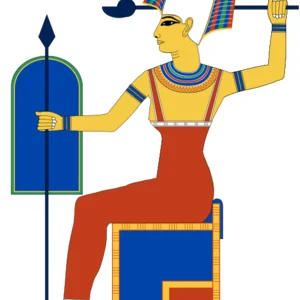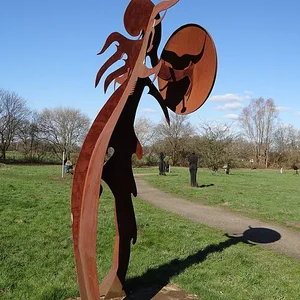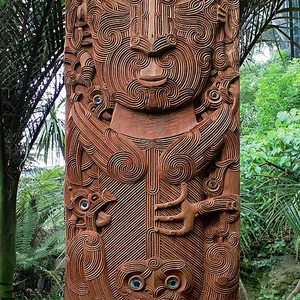

Tāne is the god of the forest and birds in Māori mythology. Son of Rangi (the Sky) and Papa (the Earth), he separated them to let light into the world. He is also the creator of the first woman, shaped from the red clay of the earth.
Tane
Tāne
8 min read
Frequently asked questions
Key Facts
- Tāne separates his parents Rangi (the Sky) and Papa (the Earth) to create light and living space
- He populates the forests he created with birds, becoming their protector
- He shapes the first woman, Hineahuone, from the red clay of the earth (Papa)
- His full name Tāne-mahuta means 'lord of the forest'
- Through his descendant Hinenuitepō, he is indirectly responsible for death entering the Māori cosmic cycle
Works & Achievements
Tāne pushed the Sky upward with his feet, separating his entwined parents to let light into the world. This cosmogonic act is the Māori equivalent of the creation of the world, making all forms of life possible.
Tāne shaped the first woman at Kurawaka from the red clay of the Earth Mother and breathed life into her. Hineahuone is the ancestral mother of all humanity in Māori tradition.
Tāne climbed to the highest heaven to obtain the three baskets of divine knowledge, which he brought back to humankind. This episode establishes the legitimacy of esoteric knowledge (*wānanga*) transmitted by *tohunga* in Māori society.
Tāne created and watches over all species of trees and birds in Aotearoa, including giant kauris, tōtaras, and endemic birds such as the kiwi, the huia, and the kākāpō.
Tāne is associated with the construction of the first Māori *whare*, whose wooden beams symbolically represent his skeleton. Each meeting house is a living embodiment of the god, uniting communities under his protection.
Anecdotes
In the beginning, Ranginui (the Sky) and Papatūānuku (the Earth) lay entwined in darkness, crushing their children between them. Tāne lay on his back, pressed his feet against the sky, and pushed with all his strength until he separated his parents, letting light enter for the very first time. This founding act is the Māori equivalent of the cosmogonic narrative of Genesis.
To create the first woman, Tāne journeyed to Kurawaka, a sacred place on the body of Papatūānuku. He moulded a human form from red clay and breathed life into it through his nostrils. This woman, Hineahuone (literally 'woman fashioned from the earth'), is the ancestral mother of all humanity according to Māori tradition.
Tāne undertook a perilous journey through the twelve heavens to retrieve the three kete (baskets) of knowledge: the kete-o-te-wānanga-tuauri (esoteric knowledge), the kete-aronui (beneficial knowledge), and the kete-uruuru-mātauranga (practical wisdom). These three baskets symbolise the entirety of knowledge passed down by the tohunga to future generations.
Tāne's daughter, Hinetītama, not knowing he was her father, married him. When she discovered the truth, she fled to the underworld and became Hinenuitepō, goddess of death and night. Tāne tried to bring her back, but she told him: 'Stay in the light to protect our living descendants; let me welcome them into the darkness when their time comes.'
In the Waipoua Forest, in the Northland of New Zealand, stands Tāne-mahuta, the largest kauri tree in the world, rising over 51 metres tall with a trunk nearly 14 metres in circumference. Around 2,000 years old, this enormous tree bears the name of the god of forests and is regarded by the Māori as his living incarnation on earth.
Primary Sources
Tane-mahuta, the father of forests and of all things that inhabit them, pressed his body upwards and separated Heaven from Earth, so that light entered the world for the first time, and trees and plants could flourish.
Tane-nui-a-rangi proceeded to Kurawaka, and there he formed the woman out of the red earth, and breathed life into her nostrils, and she became alive and was called Hine-ahu-one.
Tane ascended to the uppermost heaven, Tikanga, and obtained the three baskets of knowledge and the divine stones, which he brought back to earth for the benefit of all mankind.
Tane is the lord of forests and birds; he presides over the growth of trees and the fertility of the earth. The tohunga address karakia to him before any cutting of sacred wood.
Key Places
Sacred site on the body of Papatūānuku where Tāne shaped Hineahuone, the first woman, from red clay. This place is the mythical foundation of humanity's origin in Māori cosmogony.
The twelve celestial levels that Tāne had to traverse to reach the supreme sky and retrieve the three baskets of divine knowledge. These celestial spheres structure the vertical cosmology of the Māori world.
Sacred forest home to Tāne-mahuta, the world's largest kauri tree (~51 m, over 2,000 years old). This giant kauri bears the name of the god of forests and is venerated as his living incarnation by the Māori of Northland.
Mythical island from which the Māori ancestors set out to settle Aotearoa, and where souls return after death. Hawaiki is the cradle of the founding oral traditions — including the myths of Tāne — before their transplantation to New Zealand.
Mythical cosmogonic spaces that preceded all existence, from which Ranginui and Papatūānuku — the parents of Tāne — gradually emerged. These pre-creative dimensions structure the Māori understanding of time and the origin of the cosmos.
Typical Objects

A sacred tool made of green jade (pounamu), the toki is the quintessential instrument of the Māori sculptor and builder. Tāne, master of forests and creator of the first trees, is associated with this tool that transforms sacred wood into canoes, houses, or ritual carvings.

The three kete that Tāne brought back from the twelve heavens contain all human knowledge: esoteric, beneficial, and practical. These baskets woven from harakeke leaves symbolize the transmission of wānanga (sacred knowledge) to humanity.

The huia bird, now extinct, was the quintessential sacred bird of the Māori forest. Its black feathers with white tips, worn by high-ranking chiefs, symbolize Tāne's protection over all the winged creatures of his forest.

A red clay pigment used by Tāne to shape and color the body of Hineahuone, the first woman, at Kurawaka. Kokowai is also applied to protect sacred carvings and canoes against the elements and malevolent forces.

Tāne is the god who created the first canoes by shaping the trees of his forest; the carved paddle symbolizes the link between the forest and the ocean, between Tāne and Tangaroa (god of the sea).

A sacred vessel used in karakia rituals addressed to Tāne before the felling of trees. The gourd contains purifying water poured to lift the tapu from the wood and give thanks to the god for his forest's offering.
School Curriculum
Vocabulary & Tags
Key Vocabulary
Daily Life
Morning
In Māori cosmology, Tāne inaugurates each dawn that he himself made possible by separating the Sky and the Earth. The forest birds awaken under his protection and sing their first songs; the tohunga (priest-experts) recite karakia (incantations) in his honor to welcome the light of the newborn day.
Afternoon
Tāne watches over the forest in broad daylight: trees grow under his protection, birds nest and hunt in his canopy. Māori craftsmen who cut down a tree to build a canoe or a whare must carry out precise rituals to obtain his permission and lift the tapu (sacred character) from the felled wood.
Evening
Dusk marks the return toward darkness, the domain of his daughter Hinenuitepō. Tāne guards the boundaries between the living and the dead. Stories of his exploits are passed down orally in the evenings at gatherings within the whare, keeping the living memory of his founding myths alive.
Food
As a god, Tāne is symbolically nourished by the vegetal offerings made to him by the Māori: first-harvested fruits, sacred twigs, and medicinal plants gathered from his forest with the appropriate rituals. His divine "foods" are the morning dew on forest leaves and the golden sap of ancient kauri trees.
Clothing
Tāne is adorned with the feathers of sacred birds — the white-tipped huia, the brown kiwi, the green kākāpō — signs of his authority over all winged creatures. He is clothed in living leaves and vines, the garments of the forest of which he is the lord and absolute creator.
Housing
Tāne's domain is the deep forest of Aotearoa, in particular the ancient kauri forests of Northland. Symbolically, each whare (longhouse) is his body: the ridgepole represents his spine, the rafters his ribs, and the threshold his open mouth welcoming the living.
Historical Timeline
Period Vocabulary
Liens externes & ressources
Références
Œuvres
Séparation de Ranginui (Ciel) et Papatūānuku (Terre)
Temps mythique primordial
Création de Hineahuone, la première femme
Temps mythique
Ascension aux douze cieux et récupération des trois kete
Temps mythique
Peuplement de la forêt en oiseaux et en arbres
Temps mythique
Construction du premier whare (maison longue)
Temps mythique