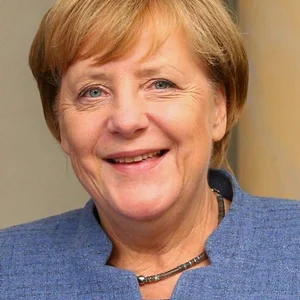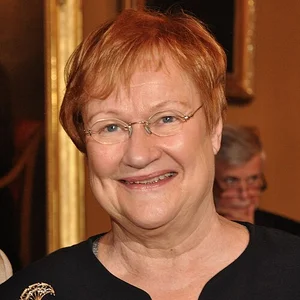

Tarja Halonen is a Finnish stateswoman who served as President of Finland from 2000 to 2012. The first woman to hold this office in her country, she also served as Minister for Foreign Affairs and has been a lifelong advocate for human rights.
Tarja Halonen(1943 — ?)
Tarja Halonen
Finlande
8 min read
Frequently asked questions
Famous Quotes
« Equality is not a gift — it is a right.»
Key Facts
- Born on 24 December 1943 in Helsinki, Finland
- First female President of Finland, elected in 2000
- Re-elected for a second term in 2006
- Minister for Foreign Affairs from 1995 to 2000
- President of the UN Human Rights Council (2006)
Works & Achievements
The first woman elected head of state in Finland, Halonen shaped the country's foreign policy in the post-Cold War era and amid deepening European integration, strengthening Finland's international standing.
Re-elected by a wide margin, she continued her commitment to multilateral diplomacy and human rights, navigating the global financial crisis and the European debt crisis with a consistent message of social solidarity.
As Minister for Foreign Affairs, Halonen steered Finland's accession to the European Union and pursued an active diplomatic agenda in support of human rights, disarmament, and Nordic cooperation.
Co-chaired by Halonen as part of the UN Secretary-General's High-level Panel on Global Sustainability, this report laid the groundwork for the sustainable development agenda adopted at the Rio+20 summit and helped shape the Sustainable Development Goals.
As a Social Democratic member of parliament for over twenty years, Halonen championed major reforms in gender equality, minority rights, and social protection, helping to establish Finland as a model of social democracy.
Anecdotes
Tarja Halonen was born on December 24, 1943, in the working-class district of Kallio in Helsinki. Growing up in these modest surroundings left a lasting mark on her: she devoted her entire career to defending the rights of workers and the most vulnerable, grounding her commitment to social justice in her own personal experience.
Before entering politics, Halonen worked as a lawyer for the Central Organisation of Finnish Trade Unions (SAK) from 1969 to 1970. This hands-on experience with the world of labor and trade union advocacy shaped her progressive political vision, which she carried throughout her career as a parliamentarian and later as head of state.
In the 2000 presidential election, Tarja Halonen narrowly won the second round with 51.6% of the vote against conservative candidate Esko Aho, becoming Finland's first female president. Her victory was celebrated worldwide as a powerful symbol of women's advancement to the highest offices of state.
Known for her straightforward manner and closeness to ordinary citizens, Halonen often refused the ostentatious protocols associated with the presidential office. She continued to visit local Helsinki markets and travel by public transport, which earned her great popularity and the affectionate nickname 'Mother of the Nation' among Finns.
After the end of her second term in 2012, Tarja Halonen did not withdraw from international affairs. She co-chaired the United Nations Secretary-General's High-level Panel on Global Sustainability, contributing to the report “Resilient People, Resilient Planet” adopted at the Rio+20 summit, continuing her fight for human rights and sustainable development.
Primary Sources
My goal is to build a Finland where every person has the opportunity to live a good life. Finland must be a state where fundamental rights and human rights are respected and where everyone has their place.
We must transform the global economy in order to preserve the planet for future generations while ensuring prosperity and human dignity for all. This challenge is both moral and practical.
Human rights are universal and indivisible. No culture, no tradition can serve as a pretext for denying them. Finland will remain firmly committed to their defence on every continent.
The Universal Declaration of Human Rights remains the foundation of our democratic societies. Its effective implementation is a permanent challenge that we must meet together, without compromise or exception.
Key Places
A working-class district of Helsinki where Tarja Halonen was born and raised. This popular neighborhood deeply influenced her social convictions and lifelong commitment to equality.
Halonen earned her law degree here, laying the foundation for her future political and legal career. The university is one of the most prestigious in the Nordic countries.
The official residence and workplace of the President of Finland, where Tarja Halonen carried out her duties for twelve years (2000–2012). It was from here that she directed Finnish foreign policy and received heads of state.
Halonen visited on numerous occasions as president and as a human rights advocate. She delivered several landmark speeches there and co-chaired the High-level Panel on Global Sustainability.
Halonen served as a member of parliament from 1979 onward, before becoming a minister and later president. It was within this institution that she shaped her political vision and championed social rights for more than twenty years.
Typical Objects

A symbol of national sovereignty that Halonen defended throughout her terms in office. As head of state, she presided over national ceremonies where the blue-and-white flag — its colors reflecting Finland's lakes and snow — held a central place.

Before entering politics, Halonen practiced law on behalf of Finnish trade unions. The robe represents her professional beginnings and her early commitment to justice and the defense of workers' rights.

The historic document that Halonen helped negotiate as Minister for Foreign Affairs in 1995. It symbolizes Finland's choice to anchor itself firmly within democratic Europe after decades of constrained neutrality.

An everyday tool of presidential diplomacy. Halonen was known for her intense diplomatic activity, maintaining constant dialogue with her European counterparts and representatives of United Nations bodies.

Halonen was known for her understated and professional style. Her dark suit — simple yet elegant — had become something of a trademark of her authority as head of state, far removed from any ostentatious display.

A document that Halonen consulted regularly to guide Finnish foreign policy and prepare her interventions on the international stage in support of fundamental rights.
School Curriculum
Vocabulary & Tags
Key Vocabulary
Daily Life
Morning
Tarja Halonen began her days early at the Presidential Palace in Helsinki. She would first review the national and international press, including the Helsingin Sanomat, before meeting with her advisors for the daily diplomatic briefing and to go over urgent matters.
Afternoon
Presidential afternoons were structured around official audiences, receptions for diplomatic delegations, and working sessions with her ministers. Halonen placed great importance on field visits to Finnish regions to stay in direct touch with the reality of the country.
Evening
Official evenings often included state dinners or receptions at the Presidential Palace. In her private life, Halonen appreciated Nordic simplicity: the Finnish countryside, the traditional sauna, and time with family were deeply ingrained habits.
Food
Like the vast majority of Finns, Halonen followed a Nordic diet based on fish (salmon, Baltic herring), potatoes, whole rye bread, and dairy products. Coffee — Finland's national drink par excellence — was ever-present throughout her busy days.
Clothing
Halonen was known for her understated and professional style: classic-colored suits (navy, grey, black), with no ostentatious jewelry or embellishments. She favored functional yet elegant outfits that reflected the image of seriousness and rigor she wished to embody.
Housing
As president, she officially resided at the Presidential Palace in Helsinki, a 19th-century neoclassical building overlooking the Baltic Sea and the Lutheran Cathedral. She also had access to the presidential summer residence of Kultaranta, on an island near Turku, where she enjoyed reconnecting with the Finnish natural environment.
Historical Timeline
Period Vocabulary
Liens externes & ressources
Références
Œuvres
Présidence de la République de Finlande — premier mandat
2000-2006
Présidence de la République de Finlande — second mandat
2006-2012
Rapport 'Peuples résilients, planète résiliente : un avenir qui mérite d'être choisi'
Janvier 2012
Engagement parlementaire pour les droits sociaux et l'égalité
1979-2000