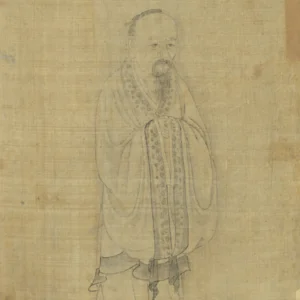

A Chinese Taoist philosopher of the 4th century BCE, Zhuangzi is one of the founding thinkers of philosophical Taoism. His writings, collected in the work that bears his name, explore freedom, the relativity of things, and harmony with the Tao.
Zhuangzi(368 av. J.-C. — 287 av. J.-C.)
Zhuangzi
État Song
8 min read
Frequently asked questions
Famous Quotes
« Now I do not know whether I was then a man dreaming I was a butterfly, or whether I am now a butterfly dreaming I am a man.»
« Perfect happiness is the absence of happiness.»
Key Facts
- Born around 368 BCE in the state of Song (present-day central China)
- A contemporary of Mencius, he developed the Taoism initiated by Laozi
- Composed the Zhuangzi, a foundational text of philosophical Taoism, around the 4th century BCE
- Refused an official government position to preserve his intellectual freedom
- Died around 287 BCE; his work would have a lasting influence on Chan Buddhism and Chinese thought
Works & Achievements
The seven inner chapters are considered the authentic work of Zhuangzi himself. They lay out the foundations of his philosophy: natural freedom, the relativity of perspectives, non-action, and union with the Tao.
Written by his disciples after his death, these chapters develop and expand upon the master's themes. Together with the inner chapters, they form the most influential Taoist corpus in classical Chinese philosophy.
Later additions by the Taoist school, these chapters introduce varied and sometimes contradictory perspectives, reflecting the richness and diversity of the Taoist tradition that grew out of Zhuangzi's thought.
One of the most celebrated metaphors in the Zhuangzi, in which a cook butchers an ox by following its natural structure perfectly. It illustrates the concept of wu wei: acting in harmony with nature without effort or force.
The story of a gigantic bird that travels thousands of li in a single flight, a metaphor for absolute freedom and spiritual elevation beyond the constraints of the ordinary world.
Anecdotes
One day, Zhuangzi dreamed he was a butterfly, fluttering freely through the air. When he woke, he wondered: was he a man who had dreamed of being a butterfly, or a butterfly now dreaming of being a man? This question, known as the 'butterfly dream,' illustrates his reflection on the boundary between illusion and reality.
When King Hui of Liang offered him a ministerial position, Zhuangzi refused, comparing official office to a sacred tortoise: it was better to live freely in the mud than to be dead and honored in a temple. This anecdote reveals his rejection of worldly honors and his deep attachment to natural freedom.
After his wife died, a friend found Zhuangzi sitting on the ground, singing and beating on a bowl. Shocked, the friend rebuked him for his attitude. Zhuangzi explained that his wife had simply returned to the great cycle of nature, and that mourning her would be to deny the eternal transformation of the Tao.
A prince asked him how to govern a kingdom. Zhuangzi replied that one must let things follow their natural course, without forcing or constraining anything. To illustrate his point, he described a cook who carved an ox by following the animal's natural joints perfectly, with no effort or resistance.
Primary Sources
In the Northern Sea there lives a fish called Kun, whose size spans several thousand li. This fish transforms into a bird called Peng, whose back is also several thousand li across.
Once upon a time, Zhuangzi dreamed he was a butterfly — a butterfly fluttering about, happy and carefree. He had no awareness of being Zhuangzi. Suddenly he awoke, and there he was, unmistakably Zhuangzi. But he could not tell: was he Zhuangzi who had dreamed of being a butterfly, or a butterfly now dreaming of being Zhuangzi?
Prince Hui's cook was carving up an ox. Every touch of his hand, every push of his shoulder, every step of his foot, every thrust of his knee — the slicing and slashing of the knife rang out in perfect rhythm, like the Dance of the Mulberry Grove.
Zhuangzi was singing and drumming on a bowl. Huizi said to him: 'You lived with her, she raised your children, she grew old alongside you. Not weeping at her death would be enough — but singing while drumming on a bowl, is that not going too far?'
Key Places
Presumed birthplace of Zhuangzi, in what is now the Henan or Anhui region. It was in this relatively modest Warring States kingdom that he developed his philosophical thought.
The river where Zhuangzi loved to fish, according to ancient accounts. It was here that he received envoys from the King of Chu offering him a ministerial post, which he refused in order to remain free.
The place where Zhuangzi is said to have briefly held the humble position of keeper of the lacquer plantations, before leaving it all behind to devote himself to philosophy and writing.
Site of the famous dialogue between Zhuangzi and his friend Huizi about the happiness of fish, one of the best-known philosophical conversations in the Zhuangzi on the nature of knowledge and empathy.
The nominal capital of the Zhou dynasty and a cultural hub where the ideas of the great schools of thought circulated. Zhuangzi was indirectly connected to the philosophical debates of his time through this center.
Typical Objects

Zhuangzi wrote his reflections on strips of bamboo bound together into scrolls, using a brush dipped in soot ink. These materials were the standard writing tools of Chinese scholars of his era.

The famous anecdote of his wife's mourning shows Zhuangzi beating on an earthenware bowl to accompany his singing — a symbol of serene acceptance of the natural cycle of life and death.

A traditional attribute of Taoist sages in classical iconography, the fan symbolizes the lightness and freedom of spirit that Zhuangzi championed in the face of social constraints.

Zhuangzi loved to fish in the Pu River, a practice that represented for him the peaceful union with nature and a rejection of worldly agitation. Fishing is a recurring metaphor for non-action (wu wei) in his writings.

In the Zhuangzi, the giant gourd given by King Hui serves as a parable about apparent uselessness and the hidden value of things. It illustrates the relativity of human judgments about what is useful and what is not.

Common footwear among scholars and wandering sages of the period, straw sandals evoke the simplicity and closeness to the earth that characterized the way of life Zhuangzi valued in his teachings.
School Curriculum
Vocabulary & Tags
Key Vocabulary
Tags
Daily Life
Morning
Zhuangzi rose at dawn, following the natural rhythm of the sun. He practiced breathing exercises (yangsheng) to cultivate his vital breath, then meditated by observing nature — birds, the wind in the bamboo — seeking to perceive the movement of the Tao in the simplest of things.
Afternoon
He devoted his afternoons to composing parables and dialogues on bamboo tablets, or wandering to the banks of the Pu River to fish. He occasionally received visitors — disciples or rival philosophers such as Huizi — with whom he engaged in lengthy debates on the nature of language and knowledge.
Evening
In the evenings, Zhuangzi gathered with those close to him over a frugal meal. He would sometimes play the zither (qin) or beat a steady rhythm on an earthen bowl, extending his reflections through music. At night, he gazed at the stars and let his thoughts roam freely, like the great bird Peng soaring across the heavens.
Food
Zhuangzi's diet was simple and vegetarian, in keeping with the Taoist ideal of frugality. He ate mainly millet, rice, stir-fried vegetables, bamboo shoots, and wild herbs. He had little taste for the lavish banquets of princely courts, which he steadfastly refused to attend.
Clothing
Zhuangzi wore garments of rough hemp or linen, dyed in natural colors — ochre, brown, deep green. Unlike officials and nobles who displayed embroidered silks, he deliberately chose simple, comfortable clothing as a reflection of his rejection of social hierarchies and outward appearances.
Housing
He lived in a modest rural dwelling, most likely a house of wood and rammed earth with a small garden. According to various accounts, he thought nothing of staying in thatched huts or sleeping under the open sky during his wanderings, preferring closeness to nature over the comfort of grand residences.
Historical Timeline
Period Vocabulary
Visual Style
Style lavis à l'encre de Chine évoquant les paysages brumeux et les forêts de bambous de la Chine des Royaumes Combattants, avec une composition épurée et une atmosphère de sérénité taoïste.
Sound Ambience
Ambiance sonore de la Chine antique des Royaumes Combattants : rivière murmurante, forêts de bambous, chants d'oiseaux et bruits de la nature que Tchouang-tseu chérissait dans sa retraite philosophique.
Liens externes & ressources
Références
Œuvres
Zhuangzi (莊子) — Chapitres intérieurs (1-7)
IVe siècle av. J.-C.
Zhuangzi — Chapitres extérieurs (8-22)
IIIe siècle av. J.-C.
Zhuangzi — Chapitres mixtes (23-33)
IIIe-IIe siècle av. J.-C.
Parabole du cuisinier Prince Hui (Yangsheng zhu)
IVe siècle av. J.-C.
Parabole du grand Peng (Xiaoyao you)
IVe siècle av. J.-C.
See also
Related Characters
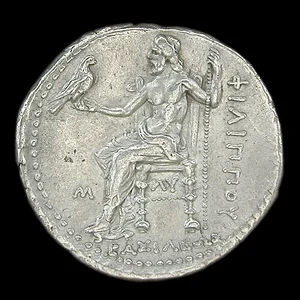
Alexander II of Macedon
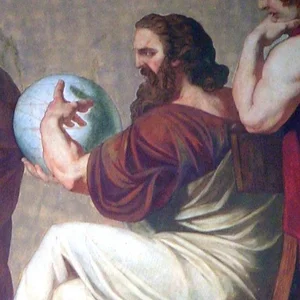
Anaxagoras of Clazomenae
499 av. J.-C. — 427 av. J.-C.
Anaximander
609 av. J.-C. — 545 av. J.-C.
Aspasia
469 av. J.-C. — 399 av. J.-C.
Catiline
107 av. J.-C. — 61 av. J.-C.
Confucius
550 av. J.-C. — 478 av. J.-C.