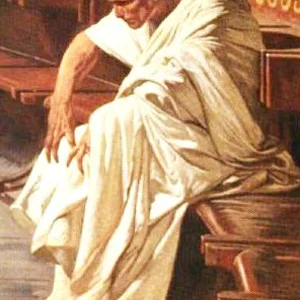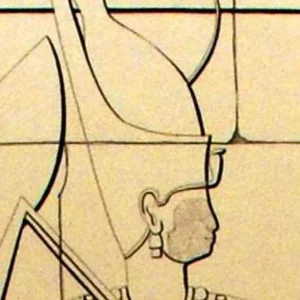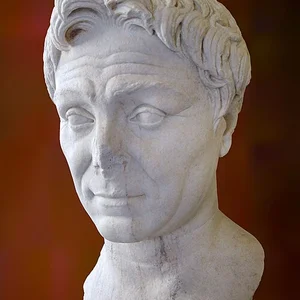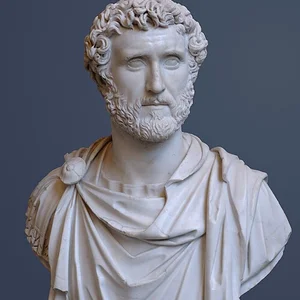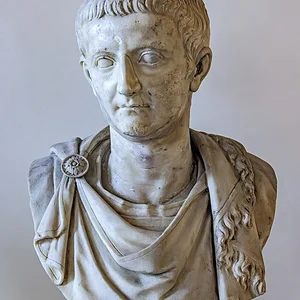

Tiberius (42 BC – 37 AD) was the second Roman emperor, successor to Augustus. He reigned from 14 to 37 AD and withdrew to Capri from 27 AD onward, leaving power in the hands of Sejanus.
Tiberius(41 av. J.-C. — 37)
Tiberius
Rome antique
8 min read
Frequently asked questions
Key Facts
- Born in 42 BC, stepson and designated successor of Augustus
- Became emperor in 14 AD following the death of Augustus
- Led brilliant military campaigns in Germania and Pannonia (12 BC – 9 AD)
- Withdrew to Capri in 27 AD, leaving the prefect Sejanus to govern Rome
- Died in 37 AD after a reign marked by treason trials (crimen maiestatis)
Works & Achievements
Tiberius led brilliant military campaigns to stabilize the northern borders of the Empire following the disaster at Teutoburg Forest. His defensive strategy, based on permanent fortified camps, laid the foundations for imperial defense for two centuries.
Tiberius crushed one of the most serious revolts Rome had faced since the Punic Wars, mobilizing up to ten legions. This victory earned him triumphal honors and the complete trust of Augustus.
Tiberius restored the imperial finances through a policy of strict austerity, cutting public spending and limiting public games. At his death, the imperial treasury held 2.7 billion sesterces — a considerable fortune.
A vast palatial complex built on the heights of Capri, the Villa Jovis served as the nerve center of Tiberian government for a decade. Its ruins, still visible today, bear witness to the emperor's architectural ambitions.
Tiberius transformed Cappadocia and Commagene into directly administered Roman provinces, strengthening Rome's control over the East. This policy of administrative integration durably consolidated Roman presence in Asia Minor.
Anecdotes
In 6 BC, at the height of his military glory, Tiberius shocked everyone by voluntarily exiling himself to the island of Rhodes. Weary of public life and at odds with Augustus, he refused all honors and lived modestly for nearly eight years, studying Greek philosophy.
Tiberius was renowned for his absolute command of both Latin and Greek, which he spoke with equal elegance. During Senate sessions, he expressed himself with such precision and calculated ambiguity that senators never truly knew what he was thinking — Tacitus noted that even his refusals seemed like veiled promises.
In AD 31, Tiberius had Sejanus arrested and executed — the powerful praetorian prefect he had himself elevated to the most influential man in Rome. A single letter read aloud in the Senate was enough to bring down the man already nicknamed 'partner of the Empire,' proving that Tiberius, even in his retreat on Capri, still held the reins of power.
Tiberius was one of the few Roman emperors to consistently refuse divine honors during his lifetime. When cities in Asia Minor sought to erect temples in his name, he firmly discouraged them, insisting that only Augustus deserved such worship. This outward modesty stood in sharp contrast to the suspicion senators harbored toward him.
When he died in AD 37 at Misenum, the news was met with scenes of public rejoicing in Rome, crowds crying 'Tiberius to the Tiber!' The hatred the common people felt for him stood in stark contrast to the more measured judgment of military historians, who recognized in him an exceptional general and a rigorous administrator.
Primary Sources
Tiberius never spoke plainly about his affairs, even when he had no intention of concealing them: his speeches were always obscure and convoluted, and even more so when he wished to make himself understood.
He was tall and strongly built, of a stature above the ordinary, broad in the shoulders and chest, and well-proportioned throughout the rest of his body from head to foot. His left hand was more nimble and powerful than his right.
Never was there seen in a general greater courage in battle, greater prudence in deliberation, greater swiftness in execution, or greater skill in seizing the favorable moment.
Tiberius, from the very beginning of his reign, pretended not to want supreme power, so as to ensure by this pretense that no one would contest that very power which he desired above all else.
Key Places
Imperial residence on the Palatine where Tiberius lived and governed during the early years of his reign, before permanently leaving the capital in 27 AD. The Palatine was the heart of Roman power.
A vast imperial palace built on the northeastern promontory of the island of Capri, where Tiberius spent the last ten years of his reign. It was from this Mediterranean retreat that he governed the Empire through written correspondence.
Greek island in the Aegean Sea where Tiberius voluntarily exiled himself from 6 BC to 2 AD. He lived modestly there, spending time with local philosophers and astronomers, far from the political turmoil of Rome.
Military port on the Bay of Naples where Tiberius died in March 37 AD at the age of 77. His death, possibly assisted according to some sources, was met with relief by those around him.
The natural frontier that Tiberius reinforced during his military campaigns between 4 and 9 AD. After the disaster of Teutoburg Forest, he was tasked with stabilizing the Rhine line and preventing the collapse of the border.
Typical Objects

A ceremonial garment bordered with purple, reserved for senior magistrates and the emperor. Tiberius, known for his austerity, wore the toga with restraint, refusing the ostentatious ornaments that other great men allowed themselves.

Symbol of military triumph awarded by the Senate, the laurel crown adorned Tiberius's head during his triumphal processions. He celebrated a triumph in 7 BC and received triumphal honors for his victories in Germania.

An everyday instrument of imperial administration, wax tablets were used to draft rescripts, orders, and official correspondence. From Capri, Tiberius governed the Empire almost exclusively through dispatches and letters.

A gold ring engraved with the princeps's seal, used to authenticate official documents and imperial letters. Its use guaranteed the authenticity of Tiberius's orders, even those sent from his seclusion on Capri.

The short sword characteristic of the Roman army, which Tiberius carried during his many military campaigns in Pannonia, Dalmatia, and along the Rhine. His frontline military experience earned him the deep respect of the legions.

A passionate reader of Greek literature and mythology, Tiberius was fond of scrolls containing philosophical and poetic texts. On Rhodes and at Capri, he willingly devoted himself to study, surrounded by Greek intellectuals.
School Curriculum
Vocabulary & Tags
Key Vocabulary
Tags
Daily Life
Morning
Tiberius rose at dawn and began his day with a long period of reading and reflection, a habit inherited from his taste for Greek philosophy developed during his time in Rhodes. He would then receive courtiers, delegations, and messengers from Rome, dictating his replies to secretaries. This correspondence-based activity was, from Capri, his primary means of governing the empire.
Afternoon
The afternoon was devoted to military and judicial affairs: reviewing reports from provincial governors, ruling on legal appeals, and overseeing imperial finances. Tiberius placed great importance on administrative rigor and personally read through many case files — unlike some of his successors.
Evening
In the evenings, Tiberius withdrew to his quarters for simple, leisurely dinners in the company of intellectuals, astrologers, and Greek grammarians. Passionate about mythology, he enjoyed posing learned questions to his guests about ancient heroes. His private life was the subject of malicious rumors spread by Suetonius, whose accounts modern historiography largely treats with skepticism.
Food
Tiberius ate modestly for a Roman of his standing: little meat, plenty of vegetables and fresh fish, and common wheat bread. He drank wine diluted with water — a sobriety that stood in contrast to the excesses attributed to other emperors. He was particularly fond of cucumbers, which he reportedly consumed daily according to Pliny the Elder.
Clothing
Tiberius wore the toga on all official occasions, with a deliberate show of simplicity: no excessive ornaments or golden fibulae. He wore a general's cuirass during military campaigns, and a plain wool tunic during his periods of retreat on Capri. This modest style of dress was, for him, a calculated political stance.
Housing
In Rome, Tiberius resided in the imperial domus on the Palatine Hill, inherited from Augustus. From 27 AD onward, he settled permanently in the Villa Jovis on Capri: a complex of terraced buildings overlooking the sea, complete with baths, hanging gardens, and colonnades offering a panoramic view of the Gulf of Naples. The imperial apartments there were spacious, though free of the ostentatious splendor found in some later palaces.
Historical Timeline
Period Vocabulary
Visual Style
Style marbre impérial julio-claudien : austérité sculpturale, colonnades de travertin, pourpre tyrienne et rouge pompéien, lumière méditerranéenne dure sur des visages réservés et calculateurs.
Sound Ambience
Un mélange de solennité impériale romaine et de calme méditerranéen, entre le murmure bureaucratique de la chancellerie et le bruit des vagues sous les falaises de Capri.
Liens externes & ressources
Références
Œuvres
Consolidation de la frontière du Rhin et du Danube
4–9 ap. J.-C.
Répression de la révolte pannonienne et dalmate
6–9 ap. J.-C.
Réforme financière de l'Empire
14–37 ap. J.-C.
Construction de la Villa Jovis à Capri
27–37 ap. J.-C.
Réorganisation des provinces orientales
17–19 ap. J.-C.