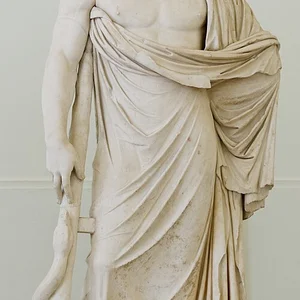

The blind seer of Greek mythology, Tiresias was the most celebrated prophet of Thebes, serving Apollo. Struck blind by the gods, he received in return the gift of prophecy and an exceptionally long life. He appears in many of the greatest works of antiquity, from Sophocles to Homer.
Tiresias
Tiresias
9 min read
Frequently asked questions
Famous Quotes
« The truth is terrible — but worse still is not to know it. (Sophocles, Oedipus Rex)»
« No man is more wretched than one who knows, when knowing brings him no benefit. (Sophocles, Oedipus Rex)»
Key Facts
- Tiresias is blinded by Hera (or Athena, depending on the version) and receives in exchange the gift of prophecy from Apollo.
- He lived for seven human generations thanks to the longevity granted to him by Zeus.
- In Homer's Odyssey, Odysseus descends into the Underworld to consult his shade.
- In Sophocles' Oedipus Rex, he reveals to Oedipus the truth about his fate.
- According to one myth, he was temporarily transformed into a woman, giving him a dual experience of the human condition.
Works & Achievements
Tiresias predicted to Laius that his son would kill him and marry his own mother. This prophecy is the central tragic mechanism of the entire Theban cycle and the driving force of Sophocles' Oedipus.
Tiresias prophesied that Thebes would defeat the Seven if a descendant of Cadmus sacrificed himself willingly. Menoikeus, son of Creon, gave his life and secured the city's victory.
From the realm of the dead, Tiresias told Odysseus of the obstacles on his journey home and revealed his ultimate fate — a gentle death coming from the sea, far from Ithaca.
Tiresias warned Creon that his refusal to bury Polynices had defiled the altars of the gods. Creon did not listen and lost both his son and his wife — the prophecy fulfilled itself point by point.
Tiresias defends the cult of Dionysus against King Pentheus, embodying the religious wisdom that recognizes the power of the new god and warns against the hubris of those who deny him.
Eliot makes Tiresias the central narrator of his modernist poem, a symbol of universal memory who has 'seen it all.' This reappropriation illustrates the enduring presence of the character in Western culture.
Anecdotes
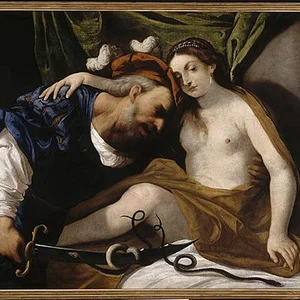
According to Ovid in the Metamorphoses, Tiresias was transformed into a woman for seven years after striking two mating snakes on Mount Cithaeron. Having become a man again by repeating the act, he became the only being to have known both sexes. When Zeus and Hera argued over whether men or women experienced more pleasure in love, they chose him as arbitrator. His answer — that women experienced nine times more — enraged Hera, who struck him blind.
To compensate for the blindness inflicted by Hera, Zeus granted Tiresias two exceptional gifts: the power of prophecy and an extraordinarily long life. According to tradition, he lived for seven human generations, witnessing the history of Thebes from its origins to its fall at the hands of the Epigones. His longevity allowed him to observe the rise and ruin of entire families, which lent his predictions an unmatched authority.
In Homer's Odyssey, Odysseus descends to the Underworld on the advice of the sorceress Circe to consult the shade of Tiresias. The seer, even in death, retained all his mental faculties — a privilege granted by Persephone. He revealed to Odysseus the trials that lay ahead and showed him the way back to Ithaca. This scene, known as the Nekyia, is one of the most celebrated passages in all of ancient literature.
In Sophocles' Oedipus Rex, Tiresias is summoned by King Oedipus to unravel the mystery of the plague ravaging Thebes. The old seer knows the terrible truth — that Oedipus killed his father and married his mother — but hesitates to reveal it. Stung by Oedipus's accusations of lies and conspiracy, he ultimately prophesies the king's downfall with devastating precision, illustrating the tragic conflict between divine truth and human will.
According to a version recorded by Callimachus, Tiresias lost his sight after accidentally coming upon Athena bathing on Mount Helicon. His mother Chariclo, a nymph and companion of the goddess, begged that his sight be restored. Athena could not do so, but she cleansed Tiresias's ears so that he could understand the language of birds, and gave him a magical staff of cornel wood to guide his steps — a gift both practical and sacred.
Primary Sources
Then came the soul of Theban Tiresias, holding his golden staff. He recognized me and spoke: 'Son of Laertes, noble Odysseus, why have you left the light of the sun to come and see the dead and this joyless place?'
TIRESIAS: Truth is powerful, and it will ultimately prevail. OEDIPUS: Where does it come from, this truth? Certainly not from you — you who are blind in ears, mind, and eyes. TIRESIAS: You insult me; you will soon speak those very words about your own family.
TIRESIAS: Know this — you stand on the razor's edge of fate. The city's altars and the hearths of the gods are all defiled by birds and dogs that have torn apart the wretched son of Oedipus, left lying without burial.
TIRESIAS: Two powers, young man, hold the highest rank among mortals: the goddess Demeter — she is the Earth — and Dionysus, son of Zeus. Both deserve our reverence. Take care not to scorn this new god.
By chance, Tiresias had struck with his staff two large snakes coupling in a green forest. Wondrous to tell! He was transformed from male to female. Seven years later, he came upon the same snakes again: 'If striking you has the power to change the striker, I will strike you once more.'
Key Places
The city whose official seer Tiresias was from its founding until its fall to the Epigoni. He advised several generations of kings, from Laius to Creon, guiding the royal family through its greatest crises.
The mythic mountain between Boeotia and Attica where Tiresias struck the two serpents that triggered his transformation. It is also where the infant Oedipus was abandoned and where Actaeon was torn apart by his own hounds.
The realm of the dead where the shade of Tiresias retains his prophetic powers — a privilege granted by Persephone to him alone. Odysseus descends to consult him during the Nekyia, a scene that became the founding model of the literary descent into the Underworld.
A sacred spring in Boeotia where Tiresias died after drinking its cold waters during the Thebans' flight from the Epigoni. The site was forever associated with his memory and with his passage between worlds.
The great sanctuary of Apollo, the god whose earthly servant Tiresias was. Although he prophesied from Thebes, his gift was understood as an extension of the Apollonian power radiating outward from Delphi.
Typical Objects

Tiresias walked with a magical staff given to him by Athena to compensate for his blindness. This object is his most recognizable attribute and symbolizes his ability to 'see' by means other than his eyes.

On Mount Cithaeron, Tiresias struck two mating serpents, triggering his transformation into a woman. Serpents are associated with him as emblems of wisdom, metamorphosis, and oracular power.

As the official seer of Thebes, Tiresias dictated his prophecies to assistants who recorded them on wooden or wax tablets, preserved in temples to be consulted by kings.

In the Nekyia of the Odyssey, Odysseus must pour the blood of sacrificed animals so that the shade of Tiresias may momentarily recover his senses. The blood becomes the ritual link between the living and the dead.

Tiresias interpreted the flight and song of birds to read divine signs. In Antigone, he observes birds fighting around the altars and reads in them a sign of the gods' anger against Creon.

The sacred plant of the god of prophecy, whose principal servant Tiresias was. The seer carried laurel branches during official consultations, a symbol of his divinely inspired mission.
School Curriculum
Vocabulary & Tags
Key Vocabulary
Daily Life
Morning
Tiresias rose at dawn to listen to the songs of the first birds, reading their omens with a precision honed over generations. Guided by his staff, he made his way to the temple of Apollo for the morning libations and the first sacrifices, whose entrails he would then interpret.
Afternoon
Afternoons were devoted to consultations: kings, generals, and ordinary citizens came to put their questions to the seer. Tiresias received them seated on a stone chair, his eyes turned toward the unseen sky, dictating his oracles in hexameter verse to assistants who transcribed them onto clay tablets.
Evening
In the evenings, Tiresias meditated on the day's signs and communed with the gods through prayer and offerings of incense. His vast memory, spanning several generations, allowed him to connect present events to ancient prophecies, building a vision of fate that no one else could match.
Food
Like Greek seers in general, Tiresias observed periods of ritual fasting before major prophecies to purify his body and open his mind to divine messages. His daily diet was frugal: barley bread, olives, dried figs, and wine heavily diluted with water.
Clothing
Tiresias wore a white linen chiton covered by a saffron wool himation — colors associated with Apollo and prophetic purity. For official ceremonies, a laurel crown completed his attire, marking his consecration to the god of prophecy.
Housing
The seer resided in Thebes in a dwelling adjoining the temple of Apollo, placed at his disposal by the city in recognition of his services. His simple but respected home was a place of constant pilgrimage, where people came seeking guidance in times of collective or personal crisis.
Historical Timeline
Period Vocabulary
Visual Style
Tirésias est représenté comme un vieillard vénérable aux yeux blancs et aveugles, drapé de blanc et de safran, tenant son bâton sacré dans un temple thébain baigné d'une lumière dorée et mystérieuse.
Sound Ambience
L'atmosphère de Tirésias mêle le crépitement du feu sacré, le toc régulier de son bâton sur le marbre et le murmure des suppliants attendant une prophétie dans un temple baigné de lumière méditerranéenne.
Liens externes & ressources
Références
Œuvres
Prophétie sur Œdipe et la maison de Laïos
Mythe, cycle thébain
Oracle aux Sept contre Thèbes
Mythe, cycle thébain
Révélation à Ulysse dans les Enfers
Mythe — Odyssée, Chant XI
Avertissement à Créon (Antigone, Sophocle)
vers 441 av. J.-C.
Défense de Dionysos (Les Bacchantes, Euripide)
405 av. J.-C.
Personnage de La Terre vaine (T. S. Eliot)
1922