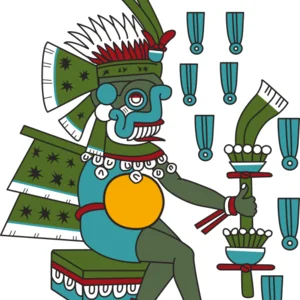

Tlaloc is the Aztec god of rain, water, and fertility. Venerated since the pre-Classic Mesoamerican civilizations, he was one of the most important deities in the Aztec pantheon, associated with both life and death.
Tlaloc
Tlaloc
9 min read
Frequently asked questions
Key Facts
- Tlaloc is attested as early as the Teotihuacan civilization (c. 100 BCE – 650 CE), long before the Aztecs
- He occupied one of the two main shrines of the Templo Mayor in Tenochtitlan, alongside Huitzilopochtli
- Children were sometimes sacrificed in his honor, particularly during the dry season to summon rain
- His realm, the Tlalocan, was a lush paradise welcoming those who died by drowning or lightning strike
- He is depicted with ring-shaped eyes, fangs, and a feathered headdress — an iconography recognizable throughout Mesoamerica
Works & Achievements
In Aztec cosmogony, Tlaloc reigns over the third sun (Nahui-Quiahuitl, 'Four-Rain'), which ends in a devastating rain of fire. This founding myth explains the cosmic cycle and the permanent necessity of sacrifices to maintain the natural order.
Atlcahualo, the first of the 18 months in the Aztec solar calendar, was entirely dedicated to Tlaloc and the Tlaloque. Processions, sacred chants, and offerings of children marked the petition for fertile rains to nourish the maize crops essential to the empire's survival.
This ritual chant in Classical Nahuatl, preserved in colonial sources, was sung by priests during ceremonies in honor of the god. It invokes life-giving rain, the fertility of maize fields, and the protection of farming communities against drought.
This wall mural from the Palace of Tepantitlan depicts Tlalocan, the god's aquatic paradise, filled with human figures playing and gathering fruit in a lush garden. It is one of the oldest known representations of Tlaloc's paradise, predating the Aztecs by several centuries.
This monumental basalt sculpture of Tlaloc weighs approximately 168 tons and stands over 7 meters tall. Its spectacular transport to the National Museum of Anthropology in Mexico City in 1964 was accompanied by an unexpected torrential downpour, which many interpreted as a sign from the god.
Anecdotes
During ceremonies honoring Tlaloc, the Aztecs sacrificed young children, as their tears were believed to be an omen of favorable rain. The more the children wept during the ritual, the more Tlaloc was expected to send abundant rainfall for the coming harvests.
Tlaloc did not act alone: he was assisted by four minor deities called the Tlaloque, each associated with a cardinal direction and a different type of rain — life-giving, torrential, icy, or destructive. These assistants stored water in enormous celestial jars, which they shattered to release rain upon the world.
At the top of the Templo Mayor in Tenochtitlan, two shrines stood side by side: one dedicated to Huitzilopochtli, god of war, painted red, and the other to Tlaloc, painted blue. This duality symbolized the essential balance between war and agriculture in Aztec civilization.
The cult of Tlaloc is far older than the Aztecs: depictions of the god with jade-ringed eyes and protruding fangs have been found at Teotihuacan, dating back to around 200 BCE. The Aztecs thus inherited and amplified an ancient Mesoamerican tradition that predated them by more than a thousand years.
According to Aztec mythology, those who died by drowning, struck by lightning, or swept away by a flood did not go to the ordinary realm of the dead, but instead to Tlalocan, a lush paradise of eternal abundance located in the east. This afterlife destination was considered one of the most enviable in all of Aztec cosmology.
Primary Sources
Tlaloc is described as the lord of rains, whose priests wore masks ringed with jade circles evoking his characteristic eyes. The rituals held in his honor lasted several days and involved fasting, offerings of copal incense, and the sacrifice of children whose weeping was interpreted as an omen of rain.
This pre-Columbian manuscript depicts Tlaloc numerous times in his canonical iconography: goggle eyes, fanged mouth, and a body covered with stripes symbolizing water. He appears associated with the divinatory cycles tied to agricultural seasons and the rain days of the tonalpohualli.
Durán describes in detail the ceremonies of the month Atlcahualo dedicated to Tlaloc: children were led to the summits of sacred mountains to be offered to the god, and their abundant weeping was interpreted as a promise of fertile rain for the harvests to come.
The Codex Vaticanus illustrates the Tlalocan, Tlaloc's paradise, as a lush, water-filled garden overflowing with flowers, fruits, and flowing water. The souls of those who died by drowning or lightning are depicted there playing and resting in eternal bliss.
Key Places
The great twin temple of the Aztec capital housed side by side the shrines of Tlaloc (north side, painted blue) and Huitzilopochtli (south side). It was the nerve center of Tlaloc's cult, where major sacrifices and annual processions took place.
This sacred mountain, 4,125 meters above sea level and visible from Tenochtitlan, was the most important annual pilgrimage site dedicated to Tlaloc. A temple at the summit hosted first-rain ceremonies, and ritual offerings were deposited there every year.
In this vast pre-Columbian metropolis — abandoned long before the Aztecs — the murals of the Palace of Tepantitlan depict a rain god identified as Tlaloc surrounded by his lush paradise, the Tlalocan, proving that this cult stretches back thousands of years.
A watery, lush paradise located to the east according to Aztec cosmology, the Tlalocan was Tlaloc's celestial realm, where the souls of the dead who had died water-related deaths — by drowning, lightning, or flood — came to dwell. This mythical place embodied fertility and eternal life.
The vast lake on which Tenochtitlan was built, Lake Texcoco was a sacred space closely linked to Tlaloc. Ceremonies and offerings were placed in its waters to honor the god, and its presence was essential to the very survival of the floating Aztec city.
Typical Objects

Tlaloc's mask is distinguished by its large eyes encircled by rings of jade or obsidian, symbols of water and preciousness. Worn by priests during ceremonies, it transformed the wearer into a living embodiment of the rain god.

These large ceremonial ceramic vessels bearing Tlaloc's face were used to burn copal, a sacred resin offered as tribute. Thousands of examples have been uncovered in excavations at the Templo Mayor in Mexico City, testifying to the fervor of the cult.

Blue-green jade was Tlaloc's sacred stone, a symbol of water, fertility, and precious life. Jade necklaces, masks, and figurines were deposited as offerings in sanctuaries and in the foundations of temples dedicated to the god.

This ritual rattle filled with seeds or pebbles was shaken during ceremonies to mimic the sound of rain and invoke Tlaloc. Priests wielded it during sacred dances and processions held in honor of the water god.

Vessels painted blue-green — Tlaloc's sacred color, associated with water — held the blessed water used in aspersion rituals. They could also serve to collect rainwater, which was considered a direct gift from the god.

Volcanic obsidian — black and razor-sharp — was used for sacrifices offered to Tlaloc during the great annual ceremonies. These ceremonial knives, sometimes decorated with turquoise mosaics, embodied the Aztec connection between death and fertility.
School Curriculum
Vocabulary & Tags
Key Vocabulary
Tags
Daily Life
Morning
At dawn, the priests dedicated to Tlaloc (tlamacazqui) rose before the sun to perform ritual ablutions in basins of holy water. Clad in their blue-green robes and ring-eyed masks, they climbed the steps of the Templo Mayor to greet the rising day with sacred chants and copal incense burned in large ceramic censers bearing the god's likeness.
Afternoon
In the cornfields surrounding Tenochtitlan, farmers watched the clouds forming over Mount Tlaloc to anticipate the rains. During droughts, processions of supplicants made their way to the temples to deposit offerings of jade, blue tortillas, and amaranth dough figurines (tzoalli) representing the Tlaloque, the god's assistants.
Evening
In the evening, at the heart of Tlaloc's blue sanctuary, priests recited sacred hymns and consulted the tonalpohualli (the 260-day divinatory calendar) to determine auspicious days for upcoming ceremonies. The sound of drums and water flutes accompanied prayers for the protection of crops and the warding off of devastating droughts.
Food
Food offerings destined for Tlaloc consisted mainly of blue and green foods: blue-dyed corn tortillas, zucchini, green beans, and edible amaranth dough figurines representing the god and his assistants. These foods were first presented before the idols, then ritually consumed by the priests and ceremony participants.
Clothing
The priests of Tlaloc wore distinctive garments: long robes dyed blue-green, the sacred color of water and jade, paper headdresses decorated with white heron feathers, and braided leather sandals. During major ceremonies, they donned imposing ring-eyed masks and painted their faces black and blue, the god's characteristic colors.
Housing
Tlaloc's sanctuary at the top of the Templo Mayor was a blue-painted chamber decorated with representations of clouds, rain, and frogs — the god's messenger animals. The sacred enclosure (tlachco) included reservoirs of holy water, aquatic plant gardens, and pools containing frogs and snakes, earthly creatures associated with rain and Tlaloc.
Historical Timeline
Period Vocabulary
Liens externes & ressources
Références
Œuvres
Le mythe des Quatre Soleils et du cinquième âge
tradition orale précolombienne, compilée au XVIe siècle
Calendrier rituel du mois Atlcahualo
pratique annuelle attestée, jusqu'en 1521
Hymne sacré à Tlaloc (Tlaloc icuic)
avant 1521, transcrit par Sahagún vers 1558
Fresque du Paradis de Tlaloc, Teotihuacan
vers 200-650 apr. J.-C.
Sculpture colossale de Tlaloc de Coatlinchán
époque aztèque, XIVe-XVIe siècle