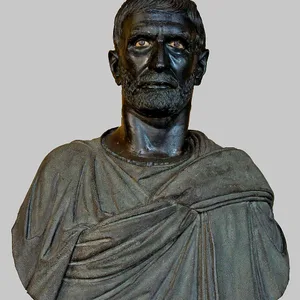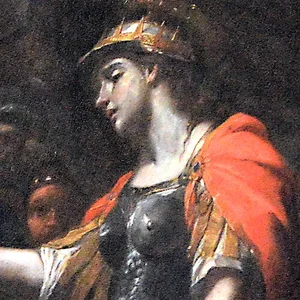

Queen of the Massagetae, a nomadic people of Central Asia, Tomyris is famous for defeating and killing Cyrus the Great around 530 BC. She embodies the resistance of the steppe peoples against the expansion of the Achaemenid Persian Empire.
Tomyris(600 av. J.-C. — 600 av. J.-C.)
Tomyris
Massagètes
9 min read
Frequently asked questions
Famous Quotes
« I warned you, and I told you I would give you your fill of blood. (Herodotus, Histories, I, 214)»
Key Facts
- Queen of the Massagetae, a nomadic people living east of the Caspian Sea, around 530 BC
- Cyrus the Great attempted to conquer her through trickery, capturing her son Spargapises and causing his death
- She inflicted a decisive defeat on the Persian army around 530 BC, during which Cyrus the Great was killed
- Herodotus recounts that she had Cyrus's head plunged into a wineskin filled with blood as a symbolic act of retribution
- She remains one of the rare female figures of antiquity to have brought a Persian conquest to an abrupt halt
Works & Achievements
Tomyris's greatest achievement was defeating and killing the most powerful conqueror of her era, halting the Persian expansion into the steppes of Central Asia. This victory shattered Cyrus's legendary invincibility and protected the independence of nomadic peoples for generations.
Before armed conflict broke out, Tomyris rejected Cyrus's marriage proposal and offered him a natural boundary — the Araxes River — as the border between their territories. This clear-eyed diplomacy reveals a queen who sought to avoid war while defending her people's sovereignty without compromise.
Despite the death of her son **Spargapises**, Tomyris held her army together and launched a large-scale counterattack. Her ability to channel grief into fighting spirit and unite all Massagetae forces speaks to her exceptional qualities as commander-in-chief.
By repelling the Persian Empire, Tomyris preserved the Massagetae's nomadic way of life — their pastoral traditions, social organization, and cultural autonomy. Her reign stands as a successful act of resistance by a steppe civilization against the first great imperial power in history.
Anecdotes
When Cyrus the Great proposed marriage to Tomyris, she immediately understood it was a political pretext to seize her kingdom without fighting. She refused outright, making it clear she had no need of a husband but of an army to defend her people. This sharp reply reveals a clear-eyed and determined woman facing the most powerful ruler of her time.
To weaken the Massagetae before the real battle, Cyrus used a trick: he abandoned a camp filled with wine, a drink unknown to these nomadic people. The Massagetae vanguard, led by Spargapises, Tomyris's son, got drunk and was massacred in their sleep. Cyrus believed he had found the weakness of the steppe peoples — but this temporary victory was about to unleash the fury of a mother.
Captured and humiliated, Spargapises asked to have his chains removed. Once his hands were free, he killed himself rather than live in the shame of defeat. Upon learning of her son's death through Cyrus's treachery, Tomyris sent him this message: 'I warned you — now I will give you your fill of blood.'
The decisive battle saw Tomyris commit all Massagetae forces against the Persian army. Herodotus describes it as one of the most violent ever fought by “barbarian” peoples: after a torrent of arrows, both sides fought hand to hand without mercy. The Persians were annihilated and Cyrus the Great met his death on that steppe battlefield.
After the victory, Herodotus reports that Tomyris plunged Cyrus's severed head into a wineskin filled with human blood, declaring: 'I promised to give you your fill of blood — here, drink your fill.' This symbolic act, whether historically accurate or not, became the enduring image of a queen avenging her son and humiliating the conqueror who believed he could bend everything to his will through cunning.
Primary Sources
Tomyris sent word to him: “King of the Medes, cease pressing forward in this matter; you cannot know whether what you are doing will profit you.” Then, after her son’s death: “Bloodthirsty wretch, do not rejoice in this advantage; I will give you your fill of blood.”
Tomyris, queen of the Scythians, after defeating Cyrus, cut off his head and plunged it into a skin filled with human blood, crying out: “Satiate yourself with the blood you have always thirsted to shed.”
The Massagetae are a Scythian people who dwell beyond the Araxes, in the plains and marshes formed by the river, as well as on the islands within those marshes. They are said to carry weapons similar to those of the Scythians.
Ctesias gives a divergent account of Cyrus’s death, depicting him falling in battle against the Derbices with no mention of Tomyris — which illustrates the plurality of ancient traditions surrounding the end of the Great King.
Key Places
Ancestral territory of the Massagetae, located between the Caspian Sea and the Aral Sea, in present-day Kazakhstan and Turkmenistan. It was here that Tomyris ruled over her nomadic people and from where she organized resistance against the Persian advance.
A Central Asian river that Cyrus sought to cross in order to attack the Massagetae, despite Tomyris's warning. Its crossing marked the point of no return for the Persian expedition and was the theater of the decisive military operations of 530 BC.
Site of the decisive battle of around 530 BC where Tomyris crushed the Persian army and killed Cyrus the Great. Herodotus describes it as one of the bloodiest battles of Antiquity; its exact location remains unknown, somewhere in the steppes east of the Caspian Sea.
Capital founded by Cyrus the Great, where his tomb still stands. It symbolizes the empire that Tomyris helped contain: by killing Cyrus, the queen of the Massagetae permanently halted Achaemenid expansion toward the steppes of Central Asia.
Typical Objects

The main weapon of Massagetae horsemen, made from horn, wood, and animal sinew glued together, it was more powerful and compact than a simple bow. Tomyris commanded fearsome horse archers who opened battles by releasing clouds of arrows before engaging in hand-to-hand combat.

A fermented drink made from mare's milk, a staple food of the nomadic peoples of the steppes. Herodotus mentions that the Massagetae had no knowledge of wine — which explains why Cyrus's ruse (leaving wine at the camp) was so effective against Spargapises's vanguard.

The portable dwelling of the nomadic peoples of Central Asia, built from felt (fulled wool) stretched over a dismountable wooden frame. Tomyris herself lived in this transportable structure, well suited to the seasonal movements of the Massagetae across the steppes between the Caspian Sea and the Aral Sea.

Herodotus notes that the Massagetae made abundant use of gold for their military equipment (arrowheads, axes, horse harnesses) but had no knowledge of iron or bronze. The gold jewelry and ornaments worn by Tomyris symbolized her rank as queen in this nomadic society.

A weapon characteristic of the Scythian and Massagetae peoples, the sagaris is a small axe with a curved blade used in close combat and on horseback. It is attested archaeologically in kurgans (monumental burial mounds) of the Pontic and Caspian steppes, confirming its central place in nomadic armament.

Herodotus attests that the Massagetae made their arrowheads from gold, a metal they possessed in abundance across their territories. These arrows, carried in a leather quiver attached to the saddle, were both formidable weapons of war and symbols of wealth and social status.
School Curriculum
Vocabulary & Tags
Key Vocabulary
Tags
Daily Life
Morning
At sunrise, Tomyris would wake in her large royal yurt, its entrance oriented eastward according to nomadic tradition. Her first tasks were to oversee the preparations for the day: a possible breaking of camp, the gathering of the herds, and the reception of clan chiefs who brought her news from the various Massagetae tribes.
Afternoon
The afternoon was devoted to the essential activities of nomadic rule: Tomyris held council with her warriors, settled disputes between clans according to her people's customs, and organized the seasonal movements to the pastures that governed Massagetae life between the plains of the Aral Sea and the banks of the Araxes River.
Evening
In the evening, around the central fire of the royal yurt, Tomyris received embassies and made her political decisions in the presence of elders and military chiefs. Meals consisted of grilled meat and livestock products; according to Herodotus, the Massagetae would sometimes mix their food with the blood of their animals during certain rituals common to the peoples of the steppes.
Food
The diet of Tomyris and her people was based on the products of their herds: horse, mutton, and camel meat, fermented mare's milk (*koumis*), and dried cheeses. Hunting supplemented these resources with the game of the steppes. Herodotus notes that the Massagetae had no knowledge of wine or cultivated grains — foods characteristic of sedentary peoples.
Clothing
Tomyris wore garments suited to life on horseback and the harsh steppe winters: leather or wool trousers, a long belted tunic, and a heavy fur cloak. Archaeological excavations of burial mounds belonging to high-ranking women in the Eurasian steppes reveal gold ornaments — bracelets, necklaces, and plaques sewn onto clothing — similar to those the queen of the Massagetae must have worn.
Housing
Tomyris lived in a large royal yurt, more spacious than those of ordinary warriors, covered with thick felt and decorated with wool carpets and hangings bearing geometric patterns. The entire structure could be dismantled within a few hours and loaded onto carts for seasonal migrations. This yurt was the center of power: a place of justice, council, and reception for foreign ambassadors.
Historical Timeline
Period Vocabulary
Liens externes & ressources
Références
Œuvres
Victoire militaire sur Cyrus le Grand
v. 530 av. J.-C.
Résistance diplomatique à l'empire achéménide
v. 530 av. J.-C.
Mobilisation totale des Massagètes après la trahison de Cyrus
v. 530 av. J.-C.
Préservation de l'identité nomade massagète
VIe siècle av. J.-C.