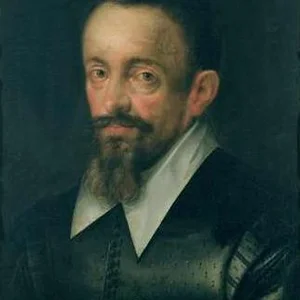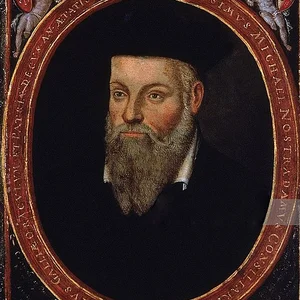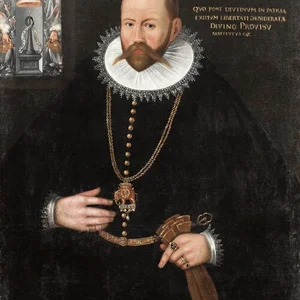

A Danish Renaissance astronomer, Tycho Brahe is renowned for his astronomical observations of unmatched precision before the invention of the telescope. He discovered a supernova in 1572 and established that comets travel beyond the Moon, challenging Aristotelian cosmology.
Tycho Brahe(1546 — 1601)
Tycho Brahe
Royaume de Danemark
7 min read
Frequently asked questions
Key Facts
- 1572: observes and publishes his work on a new star (supernova), proving that the heavens are not unchanging
- 1576: establishes his observatory Uraniborg on the island of Hven, funded by King Frederick II of Denmark
- 1577: demonstrates through observation that the great comet lies beyond the Moon, contradicting Aristotle
- 1600: welcomes Johannes Kepler as his assistant; his data would allow Kepler to formulate his laws of planetary motion
- 1601: dies in Prague, leaving Kepler astronomical data that would revolutionize astronomy
Works & Achievements
Treatise on the supernova of 1572 observed in Cassiopeia. Tycho demonstrates that this phenomenon lies beyond the Moon, challenging the Aristotelian doctrine of the immutability of the heavens.
Study of the comet of 1577 showing that it traveled through the supralunar region, invalidating the model of crystalline spheres and paving the way for a new cosmology.
An illustrated description of all the instruments at Uraniborg, presented to European sovereigns. This technical catalogue reveals the extraordinary care Tycho devoted to the precision of his measurements.
A catalogue of 777 stars (later expanded to 1,000) whose positions Tycho measured with unrivaled accuracy. Kepler would draw on it directly to establish his laws of planetary motion.
A cosmological model proposed as a compromise between Ptolemy and Copernicus: the Earth remains stationary at the center, the Sun orbits the Earth, and the other planets orbit the Sun.
A collection of scientific correspondence illustrating Tycho's European intellectual network and his exchanges with the astronomers of his time.
Anecdotes
During a sword duel in 1566 at the University of Rostock, Tycho Brahe lost the tip of his nose. He had a prosthetic made from a silver and copper alloy, which he wore until his death. Analysis of his remains carried out in 2010 confirmed the presence of copper and zinc on his facial bones.
Tycho Brahe owned a tame elk that lived in his castle at Uraniborg. The animal had an unfortunate habit of drinking beer, which ultimately cost it its life: one evening, the elk climbed a staircase while drunk and fell, dying from its injuries.
To fund his research, King Frederick II of Denmark gave Tycho Brahe the entire island of Hven in 1576. The astronomer built Uraniborg there — the first modern astronomical observatory in Europe — followed by Stjerneborg, a second semi-underground observatory designed to better shield his instruments from the wind.
Tycho Brahe died in 1601 under mysterious circumstances, eleven days after a banquet in Prague. According to tradition, he had refused out of politeness to leave the table to use the restroom, which allegedly caused a fatal urinary infection. His remains have been exhumed several times, revealing traces of mercury — possibly linked to his medical remedies.
Primary Sources
Tycho Brahe describes in detail all the astronomical instruments he designed and used at Uraniborg, explaining how they worked and their remarkable precision for the time.
"This new star surpasses in brightness all the fixed stars and almost Venus itself… It is devoid of all motion, unlike comets."
Tycho Brahe demonstrates through his calculations that the great comet of 1577 moves beyond the Moon, in the so-called "ethereal" region, thereby disproving Aristotle's theory of crystalline spheres.
Tycho Brahe's scientific correspondence with the astronomers of his time, bearing witness to the intense intellectual exchanges among European scholars on the reform of astronomy.
Key Places
Island granted by King Frederick II where Tycho built Uraniborg and then Stjerneborg. For twenty years, this site was the leading astronomical center in Europe.
The first great modern astronomical observatory in Europe, built in 1576. Tycho installed his enormous measuring instruments there and trained many students.
The city where Tycho settled in 1599 under the patronage of Emperor Rudolf II. It was here that he met Kepler and spent his final years.
The university where Tycho studied law and then astronomy, and where he lost the tip of his nose in a duel in 1566.
A residence offered by Rudolf II to Tycho near Prague, where he set up a temporary observatory and welcomed Kepler in 1600.
Typical Objects

A fixed measuring instrument mounted on a wall, with a radius of up to 2 meters, used by Tycho to measure star positions with an accuracy of less than one arcminute. It was thanks to these giant instruments that he compiled the most precise astronomical data of the pre-telescopic era.

A portable instrument with two articulated arms used to measure the angle between two celestial bodies. Tycho had several improved versions built at Uraniborg to allow multiple simultaneous observations.

A sphere made up of rings representing the great circles of the celestial sphere. Tycho owned an enormous brass globe on which he personally plotted the positions of stars as he observed them over time.

Following his duel in 1566, Tycho wore a prosthetic tip for his nose for the rest of his life, made from an alloy of copper and silver. It has become one of the most well-known symbols of this eccentric scholar.

Handwritten documents compiled by Tycho to correct for the bending of starlight as it passes through the atmosphere. These unprecedented corrections significantly improved the accuracy of his measurements.

Tycho also practiced alchemy and medicine at Uraniborg, which was equipped with a full laboratory in the basement. This pursuit, typical of Renaissance scholars, reflects the overlap between emerging science and traditional knowledge.
School Curriculum
Vocabulary & Tags
Key Vocabulary
Daily Life
Morning
Tycho would rise after only a few hours of sleep, having often stayed up through much of the night for his observations. He would dictate his notes to his assistants and verify the measurements recorded during the night. He then supervised the work of his many students and technicians in the instrument workshop.
Afternoon
The afternoon was devoted to astronomical calculations, correspondence with scholars across Europe, and writing his treatises. Tycho also ran his private printing press at Uraniborg and oversaw his alchemical laboratory, where he prepared medicines. He occasionally received noble visitors who came to admire his instruments.
Evening
In the evenings, Tycho often hosted lavish banquets for his guests, during which his tame elk sometimes roamed freely. As night fell, he would take his place at his instruments alongside his assistants to begin the nocturnal observations, dictating measurements aloud for hours on end.
Food
As a wealthy Danish nobleman, Tycho ate abundantly: roasted meats, salted fish, rye bread, cheeses, and local ales. Banquets at Uraniborg could be true feasts bringing together scholars and nobles, accompanied by beer and imported wines.
Clothing
Tycho wore the dress of a Danish Renaissance nobleman: a doublet of velvet or fine cloth, a lace collar, square-toed shoes, and a cloak. He wore his metal prosthetic nose, carefully fitted in place. When observing, he dressed in warmer clothing, as nights in the open observatory were bitterly cold.
Housing
Tycho lived in Uraniborg, a palace-observatory designed according to the principles of Vitruvius, with symmetrical gardens, fountains, a paper mill, and an integrated printing press. Its walls housed quarters for his assistants, craftsmen's workshops, and an alchemical laboratory in the basement. A second observatory, Stjerneborg, built partly underground, completed the complex.
Historical Timeline
Period Vocabulary
Visual Style
Portrait de savant nordique de la Renaissance tardive : lumière dramatique à la bougie, instruments en laiton dorés, vêtements nobiliaires danois et ciel étoilé encadré par des fenêtres en pierre.
Sound Ambience
Ambiance nocturne d'Uraniborg : vent marin, instruments en laiton, plumes sur parchemin et feu de cheminée dans une tour de pierre dédiée aux étoiles.
Liens externes & ressources
Références
Œuvres
De Nova Stella
1573
De Mundi Aetherei Recentioribus Phaenomenis
1588
Astronomiae Instauratae Mechanica
1598
Catalogus Stellarum Fixarum
1598-1602
Système tychonique
1588
Epistolarum Astronomicarum Libri
1596