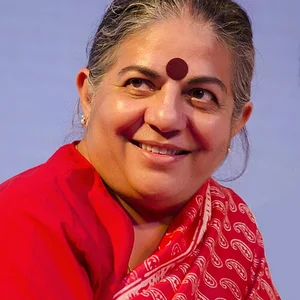

Vandana Shiva (born 1952) is an Indian physicist, philosopher, and environmental activist. Founder of the Navdanya movement, she champions biodiversity and farmers' rights while opposing GMOs and neoliberal globalization. A leading figure in ecofeminism, she received the Right Livelihood Award (the Alternative Nobel Prize) in 1993.
Vandana Shiva(1952 — ?)
Vandana Shiva
Inde
8 min read
Frequently asked questions
Famous Quotes
« The Earth is not a resource, it is a living community.»
« We are either the solution or the problem.»
Key Facts
- Born in 1952 in Dehradun, India, into a family of foresters
- Earned a PhD in quantum physics from the University of Western Ontario (Canada) in 1978
- Founded the Navdanya movement in 1987 to preserve traditional seeds and support Indian farmers
- Recipient of the Right Livelihood Award (Alternative Nobel Prize) in 1993
- Author of Staying Alive (1988), a foundational work in ecofeminism
Works & Achievements
A founding text of ecofeminism, in which Vandana Shiva argues that the domination of nature and the domination of women by Western development share the same ideological roots.
A network for the conservation of traditional seeds and the promotion of organic farming, now counting over 900,000 farmer members and 150 seed banks across India.
An essay in which Vandana Shiva examines how Western economic and scientific monoculture is destroying biological and cultural diversity on a global scale.
A thoroughly documented critique of the appropriation by transnational corporations of knowledge and biological resources belonging to peoples of the Global South, particularly in India.
A critical analysis of how agribusiness multinationals have seized control of global food production at the expense of farmers and biodiversity.
Vandana Shiva demonstrates the links between industrial agriculture, oil dependency, and the climate crisis, and makes the case for agroecology as a systemic solution.
A work that challenges the myth that industrial agriculture is necessary to feed the planet, drawing on data about small-scale peasant farming.
Anecdotes
In 1987, Vandana Shiva attended a biotechnology conference in Geneva. There, she heard representatives of multinational corporations claim that genetically modified seeds would 'feed the world.' Outraged, she decided to return to India to found Navdanya, a network for the conservation of traditional farmers' seeds, in order to protect threatened agricultural biodiversity.
Vandana Shiva grew up in the forests of the Himalayas, in the state of Uttarakhand. Her mother was a farmer who passed on to her a deep respect for nature. It was by witnessing the Chipko movement — in which women wrapped their arms around trees to prevent loggers from cutting them down — that she formed her conviction that women and nature are intimately linked in their resistance to exploitation.
At the Earth Summit in Rio in 1992, Vandana Shiva played a key role in drafting the Convention on Biological Diversity. She passionately denounced the concept of 'biopiracy': the practice of Western corporations patenting medicinal plants or seeds that Indian farmers had been using for centuries, such as turmeric and neem.
In 1993, Vandana Shiva received the Right Livelihood Award, known as the 'Alternative Nobel Prize,' for her commitment to biodiversity and farmers' rights. She used the prize money to strengthen the Navdanya network, which today preserves more than 5,000 varieties of traditional Indian seeds in its community seed banks.
Primary Sources
The recovery of the feminine principle is based on inclusivity. It is not exclusive to women but is the principle of conservation, nouturing and sustainability. The earth is our mother.
The fragmentation of the mind is at the root of the fragmentation of nature. Monocultures of the mind make diversity disappear from perception, and consequently from the world.
Neoliberal globalization treats nature as a commodity and farmers as obstacles to progress. We say no: the land is not a commodity, seeds are not intellectual property.
Industrial agriculture based on fossil fuels has given us an unsustainable food system that destroys soils, pollutes water, and contributes to climate change. Organic farming and biodiversity are our best tools for resilience.
Key Places
Vandana Shiva's hometown, nestled at the foot of the Himalayas. This is where she grew up surrounded by forests and traditional farming, and where Navdanya established its main farm-school.
An agricultural estate founded by Vandana Shiva that serves as a training center for agroecology, a living seed bank, and a site of resistance to industrial agriculture.
Home to the international trade negotiations that Vandana Shiva has been challenging since the 1980s, particularly the TRIPS agreements that allow the patenting of seeds and living organisms.
Site of the 1992 Earth Summit, where Vandana Shiva played an active role in shaping the Convention on Biological Diversity and fighting against biopiracy.
Host city of the World Social Forum, the flagship platform of the alter-globalization movement, where Vandana Shiva emerged as one of the most influential voices against neoliberal globalization.
Typical Objects

Vandana Shiva has devoted her life to preserving thousands of varieties of farmers' seeds. For her, these seeds represent biodiversity, food sovereignty, and resistance to the patenting of living organisms.

Vandana Shiva always wears the traditional sari at public appearances, asserting her roots in Indian culture and her rejection of the cultural uniformity imposed by globalization.

The seed banks created by Navdanya are physical spaces where farmers freely store and exchange their seeds. They embody the concrete alternative that Vandana Shiva puts forward against agrochemical corporations.

Trained as a physicist, Vandana Shiva draws on a substantial body of intellectual work. Her books, translated into many languages, are her tools for mobilization on a global scale.

From the World Social Forums to United Nations conferences, Vandana Shiva is a tireless speaker. Her strong, articulate voice in international arenas is one of her primary instruments of action.

Fertile soil is at the heart of all of Vandana Shiva's thinking. She views it not as an exploitable resource but as a living being to be protected, captured in her rallying cry: "Soil, not Oil."
School Curriculum
Vocabulary & Tags
Key Vocabulary
Daily Life
Morning
Vandana Shiva starts her days early, often at dawn, walking through the plots of the Navdanya farm in Ramgarh. She observes the crops, talks with farmers in training, and checks on the seed banks. Meditation and physical contact with the soil are part of her morning ritual.
Afternoon
Her afternoons are devoted to writing, research, or working meetings with Navdanya teams and international partners. When she travels — which she does very frequently — she speaks at conferences, universities, and alter-globalization forums, tirelessly carrying her message across every continent.
Evening
Evenings are often times of collective exchange: discussions with farmers, researchers, or activists. Vandana Shiva reads extensively and continues writing at night. When she is in India, she enjoys shared communal meals, in the cooperative spirit that runs through all her work.
Food
Vandana Shiva follows a vegetarian diet, true to Indian tradition and her ecological convictions. She values food from organic and local agriculture, particularly legumes, traditional rice, seasonal vegetables, and spices. She is firmly opposed to any food derived from GMOs or industrial agriculture.
Clothing
Vandana Shiva invariably wears the Indian sari, typically in vibrant tones — saffron, green, red — woven using traditional artisan methods. For her, this choice of dress is a political act: rejecting Western cultural uniformity and asserting the dignity of Indian traditions on the international stage.
Housing
She lives and works primarily at the Navdanya farm in Uttarakhand, an organic agricultural estate that also serves as accommodation for students and farmers in training. The living space is simple, rooted in the Himalayan landscape, functional and open to nature — far removed from any ostentatious luxury.
Historical Timeline
Period Vocabulary
Visual Style
Un style documentaire vibrant mêlant l'art populaire indien et l'esthétique des mouvements écologistes, avec des couleurs terreuses et végétales célébrant la biodiversité et la force des femmes.
Sound Ambience
L'univers sonore de Vandana Shiva mêle la nature vivante de l'Himalaya, le travail collectif des paysans indiens et les réunions militantes où les voix s'élèvent pour défendre la terre.
Liens externes & ressources
Références
Œuvres
Staying Alive: Women, Ecology and Development
1988
Fondation du mouvement Navdanya
1987
Monocultures of the Mind
1993
Biopiracy: The Plunder of Nature and Knowledge
1997
Stolen Harvest: The Hijacking of the Global Food Supply
2000
Soil Not Oil: Environmental Justice in an Age of Climate Crisis
2008
Who Really Feeds the World?
2016