
Vé is one of the three primordial deities of Norse mythology, son of Borr and brother of Odin and Vili. Together with his brothers, he took part in the creation of the world from the body of the giant Ymir, and breathed sense and form into the first humans, Ask and Embla.
Vé
Vé
9 min read
Frequently asked questions
Key Facts
- Vé is the son of Borr and the giantess Bestla, and brother of Odin and Vili
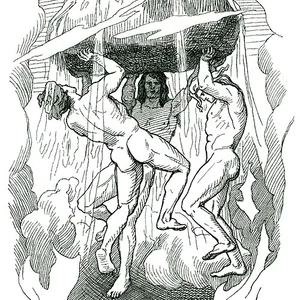
- Together with Odin and Vili, he slew the primordial giant Ymir, whose body was used to shape the world
- He took part in the creation of the first humans, Ask and Embla, granting them their appearance and senses
- His name means "sanctuary" or "sacred place" in Old Norse
- He is mentioned in the Prose Edda by Snorri Sturluson (c. 1220) and in the poem Völuspá
Works & Achievements
Together with Odin and Vili, Vé transformed the body of the primordial giant into a structured cosmos: flesh → earth, blood → seas and rivers, bones → mountains, skull → the vault of the sky. This foundational act is the central cosmogonic gesture of all Germanic and Norse mythology.
Vé granted the two lifeless trees found on the shore their form, fair appearance, speech, hearing, and sight — the five sensory gifts that define humanity. This contribution is Vé's distinctive mark within the creative triad.
Vili and Vé jointly ruled Asgard during a long absence of their elder brother, according to the Prose Edda. This episode attests to Vé's fully sovereign status within the Norse pantheon, capable of embodying the totality of divine power on his own.
As the eponymous deity of Norse sanctuaries, Vé is the divine guarantor of the boundary between profane and sacred space. The vé sanctuaries — ritual enclosures delimited in his honor — structured the religious life of Scandinavian communities until the arrival of Christianity.
Anecdotes
Together with his brothers Odin and Vili, Vé took part in the slaying of the primordial giant Ymir, whose enormous body served as the raw material for the creation of the world. From Ymir's blood sprang a flood so powerful that it drowned nearly the entire race of giants, leaving only two survivors: Bergelmir and his wife, who became the ancestors of the giants in the Norse cosmos.
In the creation of the first humans, Vé played an irreplaceable role by endowing Ask and Embla — two lifeless trees found on the shore — with form, speech, hearing, and sight. According to the Prose Edda by Snorri Sturluson, it was he who gave them líki ok lítu góða, meaning a good appearance and a fine complexion, marking the transition from plant life to humanity.
Vé, together with Odin and Vili, forms a divine triad embodying the three dimensions of creation. His name comes directly from the Old Norse vé, which designates a sacred space or enclosed sanctuary: Vé is thus literally the deity whose very essence is the sacred, the guardian of ritual spaces between worlds.
According to the Prose Edda, during a lengthy absence of Odin, Vili and Vé co-ruled over Asgard by sharing supreme power between them. This episode illustrates the Norse conception of collegial divine sovereignty: the three brothers form an inseparable unity, each of whom can temporarily embody the full extent of their shared power.
The name Vé appears in certain ancient Germanic theonyms and in ritual formulas, attesting to his worship beyond medieval Scandinavia alone. Scholars such as Georges Dumézil have proposed seeing in the Odin-Vili-Vé triad an echo of the three Indo-European functions: magical sovereignty, active will, and the sacred/sensory dimension.
Primary Sources
Borr had three sons: the first was called Odin, the second Vili, the third Vé. And it is my belief that Odin is and will be the greatest and most glorious of all the gods.
The first gave them breath and life; the second, consciousness and movement; the third, form and fair color, speech, hearing, and sight.
They had neither önd nor óðr, neither color nor speech, nor good bearing. Odin gave önd, Hœnir gave óðr, Lóðurr gave blood and fair color.
How should Odin be referred to? He may be called [...] brother of Vili and Vé, son of Borr, father of Thor.
Key Places
The celestial home of the Aesir gods, built after the creation of the world, where Vé dwells alongside his brothers Odin and Vili. It is from this divine realm that the triad exercises its sovereignty over the cosmos and receives the prayers of humankind.
The great primordial void between Niflheim and Muspelheim, the stage on which the first beings came into existence and where the cosmic adventure of Vé and his brothers began. This place that existed before the world embodies the original chaos that the divine triad shaped into an ordered cosmos.
The world of humans, literally meaning 'middle enclosure', created by Odin, Vili, and Vé from the body of the giant Ymir. It is here that Vé placed Ask and Embla, the first humans, gifting them with form, speech, and the senses.
It was in Iceland, in the 13th century, that Snorri Sturluson committed the Norse myths to writing, including the stories of Vé. Without this act of Icelandic preservation carried out after Christianization, the figure of Vé might have vanished entirely from the written tradition.
The cosmic ash tree Yggdrasil connects the nine worlds of Norse cosmology and symbolizes the structural order established by the creator gods. Its tree-like nature directly echoes the creation of Ask from an ash tree by Vé and his brothers.
Typical Objects

The raw material of creation, the body of the primordial giant Ymir was transformed by Vé and his brothers into all the elements of the universe. This cosmogonic act makes Vé one of the architects of the visible and tangible world.

A sacred space delimited by ropes and carved posts, reserved for rituals and offerings in the Norse religion. The very name of the deity is intimately linked to this ritual site, of which he is the divine guardian.

Sacred signs carved in wood, stone, or metal, runes were associated with the creator gods in the Norse tradition. Their power to give meaning and voice to things aligns with the gift of speech that Vé bestowed upon the first humans.

Vé and his brothers created the first man, Ask, from an ash tree found on the shore — the same species as Yggdrasil, the World Tree. This noble tree symbolizes the living matter that the gods transformed into a conscious and sentient human being.

A large drinking horn used during ritual sacrifices (blóts) in honor of the Norse gods, including the creative triad. These offerings of mead and animal blood maintained the sacred bond between the world of men and that of the Aesir.

Stone or wooden structures erected in Norse sanctuaries to mark off the ritual space consecrated to a deity. As a divinity whose very name means 'sacred place,' Vé is closely tied to these markers of the boundary between the profane and the sacred.
School Curriculum
Vocabulary & Tags
Key Vocabulary
Daily Life
Morning
At the dawn of the cosmos, Vé walks the borders of Asgard to ensure that the order established at creation remains intact. He perceives, like an echo, the morning prayers that the men of the North offer at vé sanctuaries — those bounded sacred spaces they have dedicated to him on the land of Midgard.
Afternoon
Vé devotes his days to the exercise of divine perception: he sees, hears, and feels everything that his own gifts have transmitted to humans, as a mirror of his essence. He sometimes deliberates with his brothers in the great halls of Asgard on the affairs of the cosmos, arbitrating the balance between the nine worlds.
Evening
In the evening, Vé presides symbolically over the blóts — the ritual sacrifices and feasts — that Norse communities organize to honor the creative triad. He receives offerings of blood and mead, sustaining the sacred bond that is indispensable between the gods and the men he helped to create.
Food
Like the other Aesir, Vé takes part in the divine banquets of Asgard, where feasting on roasted meat and mead (mjöðr) served in great drinking horns is customary. As a god, he is sustained above all by the sacred substance of the cosmos and by the ritual offerings that men send him.
Clothing
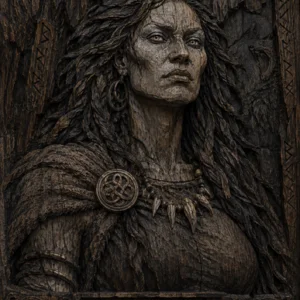
Vé is dressed in a long woolen tunic and a great dark cloak fastened with a silver runic brooch, reflecting his divine dignity. His garments — plain yet adorned with symbolic interlace patterns — evoke his nature as guardian of ritual spaces: poised between divine magnificence and sacred austerity.
Housing
Vé resides in the great halls of Asgard, the divine realm built by the gods after the creation of the world. His own space evokes a perfect vé: a bounded place charged with an invisible presence, where silence deepens and where the boundary between the world of the gods and that of men becomes permeable.
Historical Timeline
Period Vocabulary
Visual Style
Esthétique viking médiévale islandaise : formes angulaires stylisées, entrelacs runiques et knotwork, contraste dramatique entre l'obscurité du Ginnungagap et la lumière froide de l'acte créateur.
Sound Ambience
Une ambiance sonore évoquant la création nordique : vents primordiaux du Ginnungagap, chocs cosmogoniques des trois dieux bâtisseurs, premiers souffles de vie humaine et percussions rituelles dans le silence des sanctuaires.
Liens externes & ressources
Références
Œuvres
Création du monde depuis le corps de Ymir
Temps mythique
Création et animation des premiers humains Ask et Embla
Temps mythique
Régence d'Asgard en l'absence d'Odin
Temps mythique
Établissement des espaces sacrés (vé)
Temps mythique à époque viking