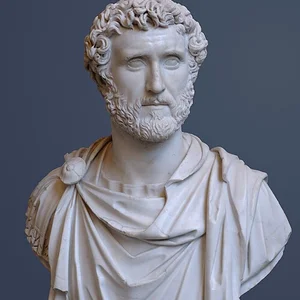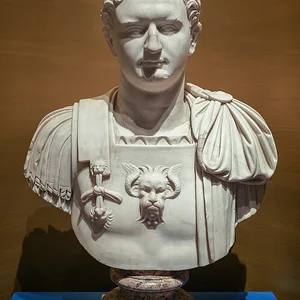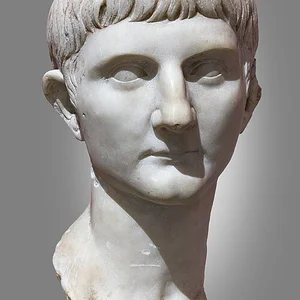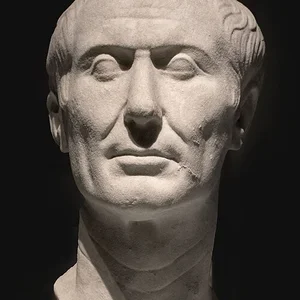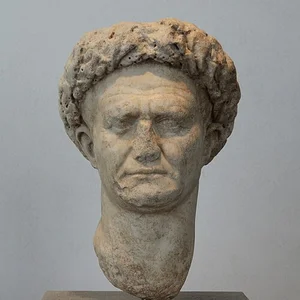

Vespasian (9–79 AD) was the ninth Roman emperor and founder of the Flavian dynasty. A general of equestrian background, he rose to power after the civil war of 69 AD. His reign marked a period of stability and reconstruction following the excesses of Nero.
Vespasian(9 — 79)
Vespasian
Rome antique
7 min read
Frequently asked questions
Famous Quotes
« Money has no smell.»
« I think I am becoming a god.»
Key Facts
- 69 AD: Vespasian prevails during the civil war known as the 'Year of the Four Emperors'
- 70 AD: his son Titus crushes the Jewish revolt and destroys the Temple in Jerusalem
- 72 AD: construction begins on the Colosseum (Flavian Amphitheatre) in Rome
- Vespasian reforms the empire's finances, which had been severely depleted under Nero
- 79 AD: death of Vespasian; his son Titus succeeds him
Works & Achievements
Vespasian initiated the construction of this iconic monument in Rome, financed by the spoils of the Judean campaign. Inaugurated under Titus, it could hold 50,000 spectators and remains a symbol of Roman power to this day.
Built to celebrate the victory in Judea, this forum housed the treasures of the Temple of Jerusalem, including the Menorah. It became one of the most admired monuments of ancient Rome.
Vespasian restored the Empire's finances, which had been ruined by Nero and the civil war, by introducing new taxes (including the famous tax on public urinals) and cutting extravagant spending. This policy enabled a revival of major public works.
Vespasian restructured provincial administration and strengthened the Rhine and Danube frontiers, bringing lasting stability to the Empire after the turmoil of 69 AD.
Vespasian extended Latin rights to all of Hispania (modern-day Spain), broadening Roman citizenship and integrating the western provinces into the Roman world. This decision fostered the lasting Romanization of the Iberian Peninsula.
Anecdotes
Vespasian is famous for introducing a tax on public urinals in Rome, which earned him mockery from his son Titus. He handed him a coin and said: 'Pecunia non olet' ('Money has no smell'). This expression has remained in use to this day.
Before becoming emperor, Vespasian commanded the Roman legions during the siege of Jerusalem in 66–68 AD. It was his son Titus who finished the job in 70 AD, destroying the Temple of Jerusalem — a major event in Jewish history.
Vespasian was known for his humor and modesty. On his deathbed, he reportedly quipped: 'I think I am becoming a god!' — an ironic allusion to the Roman tradition of deifying emperors after their death.
Coming from the equestrian class (the Roman lesser nobility), Vespasian was the first emperor who did not come from a patrician senatorial family. He embraced his modest origins and was deliberately frugal and hardworking, in stark contrast to the excesses of Nero.
It was Vespasian who ordered the construction of the Colosseum (the Flavian Amphitheatre) in Rome, on the site of the artificial lake from Nero's palace. This decision symbolized the return of a public space to the Roman people after his predecessor's extravagances.
Primary Sources
He was well built, with strong, sturdy limbs, and his face always wore a strained expression, as though he were straining at stool. A wit once asked him to make a joke at his expense, to which Vespasian replied: 'I will not, for you have no gift for making people laugh.'
Vespasian, a seasoned general commanding veteran legions, enjoyed a reputation that his successes in Britain and Judaea had established beyond all dispute.
Vespasian, having received from the Senate and the Roman people the command of the war against the Jews, led his army into Judaea with a discipline and method that even his enemies could not help but admire.
Vespasian restored the finances of the state, which had been ruined by Nero and the civil war, by raising taxes and cutting unnecessary expenditure, while never resorting to violence against citizens to enrich himself.
Key Places
A town in Latium where Vespasian was born in 9 AD. His family owned land there, and he often returned, remaining attached to his humble roots.
Vespasian ordered its construction around 72 AD on the site of Nero's Domus Aurea lake, symbolically returning the land to the Roman people.
Vespasian led the siege against Jewish insurgents there from 67 AD, before leaving his son Titus to complete the campaign when he rose to power.
It was here that Vespasian took control of Rome's grain supply in 69 AD, forcing Vitellius to negotiate. The city served as his rear base during the civil war.
Temple of Peace built by Vespasian after the victory in Judea to celebrate the end of the war and house the treasures of the Temple of Jerusalem.
Typical Objects

The distinctive garment of Roman emperors, the purple toga symbolized supreme power. Vespasian, despite his humble origins, adopted it without ostentation, preferring simplicity over the extravagance of Nero.

An engraved ring used to authenticate imperial edicts and correspondence. Vespasian used it daily to sign administrative and military decisions that reorganized the Empire.

Wax tablets on which imperial scribes drafted laws and decrees. Under Vespasian, an administrative reformer, they were in constant use as he reorganized the empire's finances and provinces.

The sword and armor of the Roman general, which Vespasian carried during his campaigns in Britain and Judea. They represent his career as a soldier before he became emperor.

Vespasian had numerous coins minted bearing his portrait and slogans such as 'PAX' (peace). Monetary reform was a key tool for asserting his authority and restoring economic confidence.

Ironically, Roman public urinals were taxed by Vespasian to replenish the state's coffers. His name became attached to these sanitary facilities in several Romance languages, including French.
School Curriculum
Vocabulary & Tags
Key Vocabulary
Daily Life
Morning
Vespasian rose before dawn, unlike previous emperors who slept until midday. He devoted his early hours to reading reports from his governors and receiving his close associates (amici) in his study, before the sun had even risen.
Afternoon
The afternoon was reserved for official audiences on the Palatine Hill: delegations from the provinces, senators, generals, and foreign ambassadors followed one another in succession. Vespasian settled matters quickly and plainly, without the ostentatious ceremonial of his predecessors.
Evening
In the evening, Vespasian withdrew for a simple meal with family or a few trusted friends. He was known for his modest table, far removed from the extravagant banquets of Nero. He enjoyed the baths and philosophical or historical conversations before retiring early.
Food
Vespasian ate simply: bread, vegetables, olives, cheese, and roasted meat in moderate portions. He drank wine mixed with water, following Roman custom. His table reflected his humble origins and his rejection of luxury — as much a political stance as a personal preference.
Clothing
In peacetime, Vespasian wore the white toga bordered with purple, a mark of his imperial dignity, but without the gold embroidery favored by some emperors. When traveling or during military ceremonies, he wore a breastplate and the red military cloak (paludamentum).
Housing
Vespasian resided in the Palace on the Palatine Hill in Rome, but he scaled it back after the extravagant spending on Nero's Domus Aurea. He preferred an orderly life, surrounded by his secretaries and his sons Titus and Domitian, whom he brought into the governance of the Empire.
Historical Timeline
Period Vocabulary
Visual Style
Illustration de style fresque romaine et réalisme archéologique : tons ocres, marbres blancs et pourpres impériaux, évoquant la Rome flavienne en pleine reconstruction.
Sound Ambience
Ambiance sonore de la Rome impériale du Ier siècle ap. J.-C. : activité du Forum, bruits de construction du Colisée, trompettes militaires et cérémonies religieuses.
Liens externes & ressources
Références
Œuvres
Amphithéâtre Flavien (Colisée)
72-80 ap. J.-C.
Templum Pacis (Temple de la Paix)
75 ap. J.-C.
Réforme des finances impériales
69-79 ap. J.-C.
Réorganisation des provinces et des légions
69-79 ap. J.-C.
Édit sur la latinité et l'octroi de la citoyenneté
74 ap. J.-C.