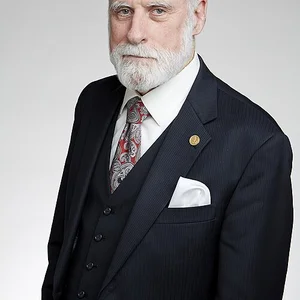

American computer scientist, co-creator with Bob Kahn of the TCP/IP protocol that forms the technical foundation of the Internet. Nicknamed one of the “fathers of the Internet,” he helped transform a military network into a global communication infrastructure.
Vint Cerf(1943 — ?)
Vint Cerf
États-Unis
8 min read
Frequently asked questions
Famous Quotes
« The Internet is for everyone.»
« I have always believed that technology, properly applied, can solve almost any problem.»
Key Facts
- 1943: Born in New Haven, Connecticut
- 1973: Co-develops the TCP/IP protocol with Bob Kahn
- 1983: TCP/IP becomes the standard protocol for ARPANET
- 1997: Receives the National Medal of Technology from President Clinton
- 2004: Turing Award laureate with Bob Kahn for the design of the Internet
Works & Achievements
A foundational paper published in IEEE Transactions on Communications that describes the TCP protocol for the first time. This eleven-page document is considered the intellectual birth certificate of the Internet.
The first official technical document (RFC) specifying the TCP protocol, co-written with Yogen Dalal and Carl Sunshine. It lays the formal groundwork that engineers around the world would be free to implement.
The mature, stabilized version of the TCP protocol, which became the reference specification still in use today. This document enabled the universal adoption of TCP/IP as the standard protocol of the Internet.
As DARPA program manager, Cerf funded and coordinated the research that led to the widespread adoption of TCP/IP. He notably negotiated the transition of ARPANET to the new protocol, completed on Flag Day in 1983.
In collaboration with NASA, Cerf is developing a communication protocol suited to the constraints of space (extreme delays, frequent outages). The project aims to extend the Internet beyond Earth for future space missions.
Anecdotes
Vint Cerf has suffered from severe bilateral hearing loss since childhood and has worn hearing aids since the age of thirteen. This personal experience reportedly made him especially aware of the importance of technologies that facilitate communication between people, according to his own public statements.
On January 1, 1983, ARPANET officially switched from the NCP protocol to TCP/IP — an event engineers call the “Flag Day.” Every computer connected to the network had to be updated simultaneously that day, an unprecedented coordinated operation in the history of computing.
In 1974, Cerf and his colleague Bob Kahn wrote their landmark TCP/IP paper in just a few months of intensive work. According to Cerf, the core idea behind the protocol came to him while sitting in a hotel lobby in San Francisco, sketched on the corner of a paper napkin.
Since the 2000s, Vint Cerf has been working with NASA on Delay-Tolerant Networking (DTN), a protocol designed for interplanetary communications where delays can reach several tens of minutes. He considers this the logical next step after the terrestrial Internet.
In 1997, Cerf received the National Medal of Technology from President Clinton, and in 2004 the Presidential Medal of Freedom from George W. Bush — alongside his co-author Bob Kahn. These are the two highest civilian honors in the United States, rarely awarded for purely technical work.
Primary Sources
A protocol that supports the sharing of resources that exist in different packet switching networks is presented. The protocol provides for loss detection and retransmission of information lost in transit.
This document describes the functions to be performed by the internetwork transmission control program and the formats and encoding of the internetwork transmission control protocol.
The Transmission Control Protocol (TCP) is intended for use as a highly reliable host-to-host protocol between hosts in packet-switched computer communication networks.
Bob [Kahn] came to me with the idea of connecting packet radio networks together. We needed a protocol that would work across many different networks and be able to handle lost packets.
Key Places
Cerf completed his doctoral dissertation there under the supervision of Leonard Kleinrock, a pioneer of packet switching. It was at UCLA that the very first message on ARPANET was sent in October 1969, and where Cerf first grasped the revolutionary potential of computer networks.
Cerf taught and led a computer networking research laboratory there from 1972 to 1976. It was here that he worked closely with Bob Kahn to design and formalize the TCP/IP protocol, which would become the foundation of the Internet.
Cerf worked there from 1976 to 1982 as program manager for computer networking research. It was from this government agency that he funded and coordinated the development of the technologies that would become the Internet.
Vint Cerf's birthplace, where he was born on June 23, 1943. Associated with Yale University, it embodies the East Coast academic environment in which the future computer scientist grew up.
Cerf has served as Chief Internet Evangelist there since 2005, a role in which he advocates for universal Internet access and participates in global debates on network governance. He embodies the continuity between the pioneers of ARPANET and the era of the commercial Web.
Typical Objects

In the ARPA and Stanford labs of the 1970s, Cerf and his colleagues worked on these cathode-ray screen and keyboard terminals, which allowed access to mainframes. It was on equipment like this that the first TCP/IP implementations were tested.

Before screens became widespread, program outputs and messages on ARPANET were printed on rolls of paper by these noisy machines. Cerf described the soundscape of the machine rooms of that era as characteristic of the birth of the network.

RFCs are the technical documents that define Internet protocols; Cerf authored and co-signed several dozen of them. These mimeographed sheets, initially distributed by postal mail, are the equivalent of scientific publication in the Internet world.

In the 1970s, to connect a terminal to the network, you would place the telephone handset on an acoustic coupler that converted data into audible sounds. These modems symbolize the hands-on, experimental era of ARPANET's early days that Cerf lived through.

Computer engineers of the 1970s used these first pocket calculators from Hewlett-Packard for quick calculations. Cerf relied on them in his daily research work before personal computers became widespread.

At the start of Cerf's career (1960s–1970s), programs were still entered via punched cards submitted to an operator. These objects illustrate the striking contrast between the early days of computing and the global network he helped create.
School Curriculum
Vocabulary & Tags
Key Vocabulary
Tags
Daily Life
Morning
In the 1970s, Cerf arrived early at Stanford or DARPA labs, often by 8 a.m. He would start by going through messages received overnight via ARPANET — time zone differences encouraged after-hours exchanges with the East Coast — and catch up on the latest RFCs published by his colleagues.
Afternoon
His afternoons were devoted to coding and debugging sessions on shared terminals, sometimes paired with graduate students. Frequent technical meetings brought together the project's dispersed members; in the pre-Internet era, some were held by telephone conference or required short flights between universities.
Evening
His evenings at home often included reading technical publications (ACM, IEEE) and drafting RFCs on paper before transcribing them the following day. Cerf has acknowledged devoting a significant portion of his personal life to this foundational work; he is an avid science fiction fan, particularly of Arthur C. Clarke's writings.
Food
Like most American academic researchers of the era, Cerf would have lunch at the campus cafeteria or order sandwiches during long work sessions. There is no particular account of a specific diet; meals were functional, often eaten at the desk.
Clothing
In the university computer labs of the 1970s, standard attire was casual: flannel shirt or polo, corduroy or chino trousers. Cerf has long worn a beard and is frequently photographed in a three-piece suit at conferences — an outfit that made him stand out among his denim-clad peers.
Housing
During his years at Stanford (1972–1976), Cerf lived with his family in a suburban house on the San Francisco Peninsula, typical of educated California middle-class life. The domestic setting was little different from that of an ordinary university professor; nothing at the time suggested that his work would transform the world.
Historical Timeline
Period Vocabulary
Liens externes & ressources
Références
Œuvres
A Protocol for Packet Network Intercommunication (avec Bob Kahn)
Mai 1974
RFC 675 – Specification of Internet Transmission Control Program
Décembre 1974
RFC 793 – Transmission Control Protocol
Septembre 1981
Programme de recherche réseaux à la DARPA
1976–1982
Delay-Tolerant Networking (DTN) – protocole interplanétaire
Depuis 2003