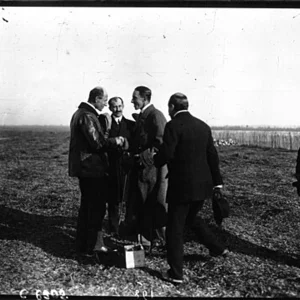

American brothers, self-taught mechanics and inventors, they achieved the first powered and controlled flight in history on December 17, 1903, at Kitty Hawk, North Carolina. Their Flyer I flew for 12 seconds, launching the age of aviation.
Wright (Orville and Wilbur)
Orville and Wilbur Wright
10 min read
Frequently asked questions
Famous Quotes
« Success. Four flights Thursday morning. All against twenty-one mile wind. Started from level with engine power alone. Average speed through air thirty-one miles. Longest 59 seconds. Inform press. Home Christmas. (telegram from Orville to his father, December 17, 1903)»
Key Facts
- December 17, 1903: first powered and controlled flight at Kitty Hawk, lasting 12 seconds and covering 36 meters
- 1905: the Flyer III completes a 39 km flight in 39 minutes, becoming the first fully operational airplane
- 1908: public demonstrations in France and the United States bring international recognition
- Wilbur Wright (1867–1912) and Orville Wright (1871–1948): owners of a bicycle shop in Dayton, Ohio
- Their work built on the research of Lilienthal and Chanute, combined with systematic wind tunnel experiments
Works & Achievements
The first powered, controlled, and sustained aircraft in history, completing four flights on December 17, 1903, at Kitty Hawk. The original is preserved at the Smithsonian National Air and Space Museum in Washington, D.C.
An improved version tested at Huffman Prairie, capable of making turns and flying closed circuits. It allowed the Wrights to accumulate more than 105 flights and truly learn to fly, progressing from a feat of daring to genuine mastery.
Considered the world's first truly practical airplane, it could stay airborne for more than 38 minutes and cover 38 km in a closed circuit. Its design incorporated all the lessons of previous flights, including a front elevator decoupled from the wing-warping mechanism.
Built entirely by hand in their workshop, this wind tunnel allowed them to test more than 200 different wing profiles and disprove Lilienthal's lift tables, which they found to be inaccurate. A decisive tool that explains why the Wrights succeeded where so many others had failed.
A patent protecting the fundamental principle of wing warping for lateral aircraft control. This patent gave rise to lengthy legal battles with other aircraft manufacturers, most notably Glenn Curtiss.
The first military airplane purchased by the U.S. Army for $30,000, after meeting the official test requirements of a minimum speed of 40 mph over 10 miles. It marks the beginning of institutional military aviation.
Anecdotes
To decide who would attempt the first powered flight on December 14, 1903, the Wright brothers flipped a coin. Wilbur won, but his attempt ended in a crash after three seconds. It was therefore Orville who achieved the first official flight three days later, on December 17, covering 36 meters in 12 seconds — less than the wingspan of a modern Boeing 747.
The Wright brothers had no engineering degree. They had learned their trade repairing bicycles in Dayton, Ohio. It was by observing how a cyclist leans their bike to turn that they came up with the idea of 'wing warping,' the lateral control principle that made their aircraft maneuverable where all their competitors had failed.
After their achievement on December 17, 1903, American newspapers refused to believe it. The Dayton Daily News, their local paper, ignored the event entirely. For nearly five years, the Wrights quietly perfected their machine at Huffman Prairie while the world's press continued searching for 'the first man to fly.' When Wilbur gave a public demonstration in France in 1908, European spectators were astonished — aviation had existed for five years without their knowledge.
Charlie Taylor, the mechanic at their bicycle shop, built the engine for the Flyer I in six weeks — a 4-cylinder, 12-horsepower engine weighing only 77 kg. No automobile manufacturer of the time had been able to supply an engine light enough. Taylor built it from scratch in cast aluminum, without any prior blueprints, working solely from Orville's sketches.
In 1908, during his demonstration flights at Le Mans, Wilbur Wright astonished the French aviators who considered themselves the best in the world. One of them, Léon Delagrange, reportedly declared: “We do not exist. Compared to the Wrights, we are mere children.” These flights made Wilbur an international celebrity and decisively launched the era of commercial and military aviation in Europe.
Primary Sources
Success four flights thursday morning all against twenty one mile wind started from Level with engine power alone average speed through air thirty one miles longest 57 seconds inform Press home Christmas.
I have been interested in the problem of mechanical and human flight ever since as a boy I constructed a number of bats of various sizes after the style of Cayley's and Penaud's machines. My observations since have only convinced me more firmly that human flight is possible and practicable.
When we got up a wind of between 20 and 25 miles was blowing from the north. We got the machine out early and put out the signal for the men at the station... After running the motor a few minutes to heat it up, I released the wire that held the machine to the track, and the machine started forward into the wind.
With all the knowledge and skill acquired in thousands of flights in the last ten years, I would hardly think today of making my first flight on a strange machine in a twenty-seven mile wind, even if I knew that the machine had already been flown and was safe.
Our invention relates to that class of flying machines in which the weight is sustained by the reactions resulting when one or more aeroplanes are moved through the air edgewise at a small angle of incidence, and has for its object a new and improved means for controlling the machine both as to its speed in a vertical plane and as to its lateral balance.
Key Places
Site of the historic flights of December 17, 1903, chosen for its steady winds and sand dunes that cushioned crashes. Now designated a national monument, it is home to the Wright Brothers National Memorial.
The bicycle repair and sales shop where the Wright brothers designed, tested, and built their flying machines between 1896 and 1905. This is where they constructed their wind tunnel and assembled Flyer I.
A farmland meadow rented from a local farmer, just a few miles from Dayton, where the Wrights refined their aircraft from 1904 to 1905 away from public scrutiny. It was here that Flyer III became the first truly practical airplane, completing circular and figure-eight flights.
The city where Wilbur Wright gave his first public demonstrations at the Hunaudières racetrack starting in August 1908, astonishing European aviators with his mastery of the aircraft. These flights revealed to the world the true reality of the Wrights' invention.
The military base where Orville Wright conducted official trials of the Wright Military Flyer for the U.S. Army in 1908–1909. It was also the site of aviation's first fatal accident: Lieutenant Selfridge died in a crash with Orville in September 1908.
Typical Objects

A biplane of spruce and ash wood covered in muslin, weighing 274 kg including the engine, driven by two counter-rotating propellers. This is the aircraft that made the four historic flights of December 17, 1903; the original is preserved at the Smithsonian National Air and Space Museum in Washington.

Built in 1901 in their bicycle shop, this 1.80-meter-long wooden tunnel allowed them to test miniature wing profiles using a belt-driven fan. Thanks to it, the Wrights accumulated aerodynamic data far superior to anything published by their predecessors.

A cast-aluminum four-cylinder engine producing 12 horsepower at 77 kg, built entirely by hand in six weeks by their mechanic. No automobile manufacturer of the time had an engine light enough, which forced the Wrights to design and build their own.

An 18-meter wooden board fitted with a metal groove along which the Flyer's takeoff trolley slid. Since Kitty Hawk had no grassy runway long enough, this device allowed the aircraft to build up the speed needed for liftoff.

A wind-speed measuring instrument that the Wrights routinely carried during their experiments to select optimal flying conditions. They meticulously recorded this data in their logbook, turning their tests into genuine scientific work.

A bicycle model manufactured and sold in their Dayton shop, their main source of income throughout their aeronautical research. The study of the bicycle — dynamic balance, lightness, precise mechanics — gave them decisive insights for designing their aircraft.

Tortoiseshell protective goggles worn during test flights to shield against the wind and engine oil spray. They symbolize the handcrafted, trial-and-error nature of the earliest flights, far removed from the sophisticated equipment of later aviators.
School Curriculum
Vocabulary & Tags
Key Vocabulary
Daily Life
Morning
The Wright brothers rose early, around 6 a.m., in the family home on Hawthorn Street in Dayton, Ohio, which they shared with their father Milton and their sister Katharine. Breakfast was simple and frugal, in keeping with the modest Protestant habits of their household. They would then walk or cycle to their workshop on West Third Street.
Afternoon
Afternoons were devoted to precision work: bicycle repairs to keep the business running, alongside aerodynamic calculations, drafting plans, and hand-crafting parts. During the years of active research (1900–1905), summers saw the two brothers away for several weeks at a time at Kitty Hawk, where they lived in tents or a wooden shack, testing their gliders from morning to night.
Evening
Evenings in Dayton were spent with the family, often gathered around books or lively discussions with their father, a bishop in the Church of the United Brethren. Wilbur and Orville, both lifelong bachelors and extremely close to each other, recorded their observations and results in meticulous logbooks. They also kept up a regular correspondence with other aeronautics researchers, such as Octave Chanute.
Food
The Wrights' diet was simple and typical of working-class American Midwest families: bread, meat, seasonal vegetables, and coffee. During their stays at Kitty Hawk, they cooked for themselves on a wood-burning stove in their barracks, often living on canned goods and supplies brought from Dayton. Katharine Wright made sure to send them extra provisions.
Clothing
In the workshop, the Wright brothers wore work overalls or street clothes covered by an apron, like any craftsman of the era. During flights, Orville wore a white shirt, a dark suit, and a cap — photographs from December 17, 1903 show him dressed as though for a business meeting, with no special gear, reflecting the experimental rather than athletic nature of their early flights.
Housing
The Wright family lived in a Victorian-style wooden house at 7 Hawthorn Street in Dayton, Ohio. The house had a workshop in the backyard. It was a cultured home with a well-stocked library: their father Milton encouraged reading and intellectual curiosity, which goes some way toward explaining the remarkable self-taught education of both brothers.
Historical Timeline
Period Vocabulary
Liens externes & ressources
Références
Œuvres
Wright Flyer I
1903
Wright Flyer II
1904
Wright Flyer III
1905
Soufflerie aérodynamique expérimentale
1901
Brevet américain n° 821,393 — 'Flying Machine'
1906
Wright Military Flyer (Signal Corps No. 1)
1909