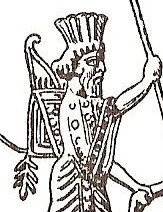
Xerxes I(518 av. J.-C. — 464 av. J.-C.)
Xerxes I
Empire achéménide
9 min read
King of the Achaemenid Persian Empire from 485 to 465 BC, son of Darius I. He is famous for leading the second Greco-Persian War against the Greek city-states, notably at the battles of Thermopylae and Salamis.
Frequently asked questions
Key Facts
- 485 BC: ascended to the Persian throne following the death of Darius I
- 480 BC: launched the invasion of Greece at the head of a massive army
- 480 BC: land victory at Thermopylae against Leonidas's Spartans
- 480 BC: decisive naval defeat at Salamis against the Greek fleet
- 465 BC: assassinated in a palace conspiracy
Works & Achievements
The monumental gateway to Persepolis built by Xerxes, adorned with colossal human-headed bulls inspired by Assyrian art. It welcomed delegations from all the peoples of the empire who came to pay tribute to the Great King.
A vast throne room whose construction was initiated by Xerxes at Persepolis, with one hundred stone columns supporting the ceiling. The building served as the setting for grand royal audiences and military receptions.
Xerxes completed the great hypostyle audience hall begun by Darius I, decorated with sculpted friezes depicting delegations from 23 tributary peoples bringing their offerings. These reliefs are an exceptional visual record of the empire's diversity.
A trilingual text carved at Persepolis in which Xerxes declares that he destroyed the sanctuaries of false gods (daivas) and imposed the worship of Ahura Mazda. It is the royal document most revealing of his religious policy.
Two pontoon bridges each stretching over 1,300 meters, built by Phoenician and Egyptian engineers to carry the Persian army across the strait. This logistical feat, unprecedented in the ancient world, allowed hundreds of thousands of men to cross in seven days.
Anecdotes
When storms twice in a row destroyed the pontoon bridges he had ordered built across the Hellespont to allow his army to cross into Europe, Xerxes commanded that the sea be given three hundred lashes and that chains be thrown into the waters to 'punish' it. Herodotus reports that men were tasked with hurling words of abuse at the waves. This episode illustrates the hubris — the excessive pride and overreach — that the Greeks attributed to the Great King.
During the Battle of Salamis in 480 BC, Xerxes had a golden throne set up on Mount Aigaleos so he could watch as a spectator what he expected to be an easy victory over the Greek fleet. Instead, he witnessed his ships lured into a trap and destroyed in the narrow strait, where their numerical superiority counted for nothing. Scribes were recording on tablets the names of commanders who distinguished themselves — a protocol that became a cruel irony as the rout unfolded.
Before crossing the Hellespont, Xerxes reviewed his vast army from a high platform. Herodotus recounts that after gazing upon his troops as far as the eye could see, the king suddenly wept. When asked why, he replied that he was struck with melancholy at the thought that in a hundred years, not one of these men would still be alive. This anecdote made a deep impression on the Ancients, who saw in it a royal meditation on the human condition.
A wealthy Lydian named Pythius, who had placed his entire fortune at the service of the expedition, asked Xerxes for a single favor: that his eldest son, one of five, be allowed to remain home rather than march to war. Enraged by such a request on the eve of a campaign, Xerxes had the young man cut in two and the two halves placed on either side of the road along which the army marched. This exemplary act of violence made clear that the royal will tolerated no exception.
Primary Sources
Xerxes, son of Darius, having assembled a vast army, marched against Greece. The pass of Thermopylae was defended by Leonidas and his three hundred Spartans, who all died to the last man holding the pass.
The messenger announces: 'O queen, with one blow all the prosperity of Persia is destroyed; the flower of our warriors has fallen.' The queen asks: 'What city then has been taken?' He replies: 'Athens — it is laid waste.'
Says Xerxes the king: Among these countries, there were some where previously the daivas were worshipped. Afterwards, by the grace of Ahura Mazda, I destroyed those sanctuaries of the daivas and proclaimed: 'The daivas shall not be worshipped.'
Xerxes had led against Greece the greatest expedition on record, with an innumerable fleet and land army; and yet he was driven back from Salamis and elsewhere, and withdrew largely as he had come.
Xerxes, after his naval defeat at Salamis, fearing that the Greeks might sail to the Hellespont and destroy his bridge, hastened back to Asia, leaving Mardonius in command of the land forces in Greece.
Key Places
The ceremonial capital of the Achaemenid Empire, where Xerxes expanded upon the building projects begun by Darius I, including the Gate of All Nations and the Hall of a Hundred Columns. This was where he resided during the great Nowruz festivals and received tribute from subject peoples.
The administrative capital of the empire where Xerxes held part of his court and from which the royal roads connected the satrapies. The palace at Susa was decorated with glazed bricks depicting lions and Immortal guards.
A narrow coastal pass where Leonidas and his Spartans held back the advance of Xerxes' army for three days in August 480 BC. The Persian victory was only made possible by the treachery of Ephialtes, who revealed a mountain path that allowed the army to outflank the defenders.
A narrow stretch of water between the island of Salamis and Attica where the Persian fleet was destroyed in September 480 BC by Themistocles' strategy. Xerxes watched the defeat from Mount Aigaleos, his vision of triumph turning into a spectacle of rout.
The strait between Europe and Asia that Xerxes crossed by having two pontoon bridges lashed side by side — a remarkable feat of ancient military engineering. The crossing of such a vast army captured the imagination of both ancient and modern observers.