
A warrior princess of the Dagomba people (present-day Ghana/northern Burkina Faso), Yennenga is venerated in Mossi oral tradition as the founding mother of the Moogo kingdom. Daughter of King Nedega, she united with a hunter named Riale, and their son Ouédraogo became the eponymous ancestor of the Mossi.
Yennenga(1101 — 1101)
Yennenga
7 min read
Frequently asked questions
Key Facts
- According to Mossi oral tradition, Yennenga was an exceptional horsewoman and warrior, daughter of King Nedega of the Dagomba
- Tradition holds that she fled her father's kingdom after he refused to allow her to marry, symbolizing a quest for independence
- Her union with the hunter Riale gave birth to Ouédraogo (meaning 'stallion' in Mooré), the founding ancestor of the Mossi chiefs
- The Moogo kingdom (meaning 'the world' in Mooré), which she is said to have helped found, is one of the best-organized pre-colonial states in West Africa
- Yennenga is today a national emblem of Burkina Faso: the Yennenga Stallion is the symbol of Burkinabé cinema (FESPACO)
Works & Achievements
Through her union with Riale and the birth of Ouédraogo, Yennenga is the direct founding ancestor of the Mossi royal dynasty that would rule the Moogo for several centuries.
Yennenga commanded a cavalry force and took part in numerous battles in her father's service, becoming one of the earliest female military commanders attested in West African oral traditions.
By letting her millet crop rot, Yennenga made a political and symbolic act of resistance against her father's arbitrary authority — an episode preserved in every version of the Mossi oral tradition.
Her memory established a feminine ideal of courage, autonomy, and strength in Mossi culture, invoked in rituals, songs, and the upbringing of girls in Burkina Faso.
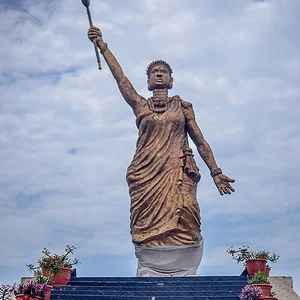
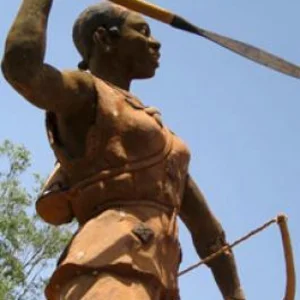
An iconic statue depicting Yennenga on horseback, erected in the Burkinabè capital as a tribute to the founding mother of the Mossi nation.
Anecdotes
Yennenga was an exceptional horsewoman, so skilled that her father King Nedega had her trained as a warrior from childhood. She commanded her own cavalry army and won many battles for the Dagomba kingdom — something entirely unprecedented for a woman in that region.
Her father, proud of her military talents, refused to let her marry, unwilling to lose his finest warrior. To express her frustration, Yennenga planted a field of millet and let the harvest rot without picking it — a symbolic way of saying that she, too, had the right to bear fruit and start a family.
During her escape from her father's palace, Yennenga disguised herself as a man to cross the forests to the north. She met a hunter named Riale — in some versions, the name came from an elephant he had killed. From their union was born Ouédraogo, whose name means 'stallion', a reference to the horse that was her mother's emblem.
Yennenga is depicted on horseback in the iconic monument of Ouagadougou, the capital of Burkina Faso, in tribute to her founding role. The film 'Wend Kuuni' (1982) and other Burkinabè works carry on this tradition of honoring the founding figure of the Mossi people.
Primary Sources
The Mossi griots recount that Yennenga, daughter of King Nedega of the Dagomba, fled on horseback and united with Riale the hunter. From their son Ouédraogo descended the Mossi chiefs, the Nakomsé, who founded the kingdom of Moogo.
The epic songs performed during Mossi royal ceremonies celebrate Yennenga as 'the mother of the Mossi', an invincible warrior and founder of the royal lineage.
Tauxier gathers accounts from elders about the origins of the Mossi, mentioning Yennenga and Ouédraogo as founding figures of the kingdom of Ouagadougou, passed down from generation to generation by village elders.
The Burkinabè author records the royal Mossi traditions, placing Yennenga at the heart of the founding narrative: her flight, her encounter with Riale, and the birth of Ouédraogo are described in detail along with regional variants.
Key Places
Region traditionally associated with the Dagomba kingdom and the court of King Nedega, Yennenga's father. This is where the palace stood from which the princess made her escape.
City considered one of the earliest centers of the Moogo kingdom founded by Ouédraogo, Yennenga's son. It is revered as the cradle of the Mossi nation.
Capital of Burkina Faso and of the historical Mossi kingdom, whose kings (Mogho Naaba) claim descent from Yennenga. An equestrian monument in her likeness stands in the city.
The forest crossed by Yennenga during her escape is evoked in oral traditions as the place where she met Riale the hunter — where everything begins.
A lake district near the founding territories of the Mossi, a symbolic landscape referenced in certain variants of the oral accounts describing the wanderings of the Mossi ancestors.
Typical Objects

Yennenga's most iconic symbol, the horse was rare and precious in the West African savanna. It represents her reclaimed freedom and her status as an elite warrior within her father's army.

Weapons used by Dagomba cavalry in battle. Yennenga wielded these arms during the military campaigns she led on behalf of King Nedega.

To escape the palace, Yennenga is said to have disguised herself as a male warrior. This act of disguise reflects both her courage and the gender constraints of Dagomba society.

The staple grain of the Sahel that Yennenga planted as a symbolic protest against being forbidden to marry: letting the harvest rot was her way of saying she was being denied her right to life and descendants.

Bracelets, necklaces, and bronze or copper ornaments marking Yennenga's princely rank at her father Nedega's court.

The signature weapon of Dagomba cavalry, used during mounted charges. It represents the military power Yennenga wielded in her father's name.
School Curriculum
Vocabulary & Tags
Key Vocabulary
Tags
Daily Life
Morning
Yennenga rises at dawn within her father's royal compound in Gambaga. She begins her day with equestrian training alongside her elite cavalry, refining her techniques for handling a lance on horseback.
Afternoon
In the afternoon, she presides over her troops' military exercises and receives reports from her lieutenants. She may also attend the councils of her father the king — an exceptional role for a woman of her era.
Evening
In the evening, she retires to her private quarters, surrounded by her attendants. She listens to the griots recounting the deeds of warrior ancestors, or prays according to the traditional animist rites of her people.
Food
Her diet is built around millet and sorghum, prepared as tô (thick porridge) or flatbreads, served with sauces made from leafy vegetables and peanuts. Game meat, dried fish, and goat's milk round out the meals of a royal household.
Clothing
As a warrior princess, Yennenga wears hybrid attire: an indigo-dyed cotton wrap during ceremonies, and a rider's outfit — loose trousers and a short tunic — during training. Ornaments of bronze, cowrie shells, and beads adorn her neck and arms.
Housing
She lives in a cluster of round mud-brick (banco) huts with thatched roofs, enclosed within a fortified compound inside the royal palace of Nedega. The walls are decorated with geometric patterns painted in ochre and white, typical of Dagomba royal architecture.
Historical Timeline
Period Vocabulary
Visual Style
Esthétique guerrière de la savane ouest-africaine médiévale : terres ocre et indigo, cavalière princière parée de bronze, baobabs sous un ciel doré.
Sound Ambience
Ambiance de savane sahélienne : vent chaud dans les herbes sèches, tambours royaux, sabots de chevaux sur la latérite et chants de griots au crépuscule.
Liens externes & ressources
Références
Œuvres
Fondation du royaume Moogo
vers XIe-XIIe siècle
Campagnes militaires pour le roi Nedega
vers XIe siècle
Acte de résistance symbolique : le champ de mil
vers XIe siècle
Transmission du modèle de la femme guerrière mossi
XIe siècle — présent
Monument équestre de Ouagadougou
XXe siècle