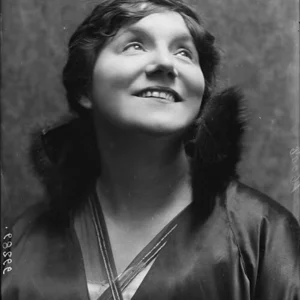

French café-concert singer and *diseuse* (1865–1944), an icon of the Belle Époque immortalized by Toulouse-Lautrec. Famous for her long black gloves and her expressionist delivery of Parisian realist songs.
Yvette Guilbert(1865 — 1944)
Yvette Guilbert
France
9 min read
Frequently asked questions
Key Facts
- Born in 1865 in Paris to a modest family, she began performing on stage in the late 1880s
- Became a star of Parisian cabarets in the 1890s, notably at the Eldorado and the Moulin Rouge
- Henri de Toulouse-Lautrec made her one of his favorite subjects, depicting her in numerous posters and lithographs (1890s)
- Her international tours took her to perform across Europe and the United States, helping to spread the influence of French song
- She died in 1944, having lived through the Belle Époque, the Great War, and the interwar years
Works & Achievements
A song by Léon Xanrof that became one of the jewels of Yvette Guilbert's repertoire. Her expressionist interpretation of this portrait of Parisian nightlife perfectly illustrates her art as a diseuse, where every word matters as much as the melody.
A realist song depicting with compassion and humor a drunken working-class woman, which Yvette Guilbert sang with striking expressiveness. This unflinching social portrait was the hallmark of her naturalist repertoire, inspired by Zola.
Among the first French artists to preserve her voice on a phonographic medium, Yvette Guilbert left historic sound documents of her art of diction. These cylinders are today exceptional records of French chanson at the close of the 19th century.
An autobiography in which Yvette Guilbert traces her journey from Parisian poverty to international fame. An essential work for understanding the artistic life of the Belle Époque from the inside.
A pedagogical manual grounded in fifty years of stage experience, in which Yvette Guilbert sets out her conception of singing as a dramatic and literary art. Used in her courses at New York University.
From 1905 onwards, Yvette Guilbert devoted herself to rediscovering and performing medieval French songs. This pioneering musicological approach earned her renewed international recognition among scholarly circles.
Anecdotes
Toulouse-Lautrec was fascinated by Yvette Guilbert and portrayed her dozens of times. When he submitted his sketches to her, she wrote him an indignant letter: “For the love of heaven, don’t make me so hideous!” The painter mischievously replied that he couldn’t help it — his genius lay precisely in these expressionist distortions. Yet those posters went on to forge her legend across the whole of Europe.
Her long black gloves, which reached up to the elbow, were not a mere fashion whim. Yvette Guilbert wore them to conceal her very thin arms, of which she was ashamed. This seemingly trivial detail would become one of the most recognizable silhouettes of the Belle Époque, immediately identifiable on the Toulouse-Lautrec posters plastered all over Paris.
In 1931, Yvette Guilbert received a letter from an unexpected admirer: Sigmund Freud, the father of psychoanalysis. The famous Viennese doctor wrote to tell her that he considered her one of the most extraordinary artists he had ever seen, and that the memory of her performances had stayed with him his entire life. This correspondence is a testament to Yvette Guilbert’s reach far beyond the world of entertainment.
Yvette Guilbert was not merely a singer: she was above all a *diseuse* — an artist who gave as much weight to words as to melody. She would take poetic or popular texts and transform them through her intonations, calculated silences, and facial expressions. This revolutionary approach profoundly influenced French realist song and paved the way for artists such as Édith Piaf.
In the 1930s, as her stage career was waning, Yvette Guilbert crossed the Atlantic to teach the art of vocal interpretation at New York University. This reinvention as an educator speaks to the lasting importance of her legacy: she was passing on to a new American generation the French conception of singing, grounded in the absolute primacy of text and dramatic expression.
Primary Sources
I wanted to tell my life as it truly was — with its joys and sorrows, its highs and lows. If I succeeded in making people love French song, in giving it the recognition it deserved, it is because I believed in it with all my strength.
Music is the servant of the text, never its mistress. The singer who sacrifices words to melody betrays doubly: they betray the poet and they betray their audience. The voice must paint every syllable, every comma, every silence.
You were one of the greatest artistic emotions of my life. Your art of diction, your way of bringing the humblest words to life, stayed with me long after the evenings when I had the fortune of hearing you.
Between 1893 and 1898, Toulouse-Lautrec produced a series of sixteen lithographs devoted to Yvette Guilbert, some of which were rejected by the artist herself, who found them too caricatural. These works constitute the most celebrated visual documents of the diseuse.
Mlle Guilbert possesses the rare gift of conveying, through the sheer power of her voice and gesture alone, the entire soul of a character in just a few verses. She is not an ordinary singer; she is a living poem.
Key Places
Yvette Guilbert was born on January 20, 1865, in the working-class Bastille neighborhood. This modest background left a deep mark on her repertoire, rooted in the everyday social reality of ordinary Parisians.
Opened in 1889, the Moulin Rouge was one of Yvette Guilbert's signature stages. This temple of Montmartre music-hall embodied all the artistic excitement of the Belle Époque and drew Toulouse-Lautrec, who made his first sketches of the singer there.
The Eldorado was one of Paris's most celebrated café-concerts, located on the Boulevard de Strasbourg. It was here that Yvette Guilbert achieved her first major popular successes in the 1890s, performing before audiences drawn from all walks of life.
Yvette Guilbert triumphed in London as early as 1894 during her first British tour. Her mastery of diction captivated English-speaking audiences, and she gave regular performances there that cemented her international reputation.
Yvette Guilbert made several tours of America and settled there periodically during the 1930s to teach the art of vocal performance at New York University, spreading the French tradition of *chanson réaliste*.
It was in Aix-en-Provence that Yvette Guilbert took refuge during the Second World War, and where she died on February 3, 1944, at the age of 79, after a career spanning more than fifty years.
Typical Objects

An emblematic trademark of Yvette Guilbert, these elbow-length gloves served to conceal her very thin arms. They became an instantly recognizable visual signature, immortalized in Toulouse-Lautrec's posters and in the collective memory of the Belle Époque.

Between 1893 and 1898, Toulouse-Lautrec created several series of lithographs depicting Yvette Guilbert on stage. These large-format posters, plastered all over Paris, helped make the singer the ultimate visual icon of the Belle Époque.

Yvette Guilbert worked meticulously on her scores, annotating each text to indicate inflections, silences, and expressive nuances. These working notebooks bear witness to her deeply literary and dramatic approach to singing.

The *cafés-concerts* of the Belle Époque were lit by rows of gas jets arranged as footlights along the edge of the stage. This yellow, flickering light bathed performers in a distinctive aura and created the enchanting atmosphere of Parisian evenings of the era.

Yvette Guilbert was among the first French artists to record her voice on phonograph cylinders from the late 1890s onward. These recordings are today exceptional sonic documents of her art of diction and of late nineteenth-century French song.

Unlike the extravagant costumes worn by many singers of the era, Yvette Guilbert favored a simple, understated white dress. This deliberate choice highlighted her physical expressiveness and created a striking visual contrast with her famous black gloves.
School Curriculum
Vocabulary & Tags
Key Vocabulary
Daily Life
Morning
Yvette Guilbert, like most café-concert performers, rarely rose before ten in the morning. She would begin her morning by reading her correspondence — letters from admirers, tour proposals, invitations to literary salons — then sit down to study new texts or carefully annotate her sheet music.
Afternoon
The afternoon was devoted to vocal work and rehearsals with her accompanist. Yvette Guilbert paid meticulous attention to the diction of each verse, testing vocal effects, expressive silences, and dramatic nuances. She sometimes received journalists or artists — painters, poets, men of letters — in her Parisian apartment.
Evening
Performance evenings began in the late afternoon with preparation and makeup. In the large cafés-concerts, several performers took the stage one after another throughout the night; Yvette Guilbert could thus perform before thousands of spectators in a single evening. After the show, it was customary to dine at neighboring brasseries with fellow performers or admirers.
Food
Since her voice was her instrument, Yvette Guilbert was very careful about what she ate. She avoided cold drinks and alcohol before performances, preferring light meals on show days. Traditional French bourgeois cuisine — soups, slow-cooked meats, seasonal vegetables — made up the staple of her table.
Clothing
On stage, Yvette Guilbert invariably wore her simple white dress contrasting with her long black gloves — a deliberately pared-down outfit designed to let her expressiveness shine through. In everyday life, she dressed with the fashionable bourgeois elegance of the day: a high-collared blouse, a long skirt, and a wide-brimmed hat trimmed with flowers or feathers.
Housing
At the height of her fame, Yvette Guilbert lived in a comfortable apartment in one of Paris's fashionable districts, furnished in the Art Nouveau style of the era. The walls were adorned with reproductions of Toulouse-Lautrec's posters and signed photographs from celebrated admirers. During her lengthy tours abroad, she stayed in the grand hotels of European and American capitals.