Imaginary interview with Fatima al-Fihri
by Charactorium · Fatima al-Fihri · Spirituality · Literature · 6 min read
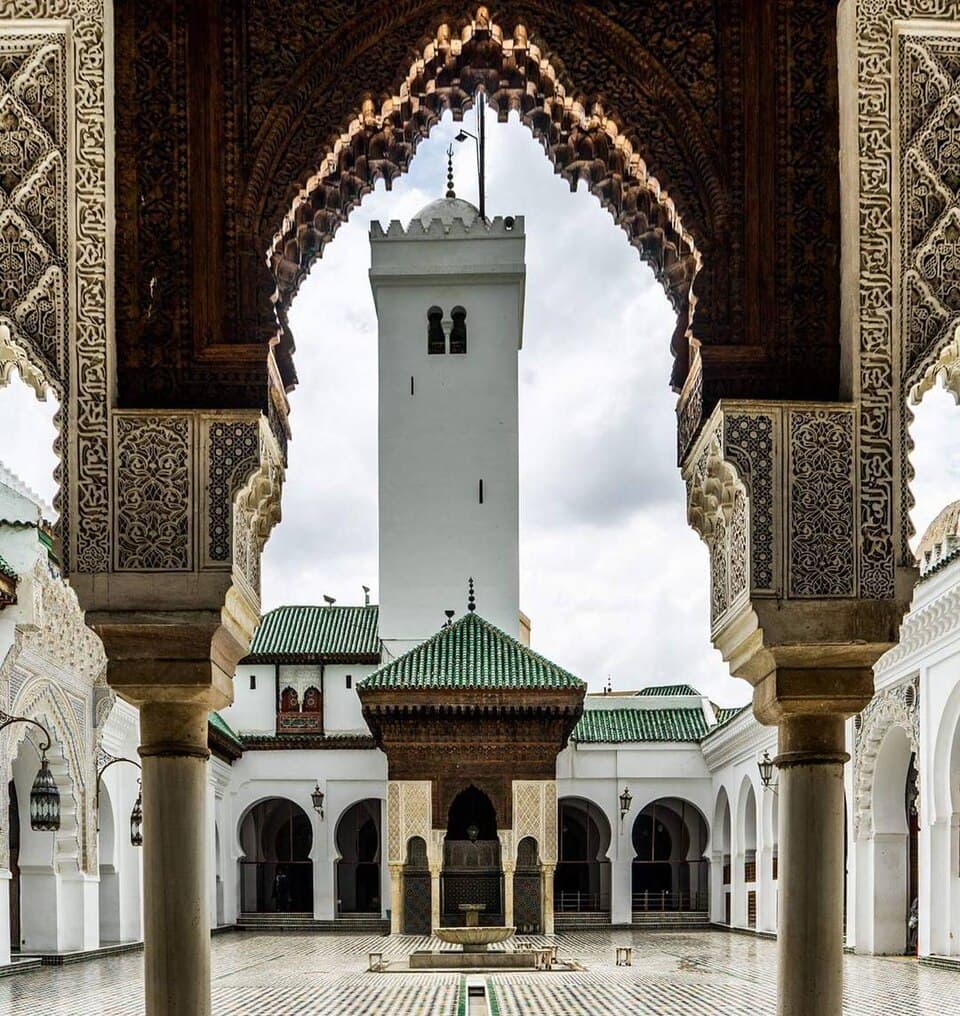
Fez, late afternoon in the year 245 of the Hijra. The dust of the construction site still floats in the golden light as Fatima al-Fihri receives us in the shade of a freshly erected wall, a prayer rug rolled under her arm. She speaks softly, the voice of a woman who has taken a vow of silence and fasting, and whose every phrase still seems to measure a stone.
—Can you tell us where your family came from, before Fez?
I was born in Kairouan, that city our people consider one of the pillars of Islam in the Maghreb, a hearth of mosques and scholars where my father traded. But the routes of commerce and the prosperity of the Idrisids called the Kairouanese westward, and we packed our bags like so many other families from our quarter. I was still young when we entered the medina of Fez el-Bali, where our people clustered in the Kairouanese quarter, keeping our ways, our cuisine, our manner of prayer. People often think that exile impoverishes the soul; ours rooted it. We brought with us not only my father's gold, but the memory of a holy city, and I grew up feeling I owed Fez what Kairouan had given us.
People often think that exile impoverishes the soul; ours rooted it.
—How did your father's death change the course of your life?
My father, Muhammad al-Fihri, was one of those merchants whom fortune had not made forgetful of God. At his death, my sister Mariam and I found ourselves heiresses to a wealth that few women hold in their hands — chests of silver dirhams struck in the name of the Idrisids, bearing their Quranic inscriptions. I could have lived in comfort, in our home with its courtyard of orange trees and myrtles, surrounded by carpets and carved stucco. But a wealth that sleeps is a wealth that accuses. That money came from the trade of a pious man; it seemed to me it must return to the community that had nourished it. It was there, between mourning and prayer, that I formed the plan to build not a tomb nor a palace, but a house of prayer and learning for Fez.
A wealth that sleeps is a wealth that accuses.
—It is said that you made a vow when the work began. What exactly did you promise?
I promised God that not a single dirham of my inheritance would serve any purpose but this building, and that I would fast as long as the walls rose. A vow is not idle talk among us; it is a contract sealed with Heaven. Every morning, after the fajr prayer and the recitation of the Quran, I would go down to the site with an empty stomach, and I would break my fast, at sunset, only with a light harira, a soup of herbs and lentils. Some around me worried about my pallor. But a vow stands firm through hunger as much as faith: as long as I felt that hollow in me, I knew the work was not finished. I only broke that fast, they say, when the last stretch of wall was raised.
A vow stands firm through hunger as much as faith.
—You went to the construction site every day. What were those days like?
In the hottest hours, when other women of my rank withdrew into the shade, I stayed among the craftsmen. I watched the porters load mortar into their woven esparto baskets, I ran my hand over the stone to judge if it rang true, I corrected a mason if an arch strayed from the plan. I wanted nothing unworthy of the house of God — neither a sloppy joint nor a scrap of waste material. And when the call to prayer rose, I would spread my Berber wool prayer rug right on the dust of the site and prostrate myself there, among the scaffolding, as if the unfinished walls prayed with me. I was told a woman had no place among masons. But whoever loves a work watches it with their own eyes; I entrusted my vow to no one.
Whoever loves a work watches it with their own eyes.
—Your sister Mariam was building her own mosque at the same time. How did you experience this double enterprise?
Mariam and I had received the same share, the same blood, the same piety — it was natural that we should raise our works side by side. While I raised the Qarawiyyin, she built from her own purse the Mosque of the Andalusians, a few alleys away. People spoke of rivalry between us; I prefer to say emulation. We showed each other our plans in the evening, compared the grain of a stucco, the quality of a column, not to outdo each other but so that each might push the other toward greater beauty. Fez gained two houses of prayer instead of one, one born of Kairouanese blood, the other greeting our brothers from al-Andalus. Two sisters, two mosques, one city enriched: I know no finer way to share an inheritance.
People spoke of rivalry between us; I prefer to say emulation.
—What place did learned women hold around you?
In the evening, after the maghrib prayer, when the construction site fell silent, Mariam and I would gather a few women of the community who could read and discuss. We would open treatises on law, on fiqh, commentaries on the Quran, and debate them by the light of glazed ceramic oil lamps until the call of isha. People often imagine knowledge as a matter of bearded men bent over scrolls. But in our homes, learning was also passed from mother to daughter, from sister to sister, on the carpets of an inner courtyard. If I wanted my mosque to become a place of teaching, it is perhaps because I had tasted, in those women's vigils, how shared speech nourishes the soul better than gold. One does not open a door to learning without having entered it oneself.
One does not open a door to learning without having entered it oneself.
—Building a mosque is one thing; ensuring it lives on after you is another. How did you plan for its future?
A stone laid without endowment is a stone that will crumble into oblivion. So I established a waqf, what we call a pious foundation: a property made inalienable, whose revenues can serve only the work for which they were vowed. No one can sell it, no heir can squander it; it runs in perpetuity. Thanks to this waqf, the upkeep of the walls and the salaries of those who would teach there were guaranteed, not for a year or ten, but from generation to generation. I understood very early that the hardest part was not raising a building, but making sure it would never need me to stand. A wise founder builds twice: once in stone, once in law.
A wise founder builds twice: once in stone, once in law.
—You converted your entire fortune into this work. Was it not dizzying to give everything?
I watched my father's chests of dirhams melt like snow in the Fez sun — every silver coin turned into dressed stone, into columns, into a marble ablution fountain imported from afar. People thought me ruined; I felt enriched. For money kept yields only money, while money vowed to God yields knowledge and prayer, and that cannot be counted. Yes, there came a moment when I held the last purse and measured the emptiness that followed. But what dizziness, tell me, compared to hearing one day, under these arches, the Quran recited and the law debated? I traded a perishable fortune for an eternal income. I never made a better bargain, and yet I am a merchant's daughter.
I traded a perishable fortune for an eternal income.
—Did you want only a place of prayer, or already something else?
A mosque where one only prostrates is half a house of God. From the start, I wanted the Qarawiyyin to also be a madrasa, a school where the Quran, fiqh, Arabic grammar, and why not the sciences of numbers and stars would be taught. I imagined circles of ulama sitting against the columns, a copper inkwell and its reed pen at hand, students from all over the Maghreb copying and debating. Prayer teaches humility; study teaches why one prays. The two, under one roof, seemed to me the most complete work a woman could bequeath to her community. One builds not only for the living of today, but for masters and disciples one will never see.
Prayer teaches humility; study teaches why one prays.
—If you imagined this house in a distant future, what would you wish for it?
I am only a woman of the 9th century and God alone knows the future; but if I were allowed to dream that people still recite here in a century, in ten centuries, I would ask for nothing more. May the lamps always burn under these arches for study vigils, may the library I hope to see born keep its manuscripts like a treasure, may a Quran copied by my hand outlast my dust. I care little if my name is remembered — women fade quickly from chronicles. But let a child from a land I do not know come and sit against one of my columns to learn, and then my waqf will have kept its promise better than my memory. One builds a stone to remember oneself; one builds a school to be forgotten in peace.
One builds a stone to remember oneself; one builds a school to be forgotten in peace.

This imaginary interview was generated by artificial intelligence from sources documented in Fatima al-Fihri's profile. It dramatises what the figure might have said based on what we know about them, but does not constitute attested historical testimony. For primary sources and factual documentation, refer to the full profile.