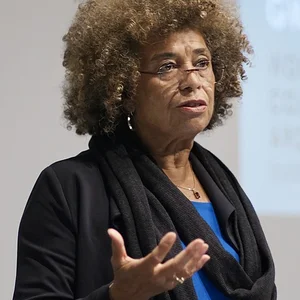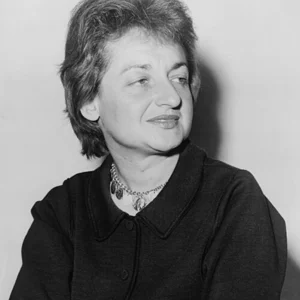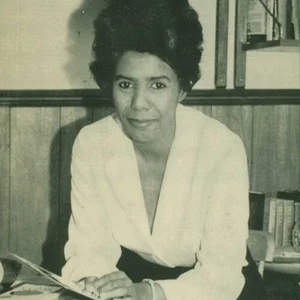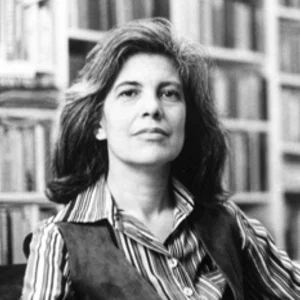

American poet and essayist (1929-2012), a major figure of literary feminism. Her work explores female identity, sexuality, and political commitment. She received the National Book Award in 1974 for “Diving into the Wreck”.
Frequently asked questions
Famous Quotes
« The connections between and among women are the most feared, the most problematic, and the most potentially transforming force on the planet.»
« Re-vision — the act of looking back, of seeing with fresh eyes, of entering an old text from a new critical direction — is for women more than a chapter in cultural history: it is an act of survival.»
Key Facts
- 1929: Born in Baltimore, Maryland, into a cultivated family
- 1951: First collection “A Change of World”, awarded a prize and prefaced by W. H. Auden
- 1974: National Book Award for “Diving into the Wreck”
- 1980: Publication of the landmark essay “Compulsory Heterosexuality and Lesbian Existence”
- 2012: Died in Santa Cruz, California, leaving a body of work spanning more than twenty collections
Works & Achievements
Her debut collection, published at age 22 and awarded the Yale Series of Younger Poets prize with a preface by W.H. Auden. Still influenced by formal tradition, it reveals an already acute sensitivity to the tensions between social norms and women's inner life.
A major turning point in Rich's work, this collection marks her explicit commitment to feminist critique. The ten-part title poem offers a sharp portrait of the condition of housewives in 1950s–60s America.
Rich's masterpiece and most celebrated collection, awarded the National Book Award in 1974. The central poem uses the metaphor of an underwater dive to explore patriarchal myths, the collective unconscious, and female identity.
A foundational essay in which Rich distinguishes lived motherhood (personal experience) from institutional motherhood (a patriarchal construct). Blending autobiography and analysis, the work became an essential reference in feminist studies.
A collection exploring the desire for a common language among women. It includes the celebrated sequence "Twenty-One Love Poems," an open and poetic declaration of lesbian love that was remarkable for its boldness at the time.
A theoretical essay that became a founding text in gender studies, in which Rich argues that heterosexuality is an institution imposed by patriarchal power, and defines the "lesbian continuum" as a form of solidarity among women.
A collection of essays linking poetry, politics, and everyday life, in which Rich champions a vision of art as an act of social resistance and refuses any separation between writing and civic engagement.
Anecdotes
In 1951, while still a student at Radcliffe College (Harvard's women's college), Adrienne Rich published her first collection “A Change of World,” which won the Yale Series of Younger Poets prize. The celebrated poet W.H. Auden, tasked with selecting the winner, wrote an effusive preface — but Rich would later criticize this condescending text, noting that Auden had praised a woman for knowing how to write “correctly,” rather than acknowledging the true power of her vision.
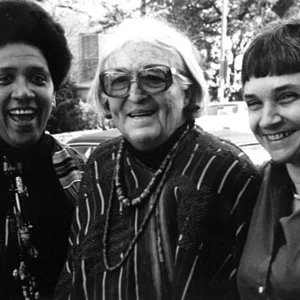
In 1974, Adrienne Rich received the National Book Award for “Diving into the Wreck,” but refused to accept it as an individual. In a gesture of feminist solidarity, she accepted it collectively with the other finalists Audre Lorde and Alice Walker, on behalf of “all the women whose creativity has been ignored, erased, or silenced.” This iconic moment entered the history of American literary feminism.
In 1997, President Bill Clinton offered Adrienne Rich the National Medal of Arts, the highest artistic honor in the United States. Rich categorically refused and sent a public letter to the chair of the National Endowment for the Arts, Jane Alexander, explaining that she could not accept an honor from a government that was simultaneously cutting cultural funding and abandoning the most vulnerable. Her refusal made front-page news and reignited the debate over the artist's role in the face of power.
Rich suffered throughout her life from severe rheumatoid arthritis, diagnosed when she was just 22. Despite chronic pain that sometimes made even holding a pen difficult, she continued to write and engage politically until the end of her life, seeing in this daily struggle against physical pain an echo of the broader resistance she championed in her poetry.
With her essay “Compulsory Heterosexuality and Lesbian Existence” (1980), Rich challenged what was then a dominant idea: heterosexuality as a natural and universal norm. She argued that heterosexuality is imposed on women through powerful social mechanisms, and that bonds between women form a “continuum” of experiences long erased from history. This text became a cornerstone of feminist and gender studies in universities around the world.
Primary Sources
First having read the book of myths, / and loaded the camera, / and checked the edge of the knife-blade, / I put on / the body-armor of black rubber / the absurd flippers / the grave and awkward mask.
Re-vision — the act of looking back, of seeing with fresh eyes, of entering an old text from a new critical direction — is for women more than a chapter in cultural history: it is an act of survival.
The assumption that 'most women are innately heterosexual' stands as a theoretical and political stumbling block for feminism. It remains a tenable assumption partly because lesbian existence has been written out of history.
I could not accept such an award from President Clinton or this White House because the very meaning of art, as I understand it, is incompatible with the cynical politics of this administration.
The institution of motherhood is not identical with bearing and caring for children. Motherhood as institution has ghettoized and degraded female potentialities.
Key Places
Adrienne Rich's birthplace, where she grew up in a cultivated, upper-middle-class family. Her father, a physician and professor at Johns Hopkins, had a defining influence on her intellectual and literary development.
Rich studied literature here from 1947 to 1951, at what was then Harvard's women's college. It was there that she wrote the poems of her award-winning first collection, under the influence of the great modernists.
Rich lived in New York during the 1960s and 1970s, a period of her feminist and political awakening. She taught at City College and was an active participant in the city's intellectual and political circles.
Rich settled in this rural Vermont village in the 1970s with her partner Michelle Cliff, finding a setting conducive to writing and reflection away from the bustle of New York.
Adrienne Rich's final home, where she taught at the University of California and completed her body of work. She died there on March 27, 2012.
Typical Objects

Rich used a typewriter for most of her career, a central tool in her daily writing practice despite the joint pain caused by her rheumatoid arthritis.

She kept notebooks in which she recorded drafts, political reflections, and readings — precious witnesses to her creative process and her thought in motion.

Photography is a central metaphor in 'Diving into the Wreck': Rich evokes the act of loading the camera before diving into the symbolic wreck of the past and its myths.

Her library brought together the great modernists (Yeats, Eliot, Auden) she had studied, alongside early feminist texts that she annotated extensively and distributed in her courses.

Afflicted with rheumatoid arthritis since her twenties, Rich relied on medical treatments to keep writing and pursuing her activist work, giving her creative discipline the dimension of a daily struggle.

Involved in numerous causes — feminism, opposition to the Vietnam War, LGBT rights — Rich took part in demonstrations and kept activist materials that directly fed her poetic commitment.
School Curriculum
Vocabulary & Tags
Key Vocabulary
Tags
Daily Life
Morning
Rich began her mornings early, devoting the first hours to poetic work in quiet and solitude. Despite the rheumatoid arthritis that sometimes made the simple act of writing painful, she maintained this daily creative discipline as a fundamental commitment to herself and her work.
Afternoon
Her afternoons were divided between university teaching (she taught at City College of New York, Rutgers, Cornell, and Stanford, among others), theoretical reading, and activist meetings — feminist consciousness-raising groups, anti-war committees, or LGBT organizations depending on the period of her life.
Evening
In the evenings, Rich read, corresponded with other writers and activists, and frequently participated in public poetry readings, a practice she considered a political act in itself. She led a simple life, without seeking out the social circles of the literary world.
Food
Rich lived modestly, without excess. During her New York years, she frequented neighborhood restaurants and shared communal meals in feminist circles. After settling in Vermont and later California, she favored simple, locally sourced food, in keeping with her values.
Clothing
Rich adopted a sober, functional style of dress, deliberately distanced from the codes of conventional femininity imposed on women of her era. She wore comfortable clothes — jeans, sweaters, practical jackets — consistent with her convictions about rejecting patriarchal dress norms.
Housing
Rich lived in New York apartments during her activist years of the 1960s and '70s, before settling in a rural house in Vermont with her partner Michelle Cliff. Her last residence in Santa Cruz, California, provided a more peaceful setting near the university where she taught.
Historical Timeline
Period Vocabulary
Liens externes & ressources
Références
Œuvres
A Change of World
1951
Snapshots of a Daughter-in-Law
1963
Diving into the Wreck
1973
Of Woman Born : Motherhood as Experience and Institution
1976
The Dream of a Common Language
1978
Compulsory Heterosexuality and Lesbian Existence
1980
What Is Found There : Notebooks on Poetry and Politics
1993