Imaginary interview with Hou Yifan
by Charactorium · Hou Yifan (1994 — ?) · Sports · 6 min read
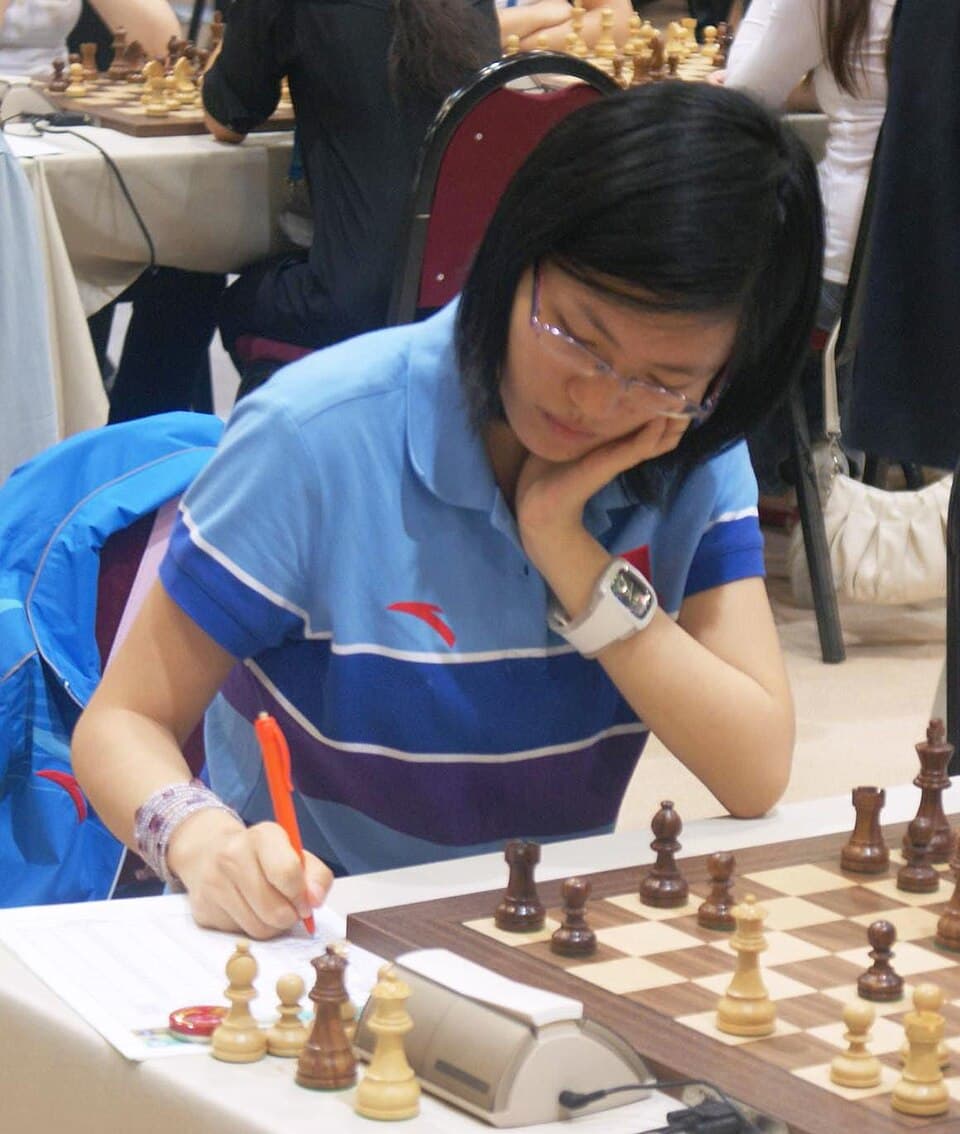
A late winter afternoon, in a quiet office on the campus of Shenzhen University. The windows overlook the palm trees of southern China, and on the table, between two piles of student papers, a travel chess set waits, half-packed. Hou Yifan receives us with the calm of someone who has spent her life measuring every move before making it.
—How did chess enter your childhood in Xinghua?
I don't remember a 'first' day, and that's precisely the sign that it came from very far back. I was about three years old, in our house in Xinghua, in Jiangsu, and my parents were moving these wooden pieces to pass the time. I watched, then I wanted to touch. The king, the queen, the bishops: to me they weren't symbols of war, they were friends, each with their own way of moving. Very quickly I was taken to a national training center, far from home, and there everything changed in nature. What had been a living-room game became a discipline with schedules, exercises, adults who expected something from me. I think I was lucky: I loved chess before I knew you could make a career out of it.
The king, the queen, the bishops: to me they were friends, each with their own way of moving.
—In 2008, you became an international grandmaster at fourteen. What did that title mean to a teenager?
At fourteen years and six months, I was awarded the title of international grandmaster, the one conferred by FIDE that knows no gender: it's the same as for men. At the time, honestly, I was mostly thinking about the next game. It was only later that I understood what that word, grandmaster, meant in the mouths of people who had waited twenty years for it. The title is not lent and cannot be lost: once obtained, it remains. That gave me a strange form of serenity, very early. I no longer had to prove that I existed in this elite; all that remained was to discover how far I could go. A child given a key so early learns quickly that the door was only the beginning of the corridor.
A child given a key so early learns that the door was only the beginning of the corridor.
—December 2010: you became the youngest world champion in history. How did you experience that triumph?
I was sixteen. The FIDE press release proclaimed me world champion, and for the first time the word 'youngest' stuck to my name like a label I would never shake off. In front of the chessboard, I wasn't thinking about history; I was thinking about square d7, the clock, the fact that my opponent was breathing a little faster. It's afterward, when the silence falls and they hand you a trophy, that the dizziness comes. I told myself: this title, now I'll have to carry it, not just brandish it. At that age, victory feels like an immense responsibility disguised as a celebration. From then on, I was watched as an answer to a question that China, and the chess world, was asking about the place of women at the top.
This title, now I'll have to carry it, not just brandish it.
—You briefly lost the crown, then recaptured it. What did that instability of titles teach you?
The Women's World Championship long operated as a knockout tournament, a brutal format where a single bad day erases two years of work. In 2012, I lost the title that way, almost by statistical accident. Many would have cried injustice; I, instead, observed the system coldly. In 2013, I recaptured it decisively, then again in 2016. Those back-and-forths taught me one thing: a player's truth is not read in a single knockout tournament, but over time, in the Elo rating that rises and holds season after season. A title can escape you on an unlucky zugzwang; a level, on the other hand, does not lie. I stopped confusing the trophy with real strength. That is perhaps the lesson that prepared me for Gibraltar.
A title can escape you on an unlucky move; a level, on the other hand, does not lie.
—Let's talk about Gibraltar, in 2017. What happened during that final game?
At the Gibraltar tournament, round after round, the pairing placed me almost exclusively against female players, even though the field included much higher-rated men. I was playing an 'open' tournament, yet I found myself locked into an invisible women's tournament, traced by the luck of the draw. On the last day, I made a decision I knew was shocking: I lost my game in a few moves, voluntarily, as a sign of protest. It was not against my opponent, to whom I owe an apology, but against a pairing I considered unfair. Sacrificing a game, for a player, is almost blasphemy. But sometimes you have to knock over your own queen on the board to be heard in a way no polite victory would have achieved.
Sometimes you have to knock over your own queen to be heard in a way no polite victory would have said.
—That gesture caused a scandal. Do you regret it, or do you fully stand by it?
I understand it was poorly received, and I don't present it as a model. Losing on purpose goes against the very idea of sport, and I wouldn't advise anyone to repeat it. But I stand by it, because it pointed to a real problem: as long as women are compartmentalized in a parallel circuit, they are deprived of the only learning that makes progress: testing themselves against the strongest, regardless of gender. I have always refused to be put in a box labeled 'best female player' as if it were a ceiling. I wanted to be judged on the same Elo rating as everyone else. That day, in Gibraltar, I chose to make noise rather than smile. A bad move, perhaps. But a move I would make again if it were necessary to awaken consciences.
—What does a champion's preparation look like in the age of computers?
My morning rarely begins with a game: it begins with a screen. I replay my recent encounters, review my openings, and above all I study the day's opponent using analysis software capable of weighing millions of positions in a breath. That is the great change of my generation: the machine does not play in my place, but it forces me to be honest. It's impossible to cheat yourself when an engine shows you, without mercy, the move you are afraid to play. In the afternoon, I play long games, several hours in total silence, where the clock becomes a third player. In blitz, that same countdown turns you into a tightrope walker. Technology has made chess both deeper and more ruthless.
The machine does not play in my place, but it forces me to be honest.
—People imagine chess as a pure mental exercise. Does the body really matter?
Enormously, and that is what the public underestimates. Sitting still for five or six hours in extreme concentration is as exhausting as physical effort. So I take care of my diet like an athlete: balanced meals, energy snacks within reach, regular hydration between moves. A fatigue spike at the end of a game, during the endgame, and that's when, with few pieces left and everything hinging on technique, you make the fatal mistake. I have learned to treat concentration like a muscle that needs refueling. Even clothing matters: comfortable but neat, because you have to sit for hours without thinking about it. You think you are facing an opponent; in reality, you first confront your own weariness.
—You could have lived only for the chessboard. Why did you insist on studying, at Beijing and then Oxford?
Because I refused that a three-year-old child moving pieces should become an adult reduced to that. I studied international relations at Peking University, then continued at Oxford as a Rhodes Scholar. Many told me I was diluting my talent, that a champion should think only of chess. I believe the opposite: reading, understanding the world, stepping off the board made me stronger in front of it. The chessboard has sixty-four squares; the mind does not have to be confined to it. Sharing my mornings between opening analysis and lecture halls taught me to change pace, to breathe differently. A life is not played on a single opening line. I have always wanted to keep several games open at once.
The chessboard has sixty-four squares; the mind does not have to be confined to it.
—In 2020, you became the youngest tenured professor at Shenzhen University. How does one go from player to teacher?
In 2020, Shenzhen University appointed me a tenured professor, and much was made of my age, as in 2008 and 2010: clearly, the word 'youngest' follows me. But teaching is not a renunciation of chess; it is its extension. In front of a student, I do exactly what I do in front of a board: I look for the move that unlocks a position, except the position is a mind that hesitates. Passing on a method, a way of thinking under pressure, managing a tempo of life as much as a tempo of a game, that fascinates me. I was trained very young by coaches who believed in me at a national center; now it's my turn to give back some of that trust. You never really leave the chessboard; you simply change sides of the table.
You never really leave the chessboard; you simply change sides of the table.

This imaginary interview was generated by artificial intelligence from sources documented in Hou Yifan's profile. It dramatises what the figure might have said based on what we know about them, but does not constitute attested historical testimony. For primary sources and factual documentation, refer to the full profile.