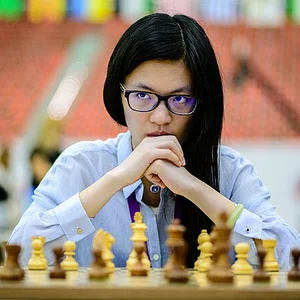

Hou Yifan is a Chinese chess player born in 1994, considered the best female player of her generation. Having become an international grandmaster at 14, she won the Women's World Championship title several times, becoming the youngest world chess champion in history.
Frequently asked questions
Key Facts
- Born on February 27, 1994, in Xinghua, China
- Becomes an international grandmaster in 2008, at the age of 14
- Wins the Women's World Chess Championship in 2010, at 16, becoming the youngest world champion in history
- Retains and reclaims the women's world title several times (2011, 2013, 2016)
- Reaches the rank of top-rated female player in the world for many years
Works & Achievements
Earned at age 14, this title ranks her among the world chess elite, men and women alike.
The youngest world champion in the history of the discipline, at age 16.
Confirms her dominance by retaining the world crown.
Recovers the title after briefly losing it, demonstrating her superiority.
Fourth women's world title, cementing her status as a benchmark player.
For long stretches, she dominates the women's world ranking with an exceptional Elo rating.
Becomes the youngest full professor at Shenzhen University, combining elite sport with teaching.
Anecdotes
At just 14 years and 6 months old, Hou Yifan earned the international grandmaster title in 2008, becoming one of the youngest players in history to claim this title, which is normally reserved for the world's elite, men and women alike.
In December 2010, at age 16, she won the Women's World Chess Championship and became the youngest world champion in the history of the discipline, a record that left a lasting mark on the chess world.
A precocious prodigy, Hou Yifan learned the rules of chess around the age of three while playing with her parents, then joined a Chinese national training center at a very young age, where her dazzling progress caught the attention of the coaches.
In 2017, during the Gibraltar tournament, she publicly voiced her disagreement with the pairing system that matched her almost exclusively against female players: she deliberately lost her final game in just a few moves as a protest against what she considered unfair.
Brilliant off the board as well, she studied international relations at Peking University and then continued her studies at Oxford as a Rhodes Scholar; in 2020, she became the youngest full professor at Shenzhen University.
Primary Sources
Hou Yifan regularly tops the women's world rankings, with an Elo rating surpassing 2600, a level reached by very few female players in history.
Hou Yifan is proclaimed Women's World Chess Champion, becoming at sixteen the youngest holder of this title.
In it, Hou Yifan explains her ambition to uphold a female presence at the highest level while pursuing university studies, refusing to limit herself to a single path.
The university appoints Hou Yifan as a professor, making her the youngest tenured faculty member at the institution.
Key Places
Hou Yifan's hometown in eastern China, where she discovered chess in early childhood.
Prestigious university where Hou Yifan studied international relations while pursuing her chess career.
Hou Yifan continued her studies here as a Rhodes Scholar, a mark of her academic excellence beyond the chessboard.
Institution in southern China where, in 2020, she became the youngest full professor.
Setting of the famous 2017 tournament where Hou Yifan protested against the pairing system for female players.
Typical Objects

Board of 64 black and white squares on which each game unfolds. It is the playing field where Hou Yifan expresses her strategic genius.

King, queen, bishops, knights, rooks and pawns make up the two opposing armies. Their codified movement obeys age-old rules.

Double clock that measures each player's thinking time in competition. It imposes tight time management, crucial in rapid games.

Document on which players record each move in algebraic notation throughout the encounter. It allows games to be replayed and analyzed afterward.

Computer program capable of evaluating millions of positions to prepare openings and endgames. An indispensable training tool for 21st-century champions.

Award presented to the winner of the Women's World Championship. A symbol of the highest title that Hou Yifan has won several times.
School Curriculum
Vocabulary & Tags
Key Vocabulary
Daily Life
Morning
An elite player's morning often begins with study: analyzing recent games, reviewing openings, and targeted preparation for the day's opponent using software. Hou Yifan, for her part, also splits her mornings between chess and university classes.
Afternoon
The afternoon is devoted to long competitive games, which can last several hours in a silence of intense concentration. Between tournaments, tactical training and problem-solving fill this slot.
Evening
In the evening, after the rounds, comes the time to analyze the games played during the day and to rest in order to recover from the mental effort. Hou Yifan also takes advantage of these moments for her reading and her studies.
Food
A top-level player takes care of her diet to sustain hours of concentration: balanced meals, energy snacks, and regular hydration during games. Nutrition is now regarded as a performance factor in modern chess.
Clothing
In competition, the outfit is comfortable but neat, often casual everyday wear suited to long hours seated. Major championships sometimes impose a proper dress code required by the rules.
Housing
Between international tournaments, hotels, and university campuses, Hou Yifan divides her life between China and her travels around the world. Her base remains China, where she teaches and trains.
Historical Timeline
Period Vocabulary
Liens externes & ressources
Références
Œuvres
Titre de grand maître international
2008
Championne du monde féminine d'échecs
2010
Défense du titre mondial féminin
2011
Reconquête du titre mondial
2013
Nouveau titre de championne du monde
2016
Numéro 1 mondiale féminine au classement Elo
années 2010
Carrière académique et professorat
2020