Imaginary interview with Li Ling
by Charactorium · Li Ling (1985 — ?) · Sports · 7 min read

We met her in the hushed hall of a former training center in Beijing, where the chalk still hangs in the air like a dust of memory. Li Ling, born in 1985, a specialist on apparatus for China at the turn of the century, agreed to look back on those years when the beam was only ten centimeters wide and childhood fit into a gym bag. She speaks softly, hands open, as if still reaching for a bar to grab.
—Do you remember the moment you were spotted?
I must have been five or six. A man came to my primary school, in central China, and made us stretch our legs, arch our backs, balance on one foot. I didn't understand it was a test. They were looking at my flexibility, my lightness, the way I fell without hurting myself. A few weeks later, my mother packed a small bag and I left to live at the provincial sports academy, far from home. They told me it was an opportunity, and it was. But a six-year-old doesn't grasp what it means to sleep every night in a shared room with three girls you didn't choose, hours away from your mother. I learned gymnastics, and at the same time, I learned to do without the arms I missed.
I learned gymnastics, and at the same time, I learned to do without the arms I missed.
—What was life like in those sports boarding schools?
We lived in a closed world, and I think that was the point. The dorm, the cafeteria, the training hall, and the classroom were all in the same complex: you could go weeks without stepping outside the gate. Luxury didn't exist, but cleanliness and order did. Every object had its place, every hour its purpose. My real sisters back then weren't my blood sisters; they were the girls I shared a room with and the fear of selection. We would tie each other's hair back before routines, massage each other's wrists at night. Beijing or the provinces, the idea was the same: immerse you so completely in training that there's no room for anything else. They called it discipline. For a long time, I called it home.
My real sisters back then weren't my blood sisters; they were the girls I shared a room with and the fear of selection.
—What did an ordinary training day look like?
Wake-up went off around six-thirty in the dorm. Breakfast calculated to the gram — rice, protein, nothing extra — then the first block at eight, half an hour of warm-up and already on the apparatus. The afternoon was longer, three or four hours, repeating full routines and reworking the element that, that day, refused to come. Eight hours a day, six days a week. The coaches sometimes filmed us, and seeing my own routine on screen was harder than any reprimand: you can't cheat an image. In the evening, school lessons, recovery stretches, group dinner, lights out around ten. Rest was part of the work, they told us. Today, that pace might seem inhuman. Back then, it was just Monday, then Tuesday, then Wednesday.
Seeing my own routine on screen was harder than any reprimand: you can't cheat an image.
—How does the body endure such a load, year after year?
The body speaks, and you learn not to listen too much. Wrists burned after bars, shins remembered every missed landing on beam. Under the apparatus, they placed thick landing mats, those foam mattresses that absorbed falls when learning a difficult element; without them, none of us would have attempted a risky release. Diet was monitored by nutritionists: rice, vegetables, fish, tofu, soups at night, never anything to weigh you down but always enough to nourish you. You had to stay powerful without ever being heavy, a balance harder than any balance on beam. We stretched joints sometimes beyond comfort. I won't say it was painless. I'll say pain was such a familiar companion that its absence, on rest days, almost made me uneasy.
—The uneven bars and beam were your favorite apparatus. What did you love about them?
Two opposite worlds in the same body. On uneven bars, everything is momentum, vertigo, release: you leave the bar, spin in the air, catch it again — and for that fraction of a second, you no longer belong to the earth. I would put chalk on my palms before every routine, that almost ritual gesture, the white powder that made the bar faithful and prevented blisters. The beam, on the other hand, is the exact opposite: ten centimeters wide, seventy to ninety seconds where the slightest tremor shows. On bars I threw myself, on beam I held myself back. Chinese gymnasts have always excelled on these two apparatus, and I think that's no coincidence: they both demand something instilled in us from childhood, absolute control over what you feel inside.
On bars I threw myself, on beam I held myself back.
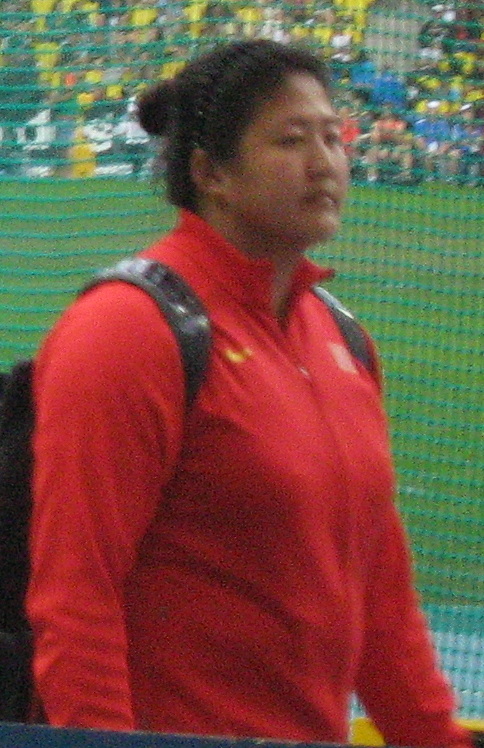
—What do you feel just before launching onto the beam?
A great silence. The crowd fades, the coach fades, only that strip of wood one meter twenty-five off the ground and the air around remain. You breathe once, deeply, and you mount. On the beam, fear is not your enemy; it's your own imbalance: if you let it rise into your shoulders, you fall; if you keep it low, in your belly, it keeps you straight. I repeated my routine thousands of times in training precisely so that, on that day, my body would know what to do on its own while my mind stayed empty. A fall costs dearly, a deduction for imbalance too, and among the best gymnasts, everything comes down to hundredths. But deep down, in the moment, I wasn't thinking about the score or the judges. I was thinking: one support, then the next, then the next.
—In 2006, the score out of 10 disappeared. How did you experience that upheaval?
Right in the middle of my career, the worst time to change the rules. I had grown up with the dream of the perfect 10, that round number everyone understood, even those who knew nothing about gymnastics. And then in 2006, the Federation introduced a new Code of Points: on one side a Difficulty score that adds up without a ceiling, on the other an Execution score that deducts faults. Overnight, it was no longer enough to be clean; you had to be harder than the other. We recomposed routines, added higher-rated elements, took risks the old system didn't reward. Some older gymnasts never quite found their footing again. I had to learn to calculate differently, to read my own routine as an addition. The dream of the 10 died that year, and we had to dream in two digits instead of one.
The dream of the 10 died that year, and we had to dream in two digits instead of one.
—Did this new system change the way you composed a routine?
Profoundly. Before, we sought perfection within a closed framework; after, we sought to push the framework. Each element was now classified by letters, from simplest to hardest, and each letter was worth tenths that increased the Difficulty score. On bars, that meant adding more daring releases, those spectacular moves where you leave the bar and catch it again, because they pay off. But the more difficulty you pile on, the more you expose yourself to execution deductions: a bent leg, lack of amplitude, a poorly held landing, and the hundredths fly away. The whole art became a tightrope calculation between ambition and cleanliness. We worked with federal coaches like architects bent over a blueprint, deciding which element was worth the risk and which was just an expensive whim. Gymnastics remained an art, but it also became arithmetic.
—You were part of a vast selection system. How did you make a place for yourself?
Through competition whose harshness few people realize. Behind every gymnast you see in competition, there are dozens in state academies training just as hard who will never step onto the podium. The Chinese system — those tǐyù xuéxiào, those state sports schools inherited from a model decades old — worked like a huge funnel. They cast a wide net, very wide, and kept only a few at the top. As a result, a national championship counted as much as an international tournament, sometimes more, because that's where national team spots were decided. You fought against your own compatriots before fighting the world. This constant internal pressure forged formidable athletes and also broke many dreams. I saw girls more talented than me leave, simply because on a given day, someone else was a hundredth better.
You fought against your own compatriots before fighting the world.
—What did the horizon of the Beijing Games represent for your generation?
A sun toward which an entire generation walked, knowing few would reach it. The 2008 Games, at home, were more than a competition: it was China showing itself to the world, and we, the athletes, carried that image on our young shoulders. Representing your country in a venue like the Beijing National Indoor Stadium, under the eyes of an entire host nation, added to the technical difficulty a pressure that the Code of Points doesn't measure. Every competition before Beijing — the Asian Games in Doha in 2006, the World Championships — served as rehearsal, test, selection. We didn't train just for ourselves; we were part of a collective momentum that had lifted Chinese gymnastics among the very best. Not all of us had the Beijing arena at the end of the road. But I believe each of us, in her own place, pushed the next generation a little higher.
We, the athletes, carried that image on our young shoulders.


This imaginary interview was generated by artificial intelligence from sources documented in Li Ling's profile. It dramatises what the figure might have said based on what we know about them, but does not constitute attested historical testimony. For primary sources and factual documentation, refer to the full profile.