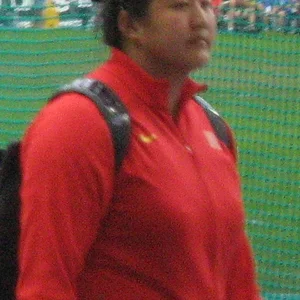

Li Ling is a Chinese artistic gymnast specializing in apparatus events. She represented China in high-level international competitions in the early 21st century.
Li Ling(1985 — ?)
Li Ling
République populaire de Chine
7 min read
Frequently asked questions
Key Facts
- Chinese artistic gymnast active in the 21st century
- Specialist in apparatus disciplines in gymnastics
- Represents China in international competitions
- Competes in a context of Chinese dominance in world gymnastics
Works & Achievements
Li Ling represented China in several competitions sanctioned by the International Gymnastics Federation, continuing the tradition of excellence among Chinese gymnasts in apparatus events in the early 21st century.
Composing and mastering a high-level uneven bars routine is in itself an artistic and athletic achievement, the product of years of work and close collaboration with national federation coaches.
A discipline requiring exceptional mental and physical control, the balance beam is one of the apparatus events in which Chinese gymnasts have historically excelled, combining acrobatic elements and choreography on a surface just 10 centimetres wide.
Through her performances in national and international competitions, Li Ling played a part in the collective momentum that propelled China to the forefront of women's artistic gymnastics in the lead-up to the Beijing Olympics.
Anecdotes
Li Ling entered China's elite gymnast selection system at the age of 5 or 6, like the vast majority of future Chinese champions. This rigorous process, managed by provincial sports federations, involves identifying in primary schools children with ideal physical qualities: extreme flexibility, lightness, and coordination. Once selected, these young gymnasts join residential training centers where they live apart from their families for most of the year.
Training for a high-level artistic gymnast in China in the early 2000s frequently reached 8 hours a day, six days a week. Li Ling, like her contemporaries, had to master not only the technical elements on the apparatus — uneven bars, balance beam, floor, and vault — but also an intense physical conditioning regimen: targeted strength training, forced stretching, and choreographic work. The slightest technical error was immediately corrected by coaches, heirs to a highly demanding pedagogical tradition.
China experienced growing dominance in women's artistic gymnastics throughout the 2000s, drawing on a network of state sports academies that functioned as true talent pipelines. Li Ling developed within this context of intense internal competition, where dozens of gymnasts vied for the few available spots on the national team, making every national competition just as decisive as international tournaments.
Representing China in an international artistic gymnastics competition at the start of the twenty-first century carried considerable symbolic weight: athletes bore the sporting image of a nation asserting itself on the world stage, in the lead-up to the 2008 Beijing Olympic Games. This collective pressure, combined with the ever-increasing technical demands of the Code of Points, meant that every routine was a demonstration in which excellence was not an option but an obligation.
Primary Sources
The new Code of Points introduced in 2006 replaced the 10-point scoring system with an open-ended system combining a Difficulty score (D) and an Execution score (E), fundamentally changing the strategies for composing routines.
Chinese gymnasts regularly appear in the rankings of major world apparatus competitions, illustrating the depth of China's national talent pool in women's gymnastics.
The Chinese women's artistic gymnastics delegation fielded a full apparatus team, demonstrating the continuity of the elite training system established since the 1970s.
The selection criteria for the national team are based on performances at national championships, technical proficiency assessed by federation coaches, and results at test competitions designated by the federation.
Key Places
The main preparation center for China's national artistic gymnastics teams, where the best gymnasts selected through provincial championships converge. This complex hosts intensive training camps ahead of major international competitions.
A multipurpose arena in Beijing that hosted the artistic gymnastics competitions at the 2008 Olympic Games. For a Chinese gymnast of Li Ling's generation, this venue symbolized the pinnacle of an entire sporting career.
A residential training institution where China's future elite gymnasts are developed from childhood, far from their families. This academic model, inherited from the Soviet system and adapted by China, forms the backbone of champion development.
The site that hosted the artistic gymnastics events at the 2006 Asian Games in Qatar, a major regional competition serving as a key benchmark for Olympic qualifications and team selection.
Liens externes & ressources
Références
Œuvres
Participations aux compétitions internationales de la FIG (2003-2008)
2003-2008
Exercice aux barres asymétriques — programme de compétition
2004-2007
Exercice à la poutre — programme de compétition
2004-2007
Contribution au vivier de la gymnastique chinoise pré-olympique
2005-2008