Imaginary interview with Philippe Honoré
by Charactorium · Philippe Honoré (1941 — 2015) · Visual Arts · Society · 5 min read

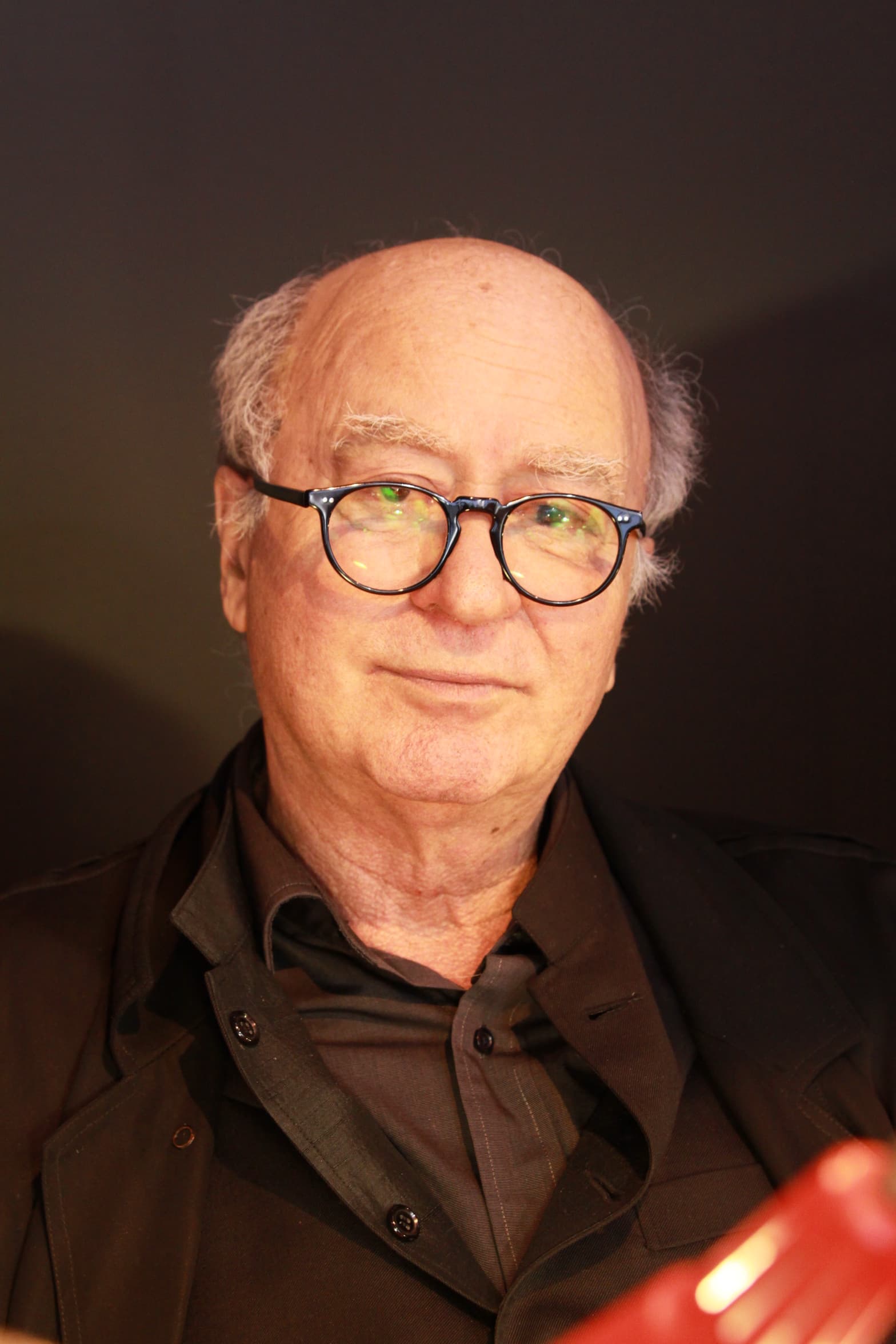
One winter morning, on rue Nicolas-Appert, in the grey light of the 11th arrondissement. At his cluttered drawing table, surrounded by poetry collections and inkwells, a man with a fine line welcomes us, pen in hand. Philippe Honoré speaks softly, with the precision of those who weigh every word like every line.
—How would you describe the gesture most familiar to you, that of hand on paper?
I dip my pen into India ink, and I wait. It's a patient craft, almost silent. My colleagues at Charlie Hebdo have a line that snaps, that charges, that exaggerates—Cabu, Wolinski, they capture a face in three furious pencil strokes. I come from elsewhere, from an older school, that of early-century illustrators who chiseled black and white like engraving. A drawing, for me, is not a cry; it's a well-constructed sentence. I seek the right line, the one that doesn't tremble, the one that stands on its own. They say I go against the current. Perhaps. But slowness is my way of being irreverent.
A drawing, for me, is not a cry; it's a well-constructed sentence.
—They say you're the most literary of the editorial cartoonists. Where does this passion for literature come from?
That passion precedes me. Before I sit down at my drawing board, I leaf through Rimbaud, Verlaine, Apollinaire—their verses lie scattered around my studio, open, dog-eared. When I illustrate a poem, I don't accompany it, I respond to it. Sometimes I slip into a press cartoon a wink that only one reader in a thousand will notice: a hidden word, a silhouette borrowed from a verse. That makes me smile, that secret complicity. Some in the editorial office find me too discreet, too "apart" with my reading. But a line without culture behind it is a hand speaking without having read anything. Literature is my reservoir of images.
A line without culture behind it is a hand speaking without having read anything.
—Do you remember the day you started the illustrated crosswords for Le Monde?
1992. They offered me a daily slot in Le Monde, and I immediately thought I wouldn't make a grid like any other. I wanted to combine two pleasures I love above all: drawing and wordplay. So every morning, I design the grid, I look for the tricky definitions—those that make you grumble then laugh—and I place a small drawing next to it that feels like a riddle. It's a clockmaker's work: the word and the image must fit together without ever repeating each other. It's been over twenty years now, this tiny rendezvous with the morning reader. People talk to me about my grids as if they were a ritual. I like the idea of entering their home through the coffee door.
—What do you like so much about a simple grid of letters?
The crossword grid is architecture. A closed space, strict rules, and yet wild freedom inside. Each definition is a little satire in miniature: you twist the meaning, you trap the hurried reader, you hide a hint of irony. It's exactly what caricature does, but with words instead of lines. Verlaine said music comes before everything; I believe a good definition has music too, a rhythm, a punchline. And a game is never innocent: under the grid slip allusions, winks at the world. To entertain seriously, to cultivate while having fun—that may be my true calling.
To entertain seriously, to cultivate while having fun—that may be my true calling.
—What does illustrating a text mean to you, as opposed to commenting on current events?
Commenting on current events is reacting to the burn of the day; illustrating a text is dialoguing with the undying dead. Since the 1970s, I have illustrated poems and classic works, and nothing makes me happier than this companionship with the greats. Before a verse by Apollinaire, I don't seek to explain—I seek to extend, to resonate. A good literary collection open on my table is already half the work done. The press gives me urgency, literature gives me duration. I need both, as one needs to inhale and exhale. Without the second, the first would quickly become noise.

—You work for a newspaper that provokes great anger. How do you live through these storms?
I live them sideways, with my pen, a bit apart from the uproar. Since the caricatures of 2006, then the fire at our offices in 2011 after the "Charia Hebdo" issue, we know that satire disturbs, that it has a price. The newspaper lives under protection, we are seen as provocateurs. But secularism and freedom of expression are not slogans you take down when it rains. Laughing at power, at religions, at the powerful—that's a very old French tradition, the one from which Charlie Hebdo was born, in the wake of Hara-Kiri. I'm not a barricade man, I'm a fine-line man. But the fine line, too, can refuse to look down.
Secularism is not a slogan you take down when it rains.
—Why keep drawing what exposes you so much, despite the threats?
Because giving in to fear would be drawing already censored. I am not unaware of the danger—the police protection around the newspaper reminds me every week. But a cartoonist who starts wondering what he has the right to draw has already lost his hand. Caricature is an irreverent old lady; she has survived kings, courts, excommunications. I'm not about to teach her prudence. I remain faithful to my corner of the table, to my inkwell, to my grids and my little mockeries. They chose me as literary rather than ferocious, but the gentleness of the line is not cowardice. It's simply another way of holding firm.

—Tell us about this New Year's drawing you just finished, "And Above All, Health."
A New Year's drawing, like we do for the new year, but in my own way, with black humor. I sketched the leader of that organization that sows terror, and under his face I placed the caption "And Above All, Health." It's the contrast that makes you laugh: those polite, good-natured wishes we exchange in January over coffee, applied to the one who embodies death. Satire lives on this wide gap between the banality of the formula and the horror of the thing. It will be published on the newspaper's account in the very first days of 2015. Nothing more than a nose-thumbing, really. But perhaps it's in nose-thumbing that the most freedom resides.
Perhaps it's in nose-thumbing that the most freedom resides.
—What would you like people to understand from a drawing so light on such a grave subject?
That a mere stroke can disarm what seeks to be terrifying. Those who kill in the name of an idea want us to tremble; opposing them with wishes for good health is refusing to grant them the seriousness they demand. Mockery is a weapon of the weak, but it is a weapon, perhaps the oldest. I learned it from poets as much as from newsrooms: Rimbaud too knew how to spit his insolence. If one day someone were to read me in a century—let's suppose—I would like them to remember this: that laughter is not the opposite of courage, but sometimes its most naked form. A man who still laughs has not been entirely defeated.
Laughter is not the opposite of courage, but sometimes its most naked form.
—What does a workday look like, from the first cup of coffee to the last line?
It starts with newspapers and radio, ear tuned to the news to be sketched, a cup of coffee cooling beside me. Then I settle in: the drawing board, the inkwell, the brushes for the grays, and above all, silence. The afternoon is for drawing proper—the sketch, the inking, that stubborn search for the right line—and for the patient assembly of crosswords. In the evening, we gather for the editorial meeting, discuss the week's themes, argue a bit, laugh a lot. Then I return to my books. A cartoonist, you see, never quite stops working: even reading Verlaine in the evening, somewhere, I am still drawing.
Read further
This imaginary interview was generated by artificial intelligence from sources documented in Philippe Honoré's profile. It dramatises what the figure might have said based on what we know about them, but does not constitute attested historical testimony. For primary sources and factual documentation, refer to the full profile.